


TL;DR: How to Improve Your B2B Website, in Priority Order
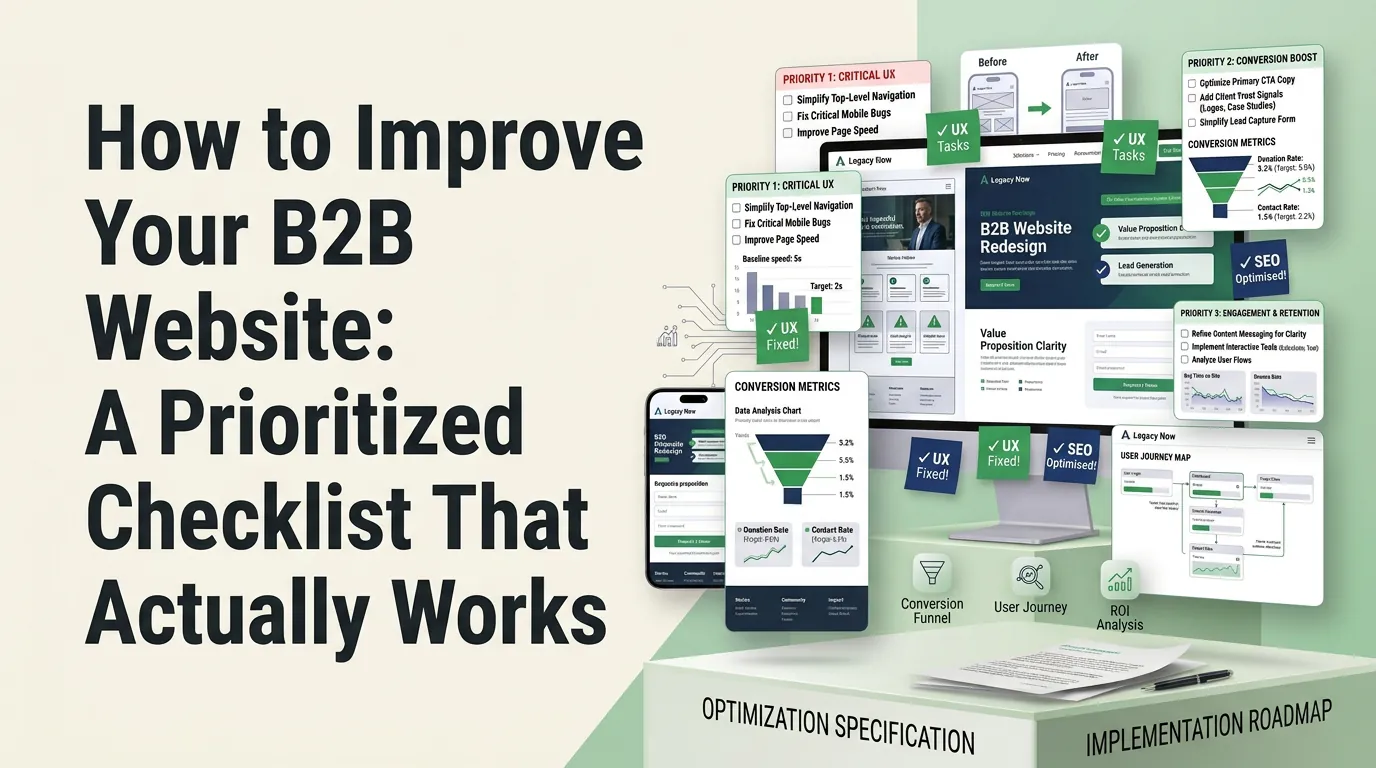
Improving your B2B website works best when you attack it in order of impact and effort rather than tackling a random list of 50 fixes. Start with quick wins this week: rewrite title tags on high-impression, low-CTR pages in Search Console, add conversion CTAs and internal links to your top blog posts, trim your conversion form, and offer direct calendar booking. Then move to tactical rewrites of your homepage hero and service pages, outcome-specific social proof, GA4 conversion events, and a solid mobile experience. Save the structural work, information architecture, content strategy, and Core Web Vitals, for the quarter.
The discipline that ties it all together is measurement. Record a baseline before every change, compare 30 days later, and treat your website as a living asset you improve a little every month. When positioning, architecture, or technical debt has drifted too far to patch, that is the signal a redesign, not another round of optimization, is the right call.
Most advice on improving your B2B website is a list of 50 things you should do, presented without prioritization, so you have no idea where to start. You read it, feel overwhelmed, bookmark it, and never act on it.
This is different. It's a prioritized checklist organized by impact and effort, starting with the improvements that produce the most benefit for the least work, and progressing to the structural changes that require more investment.
Work through it in order. The early items produce results you can see quickly, which builds the case and the momentum for the bigger investments later.
Tier 1: Quick Wins (This Week, High Impact, Low Effort)
1. Fix your highest-impression, lowest-CTR pages in Search Console
Open Google Search Console. Go to the Performance report. Sort your pages by impressions. For each page in your top 10 by impressions, check the CTR.
Any page with high impressions and a CTR below 2% has a title tag or meta description that isn't matching what searchers want. Rewrite the title tag to better reflect the search intent behind the queries bringing people to that page.
This is the single highest-ROI improvement available to most B2B websites. It takes an afternoon and often produces visible organic traffic improvement within 30-60 days.
2. Add conversion CTAs to your top 5 blog posts
Find your five highest-traffic blog posts (Search Console shows you this). Open each one. Does it have a clear next step at the end toward your primary conversion event? Does it link internally to a relevant service page within the article?
If not, add both. A contextual paragraph at the end that connects the post's topic to a relevant next step turns passive readers into potential leads. This is the fix for the most common and most costly B2B website problem: blog traffic with no conversion pathway.
3. Simplify your primary conversion form
Count the required fields on your main contact or demo request form. If there are more than four, remove the least essential ones. Baymard Institute research confirms that each additional field reduces completion.
The essential fields for most B2B forms: name, company, email, and optionally "what would you like to discuss?" Collect everything else in the first conversation.
4. Add a direct booking option
If your only conversion path is "fill out a form and we'll get back to you," add a calendar booking option (Calendly, Acuity, or similar). Let motivated buyers book time directly rather than waiting for a response. The friction reduction alone typically improves conversion.
Tier 2: Tactical Improvements (This Month, High Impact, Medium Effort)
5. Rewrite your homepage hero for specificity
If your homepage headline could describe any company in your category, rewrite it. Name your specific customer type and the outcome you produce. "We help [specific customer type] achieve [specific outcome]" converts better than any generic value statement.
The test: could a competitor put your headline on their site without anyone noticing? If yes, it's too generic.
6. Rewrite service pages to lead with outcomes
Most B2B service pages describe what the service is. Rewrite them to lead with the buyer's problem and the outcome they'll get. "Your website generates traffic but not demos" is more compelling to a buyer than "We provide comprehensive web design services."
7. Add outcome-specific social proof to key pages
Replace generic testimonials ("great to work with!") with outcome-specific ones ("increased our demo conversions by 34%"). Place ROI-focused proof on your pricing page, full case study narratives on your case study pages, and trust-reducing proof near your conversion forms.
8. Configure GA4 conversion events
If your analytics can't tell you how many people are converting, you can't improve conversion. Set up conversion events in GA4 for your primary action. This is the foundation for all future optimization. Our B2B website KPIs guide walks through the full setup.
9. Fix your mobile conversion experience
Complete your primary conversion flow on your phone. Whatever friction you encounter, your mobile visitors encounter too. Fix the form field sizes, the button tap targets, and the load speed. Our responsive B2B website design guide covers the specifics.
Tier 3: Structural Improvements (This Quarter, High Impact, Higher Effort)
10. Restructure your information architecture
If your highest-value pages are buried in your navigation, or your navigation is labeled with internal jargon instead of buyer language, restructuring the IA can significantly improve both conversion and SEO. This is more involved than the quick wins but has compounding benefits.
11. Build a content strategy connected to conversion
Rather than publishing content ad hoc, map your content to your buyers' journey, awareness, consideration, and decision stage keywords, with internal links connecting each stage toward conversion. Our B2B website content strategy guide covers the framework.
12. Improve Core Web Vitals
Run your site through Google PageSpeed Insights. Work through the recommendations, starting with image optimization (usually the biggest win). Passing Core Web Vitals improves both rankings and user experience.
When Improvement Isn't Enough: The Redesign Signal
There's a point where incremental improvement isn't the right strategy. The signals that a redesign is warranted rather than optimization:
The positioning is fundamentally wrong. If your ICP has shifted or your differentiation has evolved, optimization can't fix a homepage telling the wrong story.
The information architecture is broken. If high-value pages are buried and the navigation has no logical path to them, restructuring requires a redesign.
The technical debt is too heavy. Sites that have accumulated years of modifications sometimes reach a point where fixing performance issues costs more than rebuilding cleanly.
The visual design is eroding credibility. When dated visual quality becomes a real barrier to buyer trust, a redesign is warranted.
The honest audit, running through our full B2B website audit process, tells you which category your situation falls into.
The Before/After Discipline
The most important habit in a website improvement practice is measuring before you change anything.
Before implementing any improvement, record: current conversion rate from GA4, current organic sessions from Search Console, current CTR for the pages you're changing.
Then, 30 days after the change is live, compare. Did conversion rate improve? Did CTR on the updated pages improve?
This before/after protocol sounds obvious. Almost no B2B teams do it consistently, and the result is that they make dozens of changes over a year with no idea which ones helped. The five-minute discipline of documenting the baseline before every change produces compounding strategic intelligence about what actually works for your specific site.
The Search Console Foundation
Before any redesign or major content investment, spend an hour in Google Search Console. Find your highest-impression pages with a CTR below 2% and rewrite those title tags to match search intent. This is the fastest, cheapest way to increase organic traffic, no design work required, results often visible within 30-60 days.
Then check your top five organic blog posts. Does each link internally to a relevant service page? Does each end with a CTA toward your primary conversion event? If not, add both today.
Forrester finds over 70% of B2B buyers complete most research before contacting a vendor. HubSpot data shows companies with documented strategies generate more qualified leads. Gartner's research confirms 6-10 stakeholders in the average enterprise purchase, all evaluating you on your website.
At Wandr Studio, every engagement starts with data before creative work. MedTrainer saw a 28% increase in book-a-demo conversions after a strategy-first redesign. Zoe Financial improved onboarding completion by restructuring information request sequence, see the Zoe Financial case study.
Our B2B web design agency can help you work through this exact checklist and prioritize the highest-leverage improvements for your specific site.
Book a free discovery call for an honest assessment of where your site stands and the highest-leverage improvements available.
Related reading: B2B Website Strategy | B2B Website Redesign | B2B Website Conversion Optimization | Designing a B2B Website
The Measurement Layer: Proving What Works
Building or improving a B2B website is only half the work. The other half is knowing whether the changes are working, and that requires a measurement infrastructure most B2B companies haven't fully set up.
The measurement hierarchy runs from least to most useful:
Traffic metrics (sessions, pageviews) tell you whether your site is being seen. They're the easiest to measure and the least connected to revenue.
Engagement metrics (time on page, scroll depth, pages per session) tell you whether visitors are interacting with content. Directionally useful, still not tied to business outcomes.
Conversion metrics (form completions, demo requests, trial signups) tell you whether your website is producing qualified leads. This is where measurement starts to matter commercially.
Pipeline metrics (opportunities sourced from website, revenue attributed to website) tell you what the website is actually worth to the business.
Most B2B companies measure the top two layers with precision and have almost no visibility into the bottom two. The investment should be flipped. Our B2B website KPIs guide covers the full setup, configuring GA4 conversion events, connecting Search Console, and building CRM attribution so you can answer the question that matters: how much pipeline is your website actually generating?
HubSpot's research on marketing measurement consistently shows that companies with proper conversion tracking make better investment decisions than those flying blind on vanity metrics.
Why Strategy Has to Come Before Design
The most common reason B2B website projects disappoint isn't a failure of design craft, it's a failure to answer the strategic questions before design begins.
Who is this website for? What is the single most important action it should drive? What does the buyer need to see, in what order, before they take that action? What objections stall deals at the consideration stage, and how does the site address them?
When those questions have clear answers, design work moves quickly and produces something that performs. When they're vague, even beautiful design ends up on a site that doesn't convert.
This is why every serious B2B website strategy starts with discovery, stakeholder interviews, analytics review, ICP mapping, competitive analysis, before a single design decision is made. The strategy is the foundation. The design executes it. Reversing that order is the single most expensive mistake in B2B web design, and it's the reason so many redesigns produce sites that look better but perform about the same.
The output of a proper discovery process is a strategic brief that guides every subsequent decision. It also creates internal alignment, resolving competing stakeholder priorities before they become expensive design debates. When the strategy is documented and approved, feedback cycles are shorter, the design work is faster, and the outcome is measurably better.
The Mobile and Performance Reality
Whatever your B2B website's specific goals, two technical factors affect them across the board: mobile experience quality and page performance.
Google's mobile-first indexing means Google evaluates the mobile version of your site to determine rankings. If your mobile experience is inferior to your desktop experience, your search visibility is limited by your mobile quality, regardless of how good the desktop site looks.
And Core Web Vitals, Google's measures of loading performance (LCP under 2.5 seconds), interactivity (INP under 200ms), and visual stability (CLS below 0.1), are direct ranking factors. A site that fails these on mobile competes at a disadvantage in organic search.
The most impactful performance improvement for most B2B sites is image optimization: compressing images and converting to WebP format typically resolves the majority of load time issues. Run your site through Google PageSpeed Insights to see your specific issues and their impact. Our responsive B2B website design guide covers the full mobile and performance playbook.
Beyond SEO, mobile and performance directly affect conversion. B2B buyers research on mobile throughout their consideration cycle, during commutes, between meetings, in the evenings. A slow or broken mobile experience leaks pipeline at every stage of the journey. Complete your primary conversion flow on your own phone: whatever friction you encounter, your mobile prospects encounter too.
Building for the Long Term
The highest-performing B2B websites aren't the products of a single redesign, they're the result of treating website performance as an ongoing practice.
The rhythm that compounds:
Monthly: Publish one to two new content pieces mapped to specific keyword targets. Scan Search Console for new quick-win opportunities. Check conversion rates for unexpected changes.
Quarterly: Deep-dive into Search Console data to find high-impression/low-CTR pages that need title tag work. Update your top-performing blog posts with fresh data and examples. Review conversion rates against your baseline.
Annually: Comprehensive audit of the entire site. Review whether positioning still reflects who you are and who you serve. Assess whether visual quality remains competitive with what buyers see from alternatives.
This ongoing practice, small, consistent improvements, produces dramatically better results over 12-24 months than periodic crisis-driven redesigns. A site that gets 2% better every month is a substantially better site after two years, without ever requiring a disruptive rebuild.
The same logic applies to what your website is ultimately for: keeping the customers it wins. As Paula Lopez, Wandr's Head of Product, puts it, "you cannot fix customer retention without fixing the service first," and a service, she notes, is "never finished." A website is exactly that kind of service, so the teams that keep iterating on it are the ones whose sites keep converting and keep retaining.
The companies that win on B2B web performance are the ones that build this discipline into their operations. Not the ones with the biggest one-time budget, but the ones who treat their website as a living asset that deserves consistent attention.
That's the approach we bring to every engagement at Wandr Studio: strategy-first design, measurable outcomes, and a foundation built to keep performing long after launch.
Final Thoughts on Improving Your B2B Website
Improving your B2B website is not about chasing every tactic at once. It is about sequencing the work so momentum builds: quick wins this week prove the model, tactical rewrites this month sharpen the message, and structural changes this quarter compound the results. Underneath all of it sits the before/after discipline that turns guesswork into intelligence about what actually moves conversion and pipeline on your specific site. Do the cheap, high-impact work first, measure everything, and reserve a full redesign for the moments when positioning, architecture, or technical debt genuinely warrant it.
The teams that pull ahead are not the ones with the biggest one-time budget. They are the ones who treat the website as a living asset and improve it a little every month, so it keeps earning its place as their best-performing sales channel.
Work With a B2B Web Design Agency That Prioritizes the Right Improvements
If you want an outside read on which improvements will move the needle fastest, our B2B web design agency can help you work through this checklist, pressure-test your priorities, and build a roadmap grounded in data, the same strategy-first approach behind results like the MedTrainer case study. Book a free discovery call for an honest assessment of where your site stands and the highest-leverage improvements available to you right now.
