Grepp

4.5-5 out of 5 for the highest-rated page in testing, and Grepp's 'BeyondCampus' launched in the U.S. three months after kickoff.

Grepp product design by Wandr
INDUSTRY
Education
PLATFORM
Website
SIZE
Growth
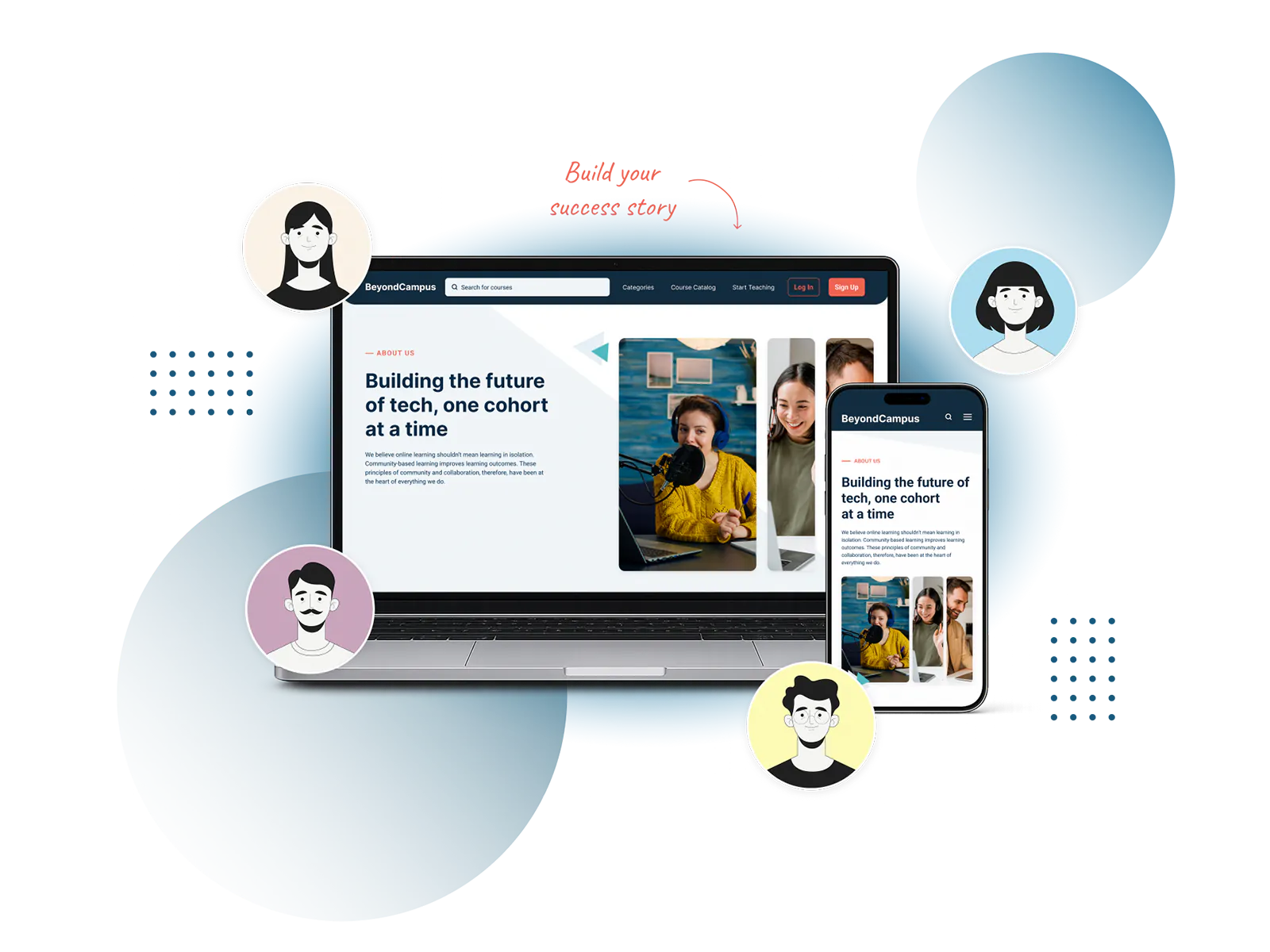
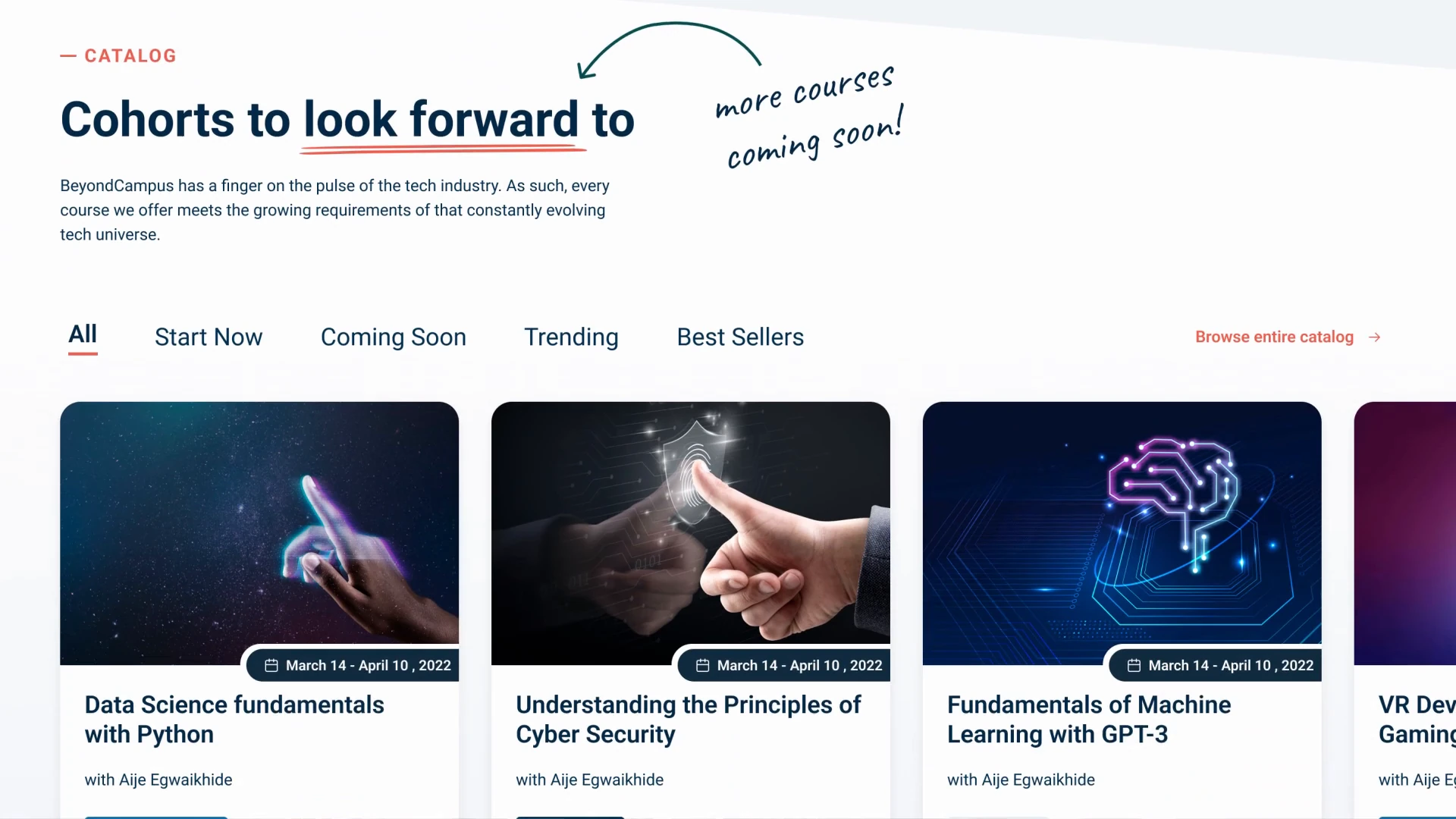
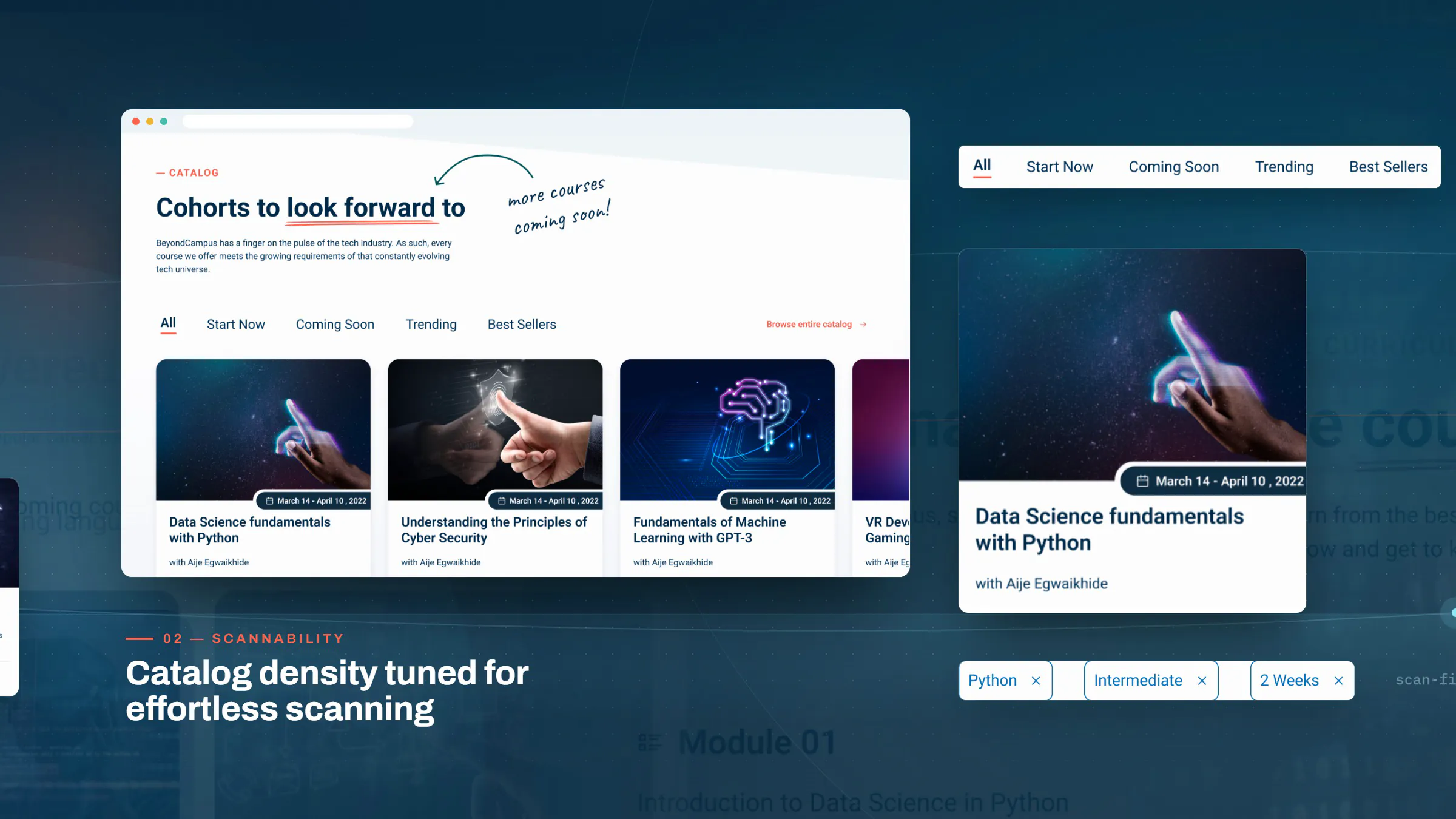
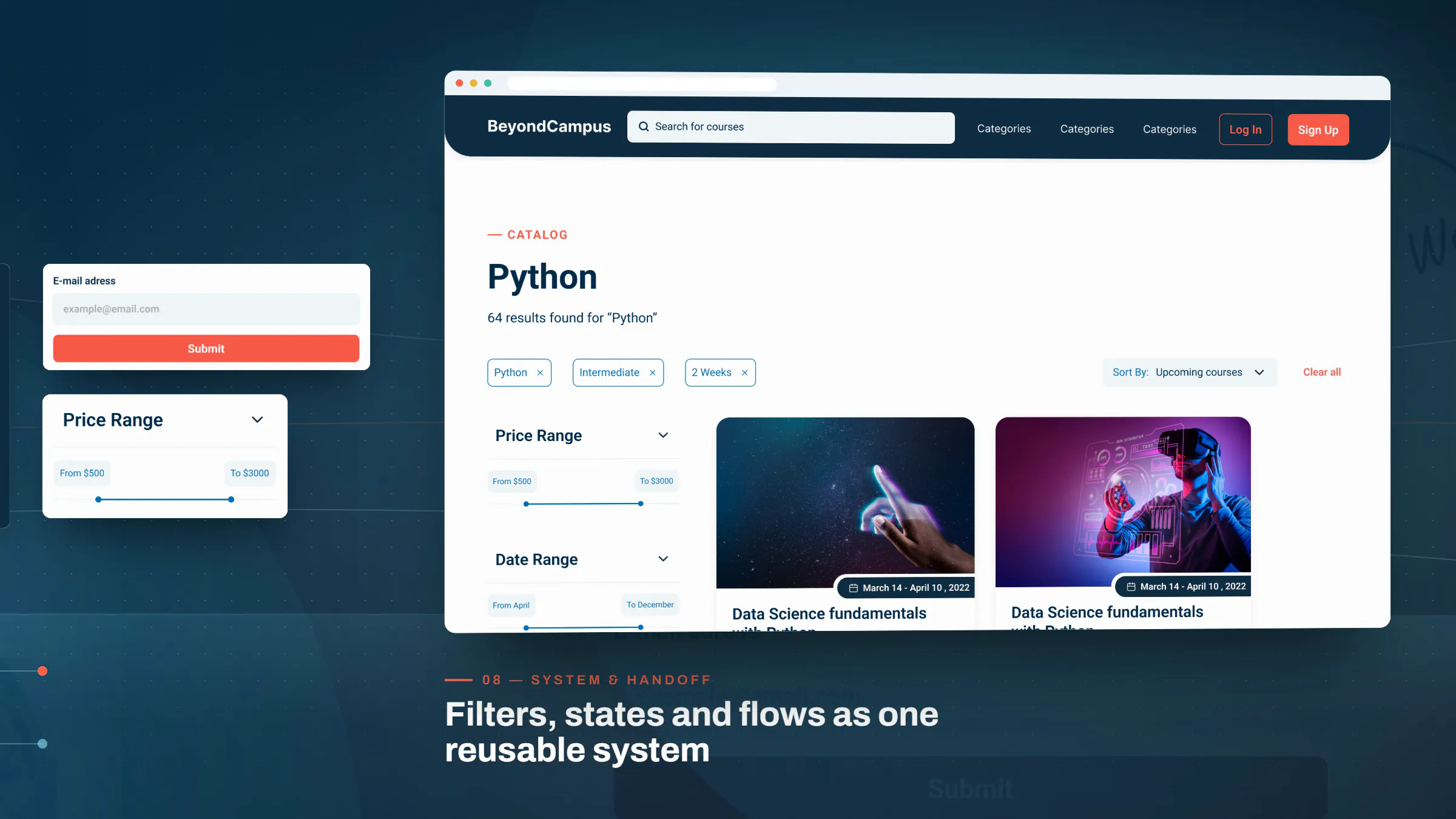
Grepp BeyondCampus course catalog with tech cohort cards on desktop
Education
·
Website
·
UX Research & Website Redesign
At a glance

Four pages, two markets, and a brand that was Not in the scope.

Phase 1 · Discovery
01
Discovery.
Run collaborative workshops with Grepp's leadership to pin down the mission, the value proposition, the customer segments on both sides of the marketplace, and, just as usefully, which of the team's beliefs were facts and which were still assumptions.
Phase 2 · Research
02
Research.
Interview the stakeholders, then six developers across three career stages. A compressed round by design, run alongside the secondary evidence on what cohort-based learning does to completion rates and a section-by-section teardown of 23 competitor and reference sites.
Phase 3 · Design
03
Design.
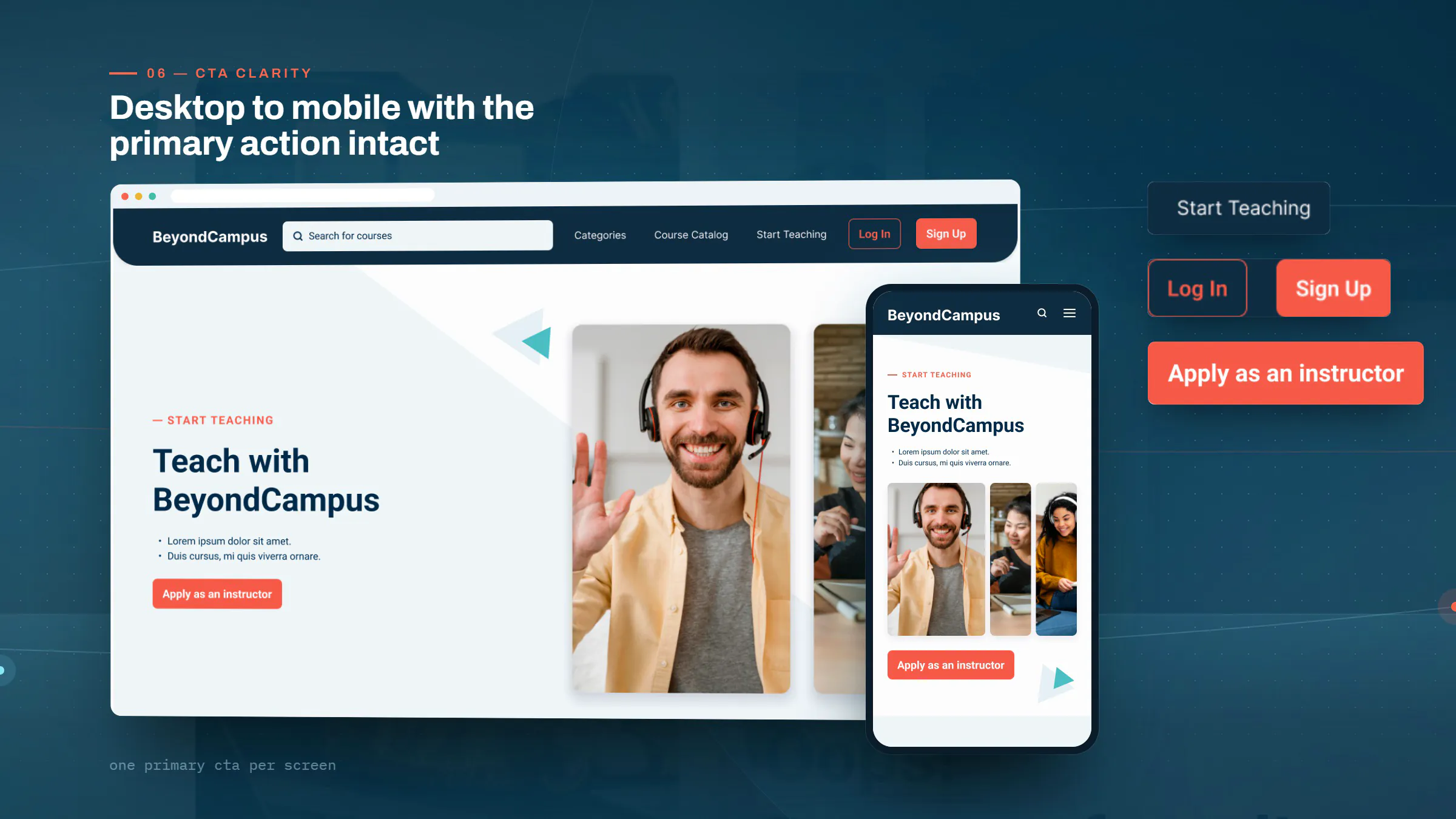
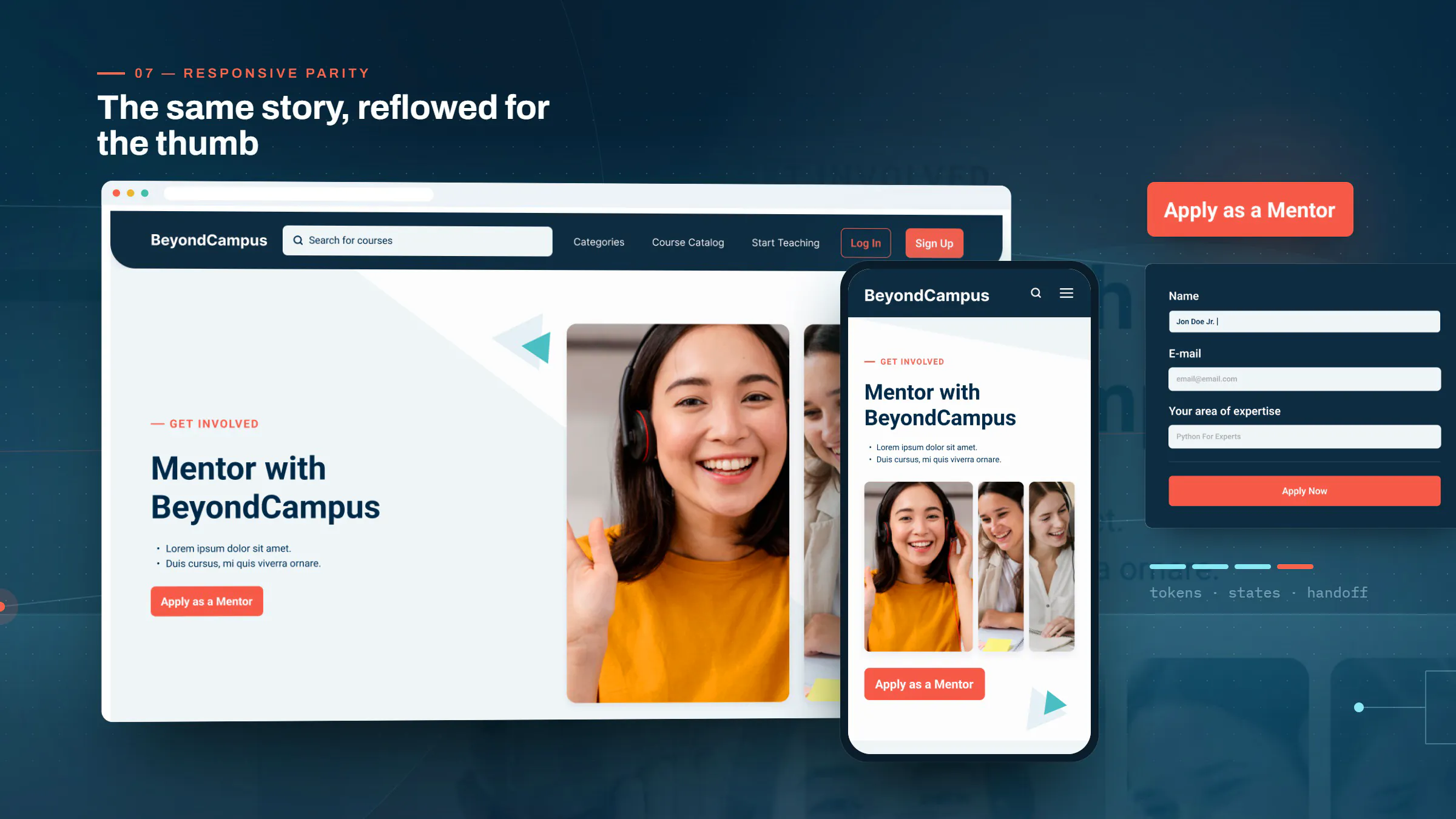
Build the information architecture and design the four core pages on a milestone pipeline, presenting each deliverable in a working session so feedback and iteration happened in the same week rather than the same month.
Phase 4 · Testing & brand
04
Testing and brand.
Test the mid-fi designs with four target users on Figma prototypes, fold the findings back into the copy and layout, then build a U.S. brand direction from scratch when the Korean assets did not arrive.
Drag / scroll →
RESEARCH
6 interviews
Students, junior and senior developers
BENCHMARK
23 sites
Cohort courses, MOOCs, course-creation tools
OUTPUT
4 core pages
Home, about, course catalog, course detail
PACE
1 week early
Delivered ahead of a tight schedule
The Client

The company Korea's developers are hired through, looking for a second market.

Client product designed by WANDR

Grepp is a South Korean technology company founded in Seoul in 2014. It runs Programmers, Korea’s first combined developer education, assessment and recruitment service, alongside Monito, an online proctoring product for coding tests. It is engineering-led: the platform behind BeyondCampus, a web IDE, coding tests, code review, Q&A and live classrooms, was built in-house. The front end was the thin part, a grid of cards a user clicked into to see what a course contained.

In late 2021 Grepp set its sights on the United States, and BeyondCampus was the product it was taking there. Having already tried and failed to hire a product design team in the U.S., co-CEO Samuel Lim reached out to WANDR that December. Grepp did not need a translated website. It needed a front end built for a different audience in a far more crowded market.

2014
Seoul, South Korea
420K+
Coding tests taken on Programmers
1,800+
companies use grepp for hiring, training, etc.
The Challenge

Strong engineering, a crowded market, and nothing on the screen to prove either.

This was not a hard design problem, and framing it as one would be dishonest. It was a clear one, with five constraints that had to be respected at once.

Problem 01

A backend company with a front end that undersold it.

Grepp's engineering was genuinely differentiated: a browser-based IDE, code review, Q&A and live classrooms sat behind the product. None of that was legible from the outside. The existing interface showed cards and course contents, which is what every competitor showed, so the one thing BeyondCampus had that the others did not was invisible at exactly the moment a visitor was deciding.

Problem 02

Entering a saturated market with nothing to anchor on.

The U.S. online education market is crowded and unforgiving. BeyondCampus would be landing beside Udemy, Coursera, Codecademy, Skillshare and Maven, every one of them with an established audience, a known name, and a marketing budget Grepp could not match. A new entrant with no brand recognition has one chance to give a reason to believe, and it happens above the fold.

Problem 03

An audience that decides fast and does not forgive vagueness.

The target users, computer science students and junior developers, are unusually discerning consumers of software. They are digital natives, they research before they buy, they judge interface quality instinctively, and they leave in seconds when a value proposition is not immediately legible. One participant summed up the barrier: “When it comes to online learning, it is very hard for me to click on the ‘pay’ button. I am always weary if the course will be any good.” A generic education site would not survive this audience.

Problem 04

The differentiator the client was counting on had already become table stakes.

BeyondCampus was built on community and cohort-based learning, and Grepp expected that to be the hook. The research said otherwise. Every interviewee recognised community immediately, and every one of them treated it as a given rather than a delighter, because Stack Overflow and Reddit already supply it for free. Cohorts also carried a cost these users felt keenly: senior developers had no room in their schedules for a fixed timetable at all.

Problem 05

The brand that was supposed to arrive, did not.

The plan was for Grepp's internal team in Korea to supply brand assets for BeyondCampus. They were delayed, and what did exist was built for Korean expectations rather than American ones. With a launch date fixed and a timeline already tight after the failed U.S. hiring attempt, the project needed a visual identity that did not exist yet, and needed it without moving the date.

Drag / scroll →
Before / After

Same platform, rebuilt for a market that had to be convinced.

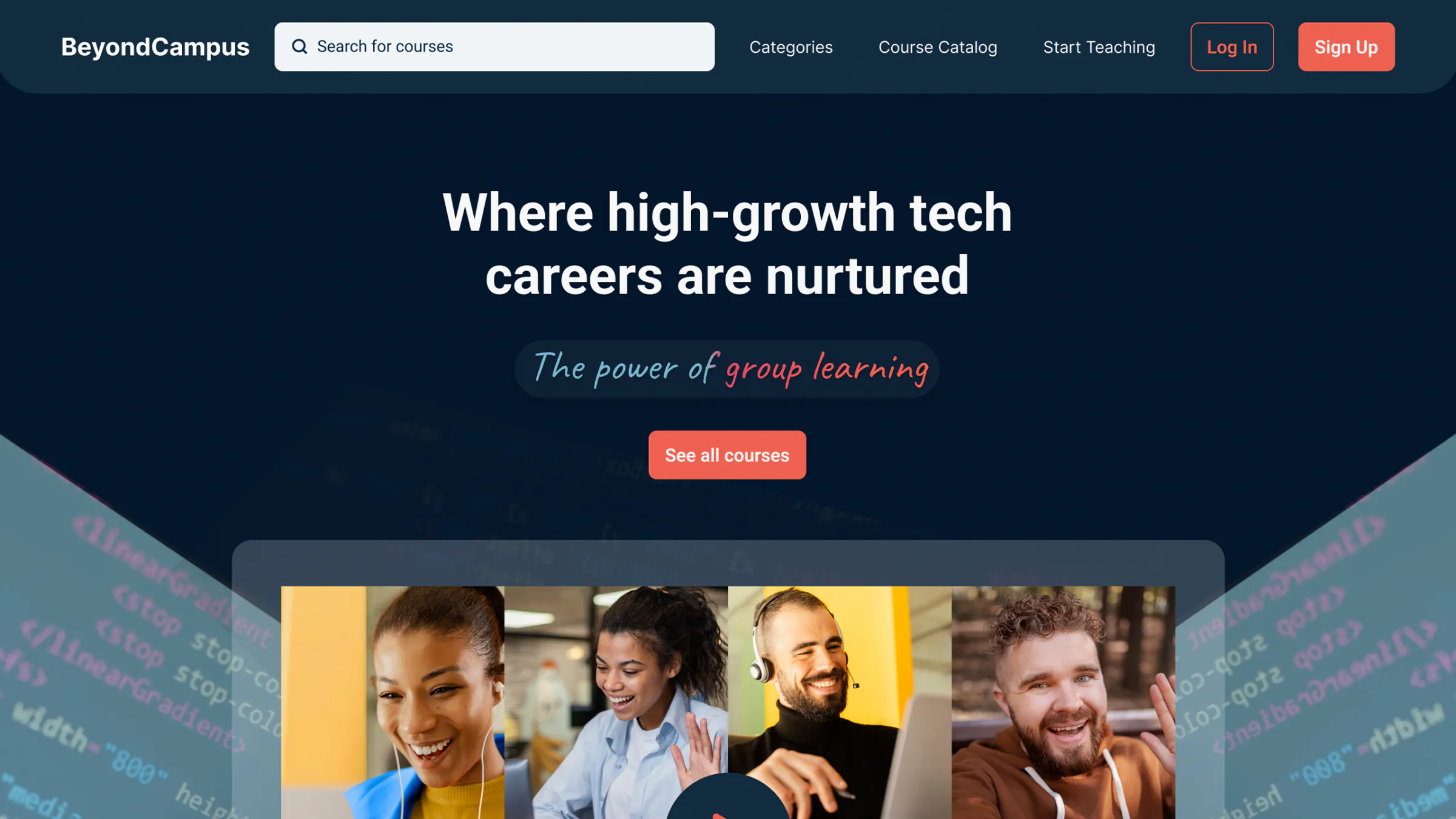
Drag the handle to see how the landing experience changed, from a page that listed what the platform could do into one that translates every feature into the outcome a developer actually wants.

After redesignAfter redesign
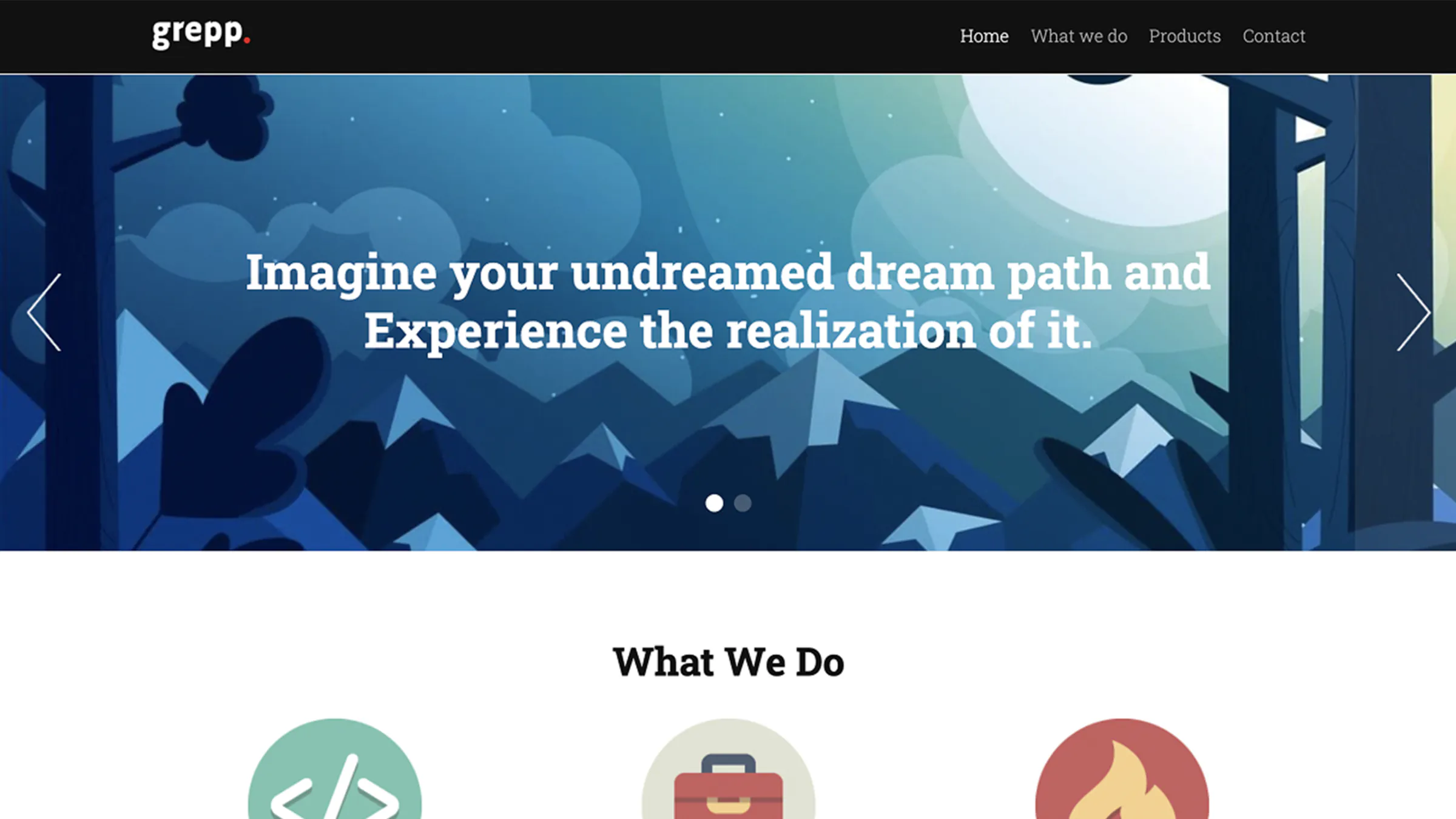
Before redesignBefore redesign
Before
After WANDR
Our Role

Strategy through brand, with Grepp's engineers builing it.

01
Discovery and scoping workshops with Grepp's leadership team
02
Problem topology, empathy mapping, and a certainties versus assumptions audit
03
Secondary research on cohort-based learning outcomes and the online education market
04
Six in-depth user interviews across three developer career stages
05
Benchmark analysis of 23 platforms across cohort courses, MOOCs and course-creation tools
06
Landing page pattern mapping across every site analyzed
07
User journey maps for the junior and the senior developer paths
08
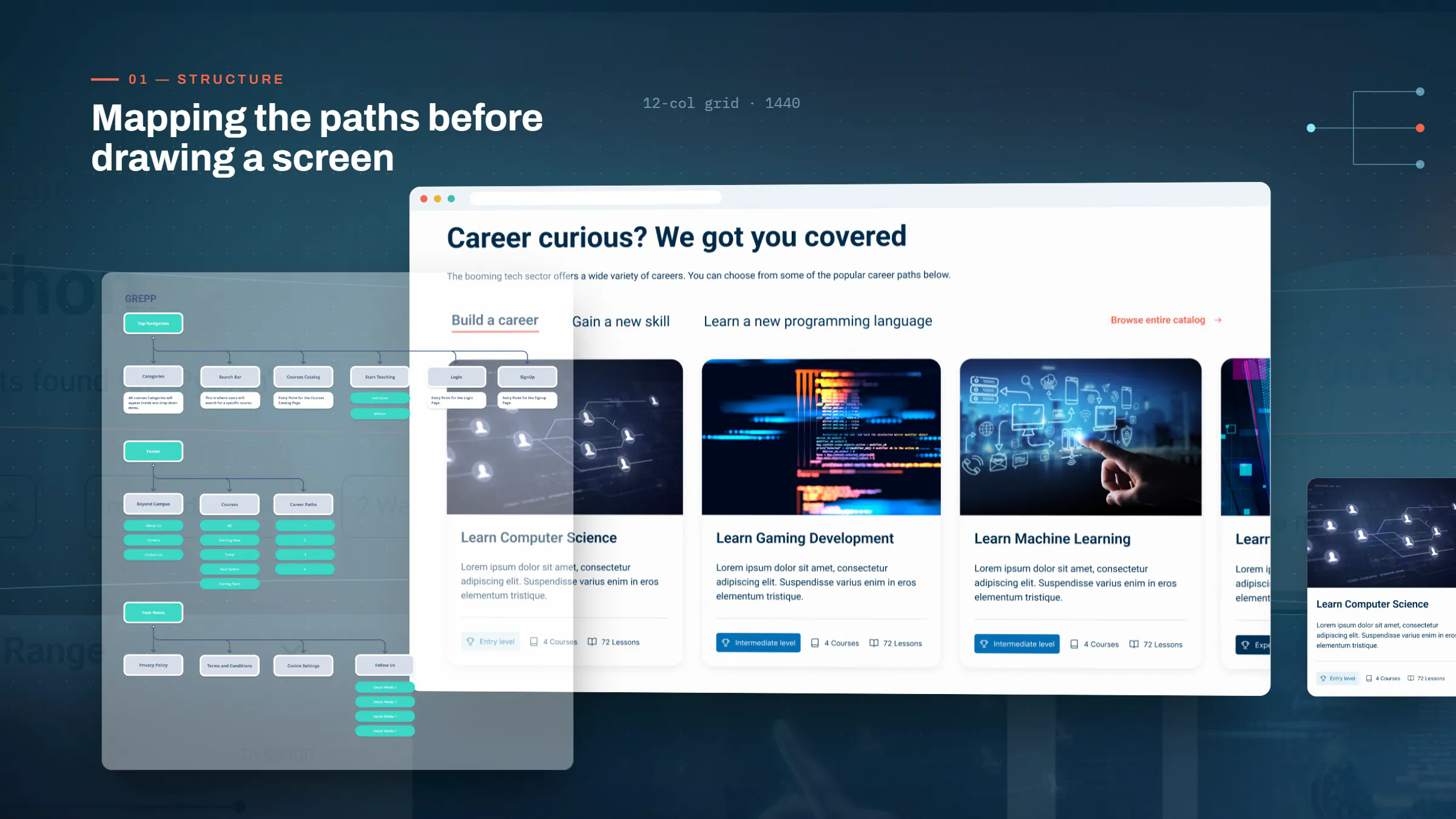
Information architecture for the BeyondCampus marketing website
Research

We asked developers what they actually do, not what they say they want.

The research round was small on purpose, because the timeline left no room for a full cycle of interview rounds. WANDR interviewed Grepp's stakeholders first, then ran six in-depth interviews across three deliberately different career stages, computer science students, junior developers with nought to two years of experience, and senior developers with five years or more, to find out where the real ideal customer profile sat. Every session was a scripted, conversational Zoom interview about how these developers actually find, judge and buy learning, run alongside secondary research into cohort-based learning outcomes and a section-by-section teardown of the platforms they already use.

01
Interviews

Cohorts are not for everyone, and the research said so in the first week.

Senior developers liked the idea and had no room for it. “Live courses provide the discipline, but with a full time job and a new born, there is no way I can make time for it right now,” one told us. Students and junior developers would commit to a cohort, but only for genuinely complex topics; for a problem at work they go to Google or Stack Overflow first. That single finding moved seniors out of the primary audience and pointed the whole site at students, junior developers and career switchers.

02
Teardowns

The category already had a house style, and it was not a feature list.

We took 23 sites apart across three groups: cohort-based course platforms including Maven, Section4, Reforge and Bloom Institute of Technology, MOOCs including Coursera, Udemy, edX and Codecademy, and course-creation tools including Disco, Teachfloor and Airtribe. Mapping the landing page structures showed the pattern: a hero, a feature showcase and a footer on 23 of 23 sites, testimonials and a closing call to action on 18, a logo cloud on 16, featured courses on 14. Maven won the team's vote, and it won it on one thing, translating features into benefits.

03
Completion

The strongest argument for the product turned out to be a completion rate.

Self-paced online courses are completed by as few as 3% of the people who start them, while cohort-based courses routinely clear 90%, and the research is consistent about why: 85% of participants in one study said being part of an online community helped them learn, and 94% said cohort discussions increased their interest in the material. That gap became the narrative spine of the page, because it is the one claim a skeptical developer cannot argue with.

One website, 3 very different learners.

Persona 01
The computer science student.

The computer science student.

Final-year and freshly graduated CS students who want the latest and greatest to launch a career with. Price sensitive, portfolio driven, and looking for a project big enough to show off. “The courses I enjoy the most are the ones where every assignment is part of a bigger project I can show off to my friends.”

Price-sensitive
Portfolio-driven
Scans, does not read
Persona 02
The junior developer and career switcher.

The junior developer and career switcher.

Nought to two years in, learning for advancement or mid-pivot into engineering. Will commit to a cohort for a complex topic if the time cost is bounded and mentors are reachable. “If it only lasts a couple of hours and I have access to mentors and can ask questions in that period, that is great.”

Time-poor
 Wants mentors
Needs clear structure
Persona 03
The senior developer.

The senior developer.

Five or more years of experience, interested in the model and unable to fit it in. Prefers documentation and self-paced video that can be sped up, and researched the strongest option for a specific use case rather than following a recommendation.

Self-paced  
 Documentation-first
Moved out of the primary audience
The Strategy

Sell the outcome, prove the claim, Speak the language.

‍
01

Outcome.

Translate every feature into a benefit. The original site listed what the platform could do. The new one sells what a developer gets, on the model of the iPod launching as a thousand songs in your pocket rather than a gigabyte of storage.

02

Proof.

Lead with the completion gap. The 3%-versus-90% difference between self-paced and cohort-based courses is the single hardest fact in the category, and it belongs where doubt peaks rather than buried in a features section.

03

Language.

Design like a developer would. Handwritten accents, hand-drawn arrows and small references to coding culture ran through the pages, because credibility with this audience is earned in the details. “There is a lot of small references to the coding culture and things we use in tech, that is very nice,” one tester said.

05

Depth.

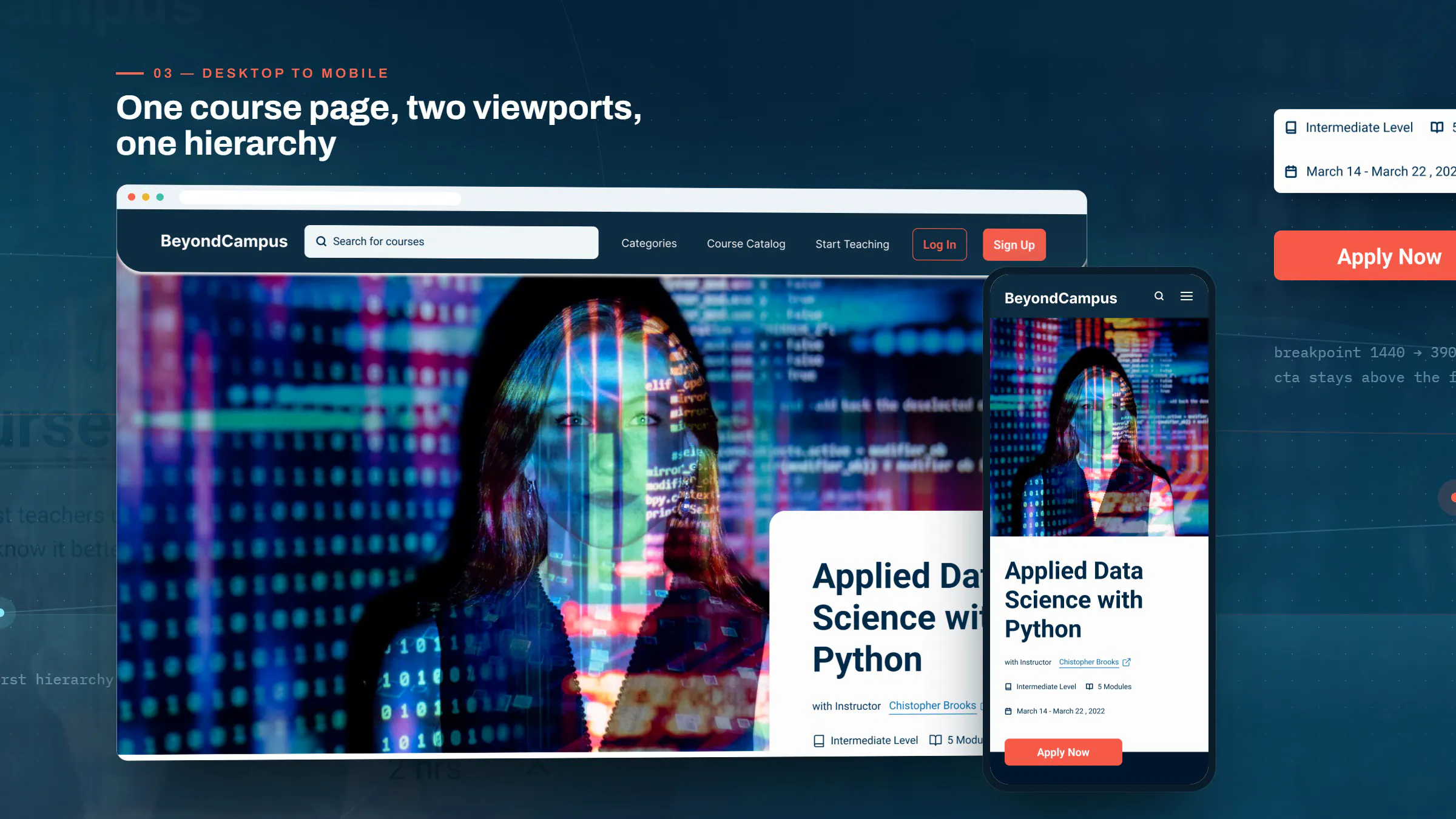
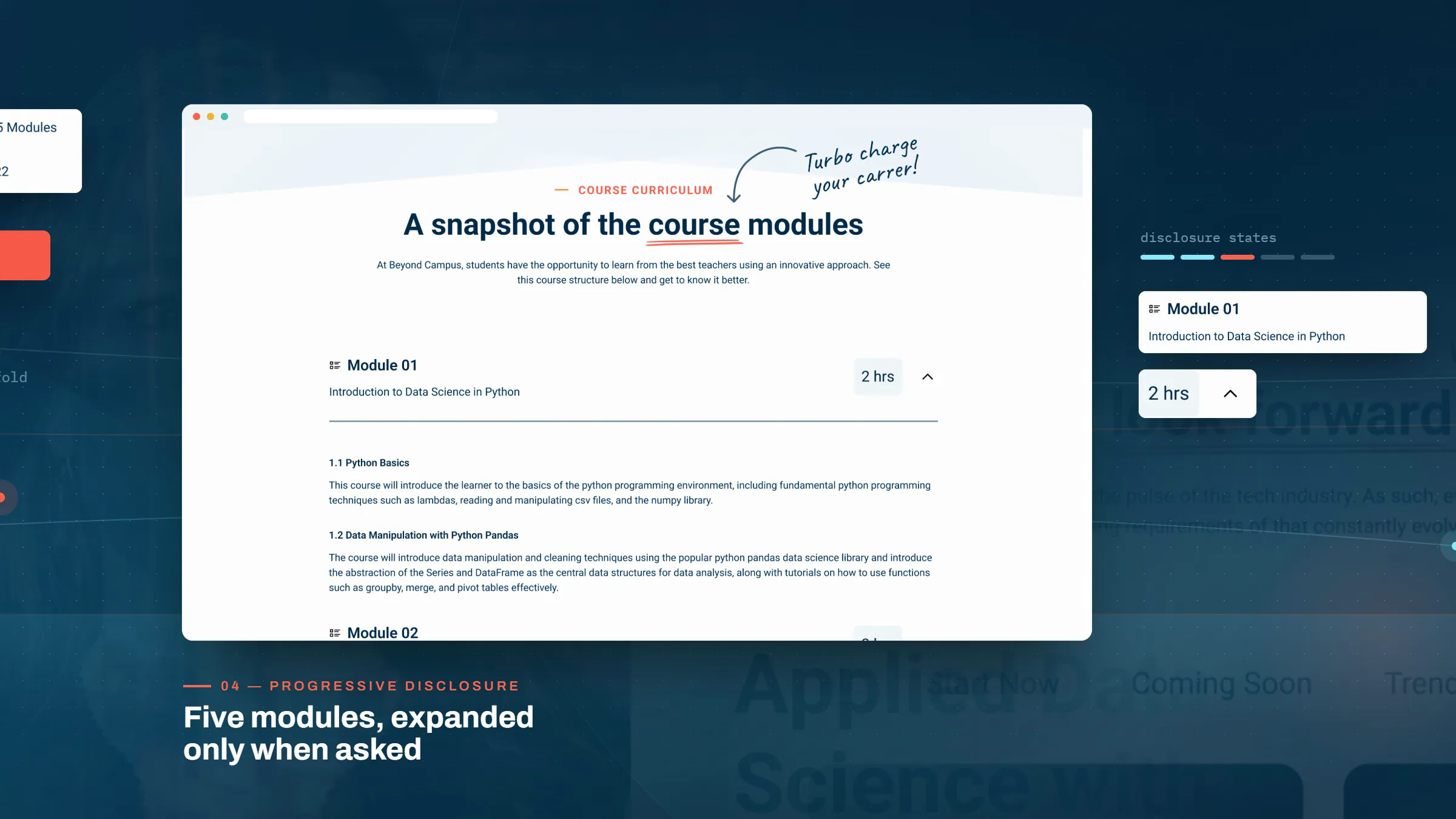
Over-inform on the course page. Everywhere else less is more, but on the page where a developer decides to pay, there is no such thing as too much detail: curriculum, structure, time per section, instructor, and outcome.

Principle 01 of
→ Continue scrolling
THE KEY INSIGHT

When your differentiator becomes table stakes, sell the mechanism instead.

Grepp came in believing community was the reason to choose BeyondCampus. Every single interviewee recognised the community theme, and every one of them treated it as the price of entry rather than a reason to switch, because free communities already do that job. The thing that actually moved people was narrower and more concrete: writing code alongside other people, getting it reviewed, and being unstuck by a mentor in the moment. Community is a category; co-programming is a mechanism. In a market this crowded, the mechanism is what a skeptical buyer can evaluate, and the category is just what everyone claims. It also happened to be the thing Grepp's engineers had actually built and the competition had not. The research did not change the product. It changed what the product said about itself.

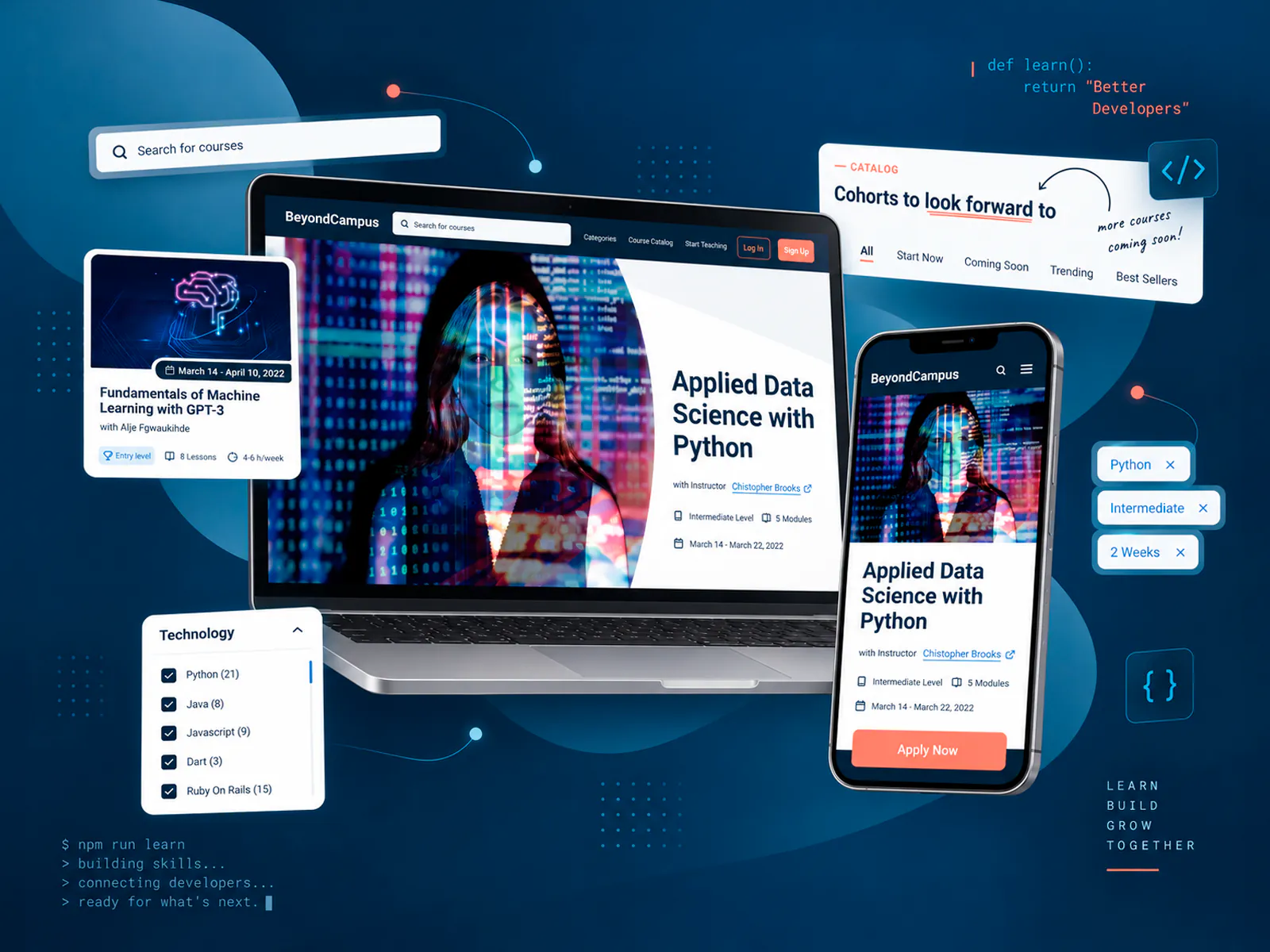
Case study design screen 1 by WANDR
Case study design screen 2 by WANDR
Case study design screen 3 by WANDR
Case study design screen 4 by WANDR
Case study design screen 5 by WANDR
Case study design screen 6 by WANDR
Case study design screen 7 by WANDR
Case study design screen 8 by WANDR
Screen 01 of 08
→ Scroll horizontally
Outcomes

What the work moved.

The engagement closed with the four core pages designed, tested and documented as a design system, a U.S. brand direction that had not existed at kickoff, and a research base Grepp's team could keep building against. Grepp announced the public launch of BeyondCampus on 13 June 2022, three months after kickoff, and carried WANDR into discussions for the subsequent UI and development phases.

01 · TESTING
4.5 to 5
Course description page rating, out of 5. The highest-rated of the four pages tested
02 · PACE
1 week early
Delivered ahead of a tight schedule
with an unplanned branding phase absorbed mid-project
03 · BRAND
0 → 1
U.S. visual identity, built from scratch when the Korean assets did not arrive
04 · AUDIENCE
3 → 2
Developer segments carried into design senior developers moved out of the primary audience

Client Voice

In their words.

“
They have a lot of experience in strategically and systematically doing design work.

[They organize] everything in a set of pipelines, which allows them to work very quickly.
Samuel Lim
Samuel Lim
CEO, Grepp, Inc.
See full Clutch review
Up next

Another story worth reading.

Swipe Out Hunger case study preview
Next Case Study

Swipe Out Hunger

Nonprofit
·
WordPress CMS
Read next case
Read the next case study