

A design system is a shared set of components, tokens, guidelines, and governance rules that allow product teams to design and build consistently at scale. Most definitions stop there. The more useful framing is what a design system replaces: the hundreds of small, redundant decisions that design and engineering teams make independently every sprint, the inconsistency that accumulates every time those decisions diverge, and the rework that follows when no one can agree on what the product is supposed to look like or how it is supposed to behave. The business case for a design system is not about design quality. It is about operational efficiency, engineering velocity, and the compounding cost of building without one.
What a Design System Actually Is
A design system is not a Figma file. It is not a component library. It is not documentation.
Those things are outputs of a design system. The system itself is the organizational infrastructure that governs how design decisions get made, communicated, and implemented consistently across a product as it grows.
A complete design system has four layers that most partial definitions collapse into one.
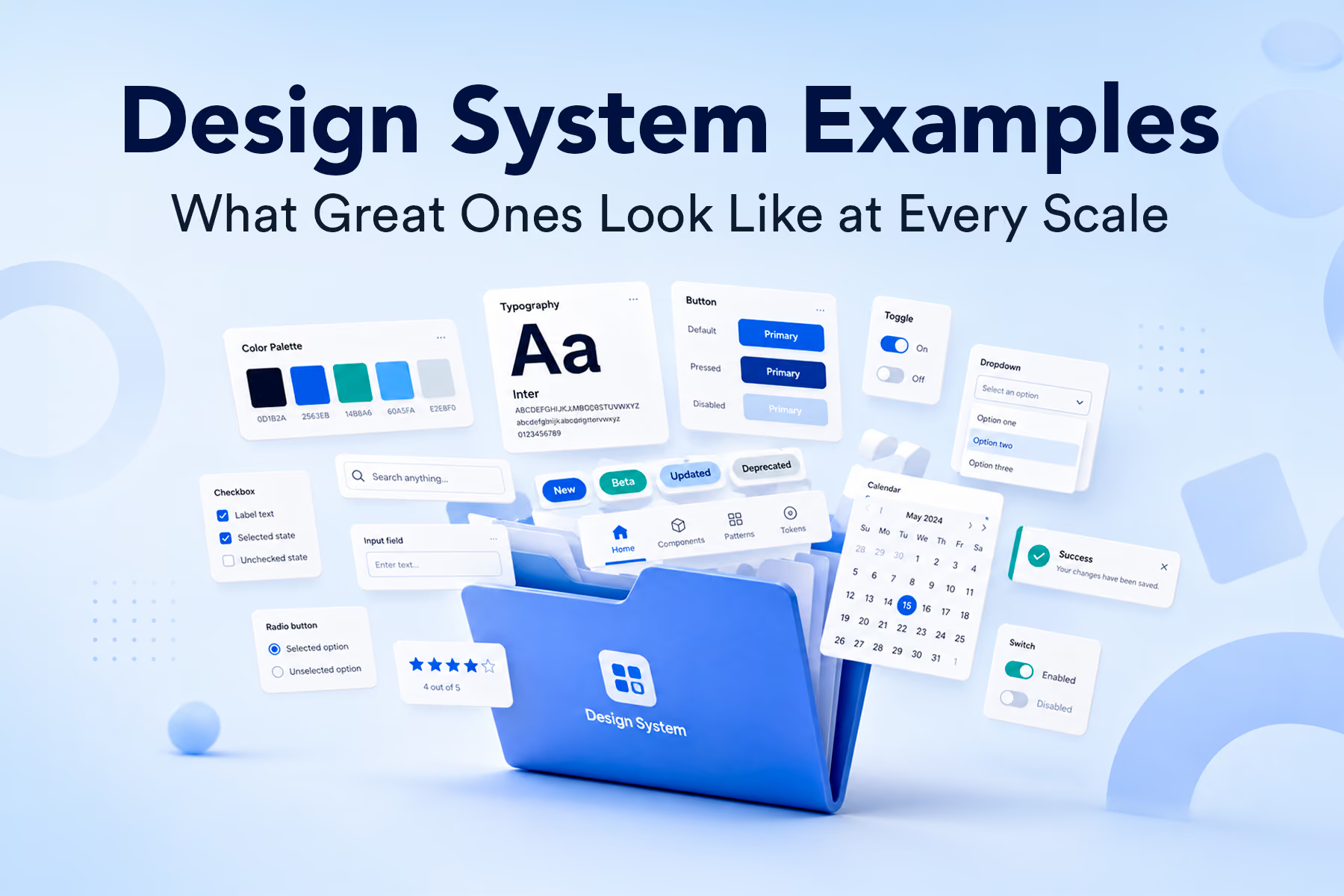
Design tokens are the foundational decisions that everything else inherits: the color palette, the typography scale, the spacing system, the motion principles, the elevation model. Token decisions are upstream of every component. When a token changes, every component that references it updates automatically. When there are no tokens and color values live directly inside components, a brand color change requires touching every component individually.
The component library is the reusable UI elements built on top of the token foundation: buttons, forms, navigation patterns, cards, modals, data tables, and every other interface building block the product uses. Components documented with usage guidelines, interaction states, accessibility specifications, and responsive behavior. Each component represents a decision made once rather than remade every time a new screen requires it.
Usage guidelines and principles govern when and how components are used: which component is appropriate for which context, how to handle edge cases the component does not cover, what the decision criteria are when two components could both technically work. Without this layer, the component library becomes a catalog that teams browse and interpret individually, producing inconsistency that looks unified at the component level but diverges at the product level.
Governance defines how the system evolves: who can propose changes, how proposals are evaluated, how breaking changes are communicated and versioned, and who is responsible for maintaining the system over time. A design system without governance is a snapshot that becomes outdated the moment the product continues to evolve without it.
What a Design System Is Not
A design system is not a one-time project. It is a living product that requires ongoing ownership, iteration, and maintenance. Teams that treat a design system as a deliverable to be completed rather than a product to be maintained find themselves with accurate documentation of decisions that no longer reflect the actual product within twelve months of launch.
A design system is not purely a design artifact. The most common failure mode in design system work is building a system that designers love and engineers find difficult to implement. A design system that exists in Figma but does not have a corresponding implementation in code is not a system. It is a reference document. The system only delivers its operational value when design and engineering are building from the same source of truth.
A design system is not a constraint on creativity. This is the most persistent misconception among product teams that resist investing in one. A well-built design system does not eliminate design decisions. It eliminates the redundant ones, freeing designers and engineers to spend their time on the decisions that actually require creative judgment rather than on recreating patterns that already exist elsewhere in the product.
The Business Case: What It Actually Costs to Not Have One
The cost of operating without a design system is rarely visible as a single line item. It accumulates invisibly across every sprint, every hire, and every product expansion.
Redundant design and development work. Without a shared system, designers and engineers solve the same UI problems independently across different parts of the product. The same button pattern gets designed three times by three different designers and implemented four times by four different engineers. The Forrester Research estimate that teams without design systems spend up to 30% of their design and development time recreating existing UI decisions is consistent with what Wandr observes across client audits. At engineering salary rates, that number compounds quickly.
Inconsistency that erodes product quality over time. The inconsistency that accumulates without a design system is not always visible to internal teams who are too close to the product to see it clearly. It is almost always visible to users. Different interaction patterns for the same action on different screens. Color values that are close but not identical. Typography that does not quite follow the same scale across features built by different teams at different times. Each individual inconsistency is minor. The cumulative effect is a product that feels unpolished in a way users sense without being able to articulate.
Onboarding friction for new team members. Without a shared system, every new designer and engineer who joins the team has to reverse-engineer the product's design conventions from the product itself. How long does onboarding take? As long as it takes to understand the implicit patterns well enough to contribute without introducing new inconsistency. With a well-documented design system, that onboarding time collapses to the time it takes to read the documentation.
Redesign cycles that should not be necessary. The products that require full redesigns every two to three years are almost always the ones without design systems. Inconsistency accumulates to the point where it cannot be addressed incrementally, and the only path to a coherent product is starting over. A design system makes incremental improvement the default rather than the exception.
Slower feature development. Teams with mature design systems ship new features significantly faster than those without because the component-level decisions are already made. The engineer building a new screen is assembling from a shared library rather than building from scratch. Figma's State of Design Systems research places the feature development speed advantage at up to 50% for teams with mature systems. Even a more conservative estimate represents a meaningful competitive advantage in markets where shipping speed determines outcomes.
When the Business Case for a Design System Is Strongest
The business case for a design system is not equally strong at every stage of product development. Understanding when the investment makes the most sense is as important as understanding why the investment matters.
When the product has more than one team contributing to it. A single-designer, single-engineer team can maintain informal consistency through direct communication. Two teams building in parallel cannot. The moment a product has multiple contributing teams, informal consistency breaks down and the operational cost of not having a system starts accumulating.
When the product is preparing to scale. The best time to build a design system is before the inconsistency that makes it necessary is already embedded in the codebase. Design systems built proactively are significantly less expensive than design systems built to fix existing inconsistency, because proactive systems involve only new component development, while reactive systems involve audit, migration, and the organizational complexity of getting existing teams to change how they work.
When the product operates across multiple platforms or markets. A product that exists on web and mobile, or that operates in multiple languages and markets, multiplies the cost of every design decision that is not governed by a shared system. Tokens and components built once serve every platform and market. Decisions made independently for each platform or market produce inconsistency that compounds with every expansion.
When design-to-development handoff is a recurring source of friction. If your team regularly experiences implementation discrepancies, where what ships does not match what was designed, the root cause is almost always the absence of shared component specifications that engineering can build directly from. A design system replaces interpretation with specification.
What the ROI of a Design System Looks Like in Practice
Wandr's work with WWF Canada illustrates one dimension of design system ROI. The platform had been fragmented across four separate systems, making every content update developer-dependent and creating campaign launch delays that cost the organization measurable revenue. The design system and modular CMS architecture Wandr built produced an 80% reduction in developer overhead and campaign launches three times faster. The 37% increase in digital donations and 30% increase in site-generated purchases that followed were downstream of a system that made consistent, rapid execution possible.
Fanatics represents a different dimension of ROI: the operational efficiency of a global platform where multiple product teams can build simultaneously from a shared foundation without producing the visual and interaction fragmentation that would otherwise accumulate across every release.
Tenable's three-year design system partnership illustrates the long-term compounding value: a system built and maintained through significant organizational growth, including a public offering, provides a stable foundation that scales with the company rather than becoming a constraint on it.
In each case the return on design system investment is not primarily aesthetic. It is operational. Faster development, reduced rework, better onboarding, and a product that stays coherent as it grows.
How to Know If Your Product Needs a Design System Now
A few signals that indicate the business case for a design system investment has become urgent:
Your designers regularly solve UI problems that feel familiar because they were already solved somewhere else in the product. Your engineers build components that duplicate existing implementations in other parts of the codebase. New team members take months to contribute without introducing inconsistency. Feature development requires more design review than it used to because there are no shared standards governing what correct looks like. Your product looks slightly different across features depending on which team built them.
Any one of these signals is worth taking seriously. All of them together indicate that the cost of not having a design system is already significant and growing with every sprint.
Final Thoughts
What is a design system? It is the infrastructure that allows a product to grow without accumulating the design and development debt that eventually forces a complete rebuild. It is the shared language that lets design and engineering teams communicate without interpretation. It is the operational framework that turns redundant individual decisions into consistent, scalable standards.
The business case is not about making the product look better, though that is almost always a byproduct. It is about eliminating the hidden operational costs that compound invisibly until they become impossible to ignore.
The teams that invest in design systems before those costs become urgent build products that scale cleanly. The ones that wait until the inconsistency is undeniable pay significantly more to fix it than they would have paid to prevent it.
Work With a Design System Agency That Understands the Business Case
Wandr has built and consolidated design systems for Fanatics, Tenable, WWF, Modfi, Buildbox, and product organizations across fintech, cybersecurity, nonprofit, gaming, and enterprise software. If your product team is evaluating a design system investment and wants to understand what the right scope and approach looks like for your specific context, schedule a free consultation with our team and let us show you where to start.