



When you hire a designer staffing agency, you’re not just hiring talent. You’re hiring accountability.
The real differentiator isn’t whether someone can send resumes. It’s whether they have clear SLAs around response times, escalation, and replacement and whether those SLAs actually protect your roadmap.
If your staffing partner can’t clearly explain what happens when something isn’t working, you’re exposed.
This guide breaks down what enterprise teams should expect from a serious designer staffing agency.

- A strong designer staffing agency should define response times, escalation paths, and replacement timelines upfront.
- Design-led vetting increases first-time match success.
- Escalation should include structured improvement windows before replacement.
- Backup coverage (design lead stepping in) protects delivery.
- 72-hour replacement windows are industry best practice.
How a Designer Staffing Agency Should Structure SLAs

Most agencies start with recruiting. At Wandr, we start with design.
That means:
- Designers are vetted by design experts.
- Profiles are handpicked per project, not pulled from a generic bench.
- Fit is evaluated technically, culturally, and operationally.
This increases first-try match success.
Service Level Agreements (SLAs) are commonly defined in enterprise IT governance as formal commitments around response times and service continuity, as outlined by frameworks such as ITIL (Information Technology Infrastructure Library) -- essentially setting expectations for response and continuity.
A serious designer staffing agency should treat SLAs with the same level of operational discipline.
It’s also why our designers don’t feel “outsourced.” They’re trained in agency environments. They know how to adapt to different rhythms, tools, and teams.
They embed. They don’t impose.
That’s the first expectation when hiring a designer staffing agency: increased chances of a match the first time.
What Response Times Should a Designer Staffing Agency Guarantee?

When issues arise, you shouldn’t be guessing who to contact. A professional Designer Staffing Agency should clearly define:
- Who owns the account?
- What’s the response window?
- What’s the escalation ladder?
Initial response should be same-day. Not next week… Not “we’ll get back to you.”
Speed protects velocity.
According to IBM, service level agreements (SLAs) establish clear performance metrics — including response times and service continuity targets — which improve service reliability, accountability, and overall customer experience. Clearly defined SLAs help reduce operational disruption by setting measurable expectations upfront.
If your staffing partner cannot articulate response timelines in writing, you are operating without structural protection.
How a Designer Staffing Agency Should Handle Escalation Before Replacement
Replacement shouldn’t be reactive. It should be structured.
There are usually two paths.
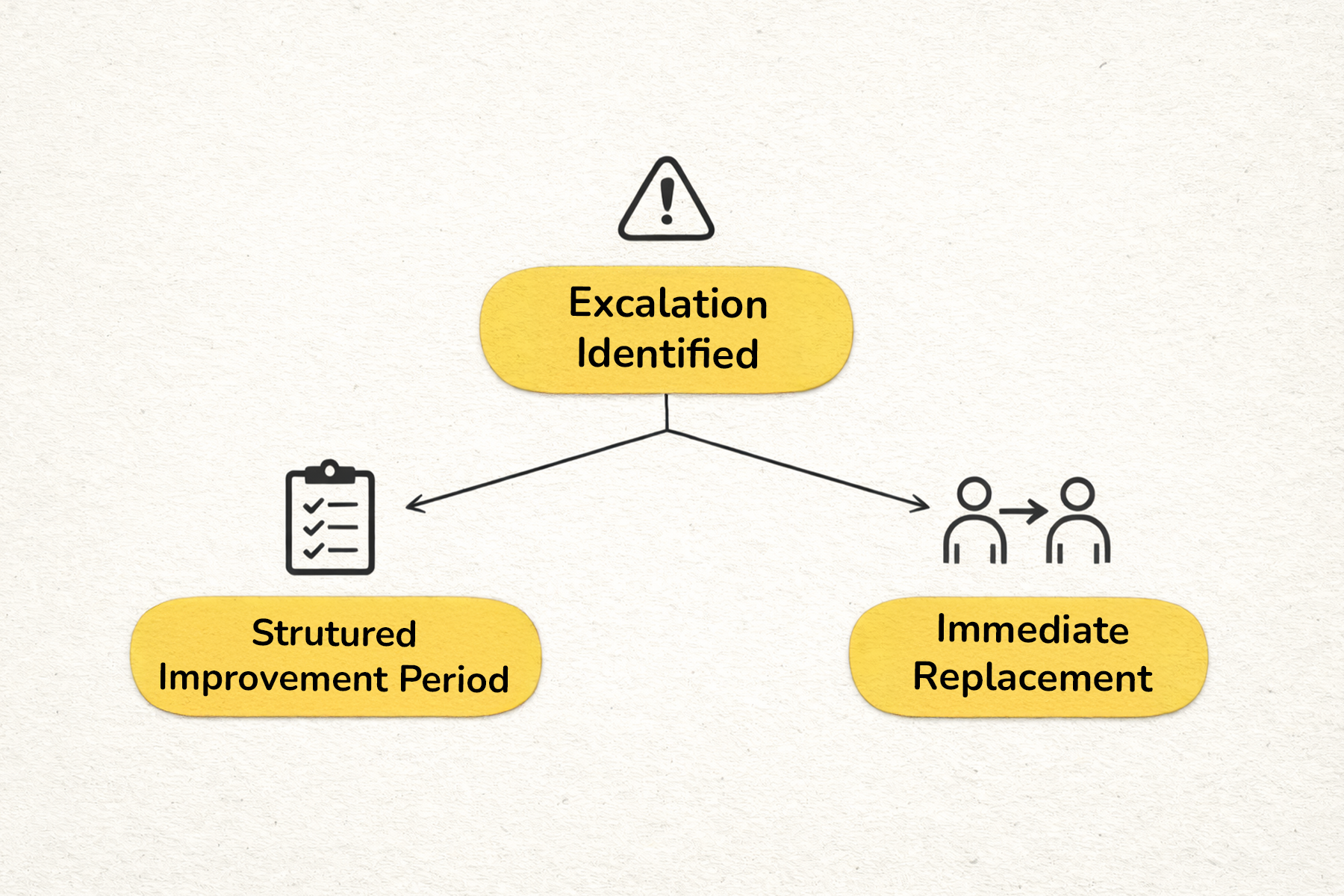
Path A: Structured Improvement Period
If the issue is small:
- The design lead shadows the resource.
- A 2–3 week improvement window is defined.
- Progress is tracked.
- A backup candidate is identified quietly in parallel.
If improvement works — great.
If not — transition happens seamlessly.
Path B: Immediate Replacement Process
If the client says: “This is not working,” a serious designer staffing agency moves immediately. Options include:
- 72-hour replacement window
- A senior design lead temporarily stepping in
- Or a structured transition while the replacement is finalized
In practice, most clients allow the 72-hour window. Immediate removal is rare, but contingency plans must exist.
That’s what real SLAs look like.
Why Designer Staffing Agency Coverage During Escalation Matters

This is where many staffing firms fail.
If a resource is escalated, what happens to the work? A strong Designer Staffing Agency ensures:
- A senior design lead can temporarily step in
- Active deliverables are protected
- Sprint cycles are not disrupted
Escalation should not mean roadmap freeze.
Harvard Business Review research consistently shows that accountability structures — not just talent — determine sustained team performance. An SLA without defined backup coverage is not protection. It’s paperwork.
How a Designer Staffing Agency Reduces Escalation Through Design-Led Vetting
Here’s where the model fundamentally differs.
Our designers are:
- Vetted by industry experts
- Embedded in agency workflows
- Trained to adapt to different client operating models
They know how to:
- Merge into your culture
- Adjust cadence
- Work inside your tools
- Feel like part of your organization
They are not rigid. And rigidity is what causes most escalations.
That’s why our UX/UI Staff Augmentation Services are structured around alignment first — staffing second.
Designer Staffing Agency vs Traditional Staffing Firm: SLA Differences
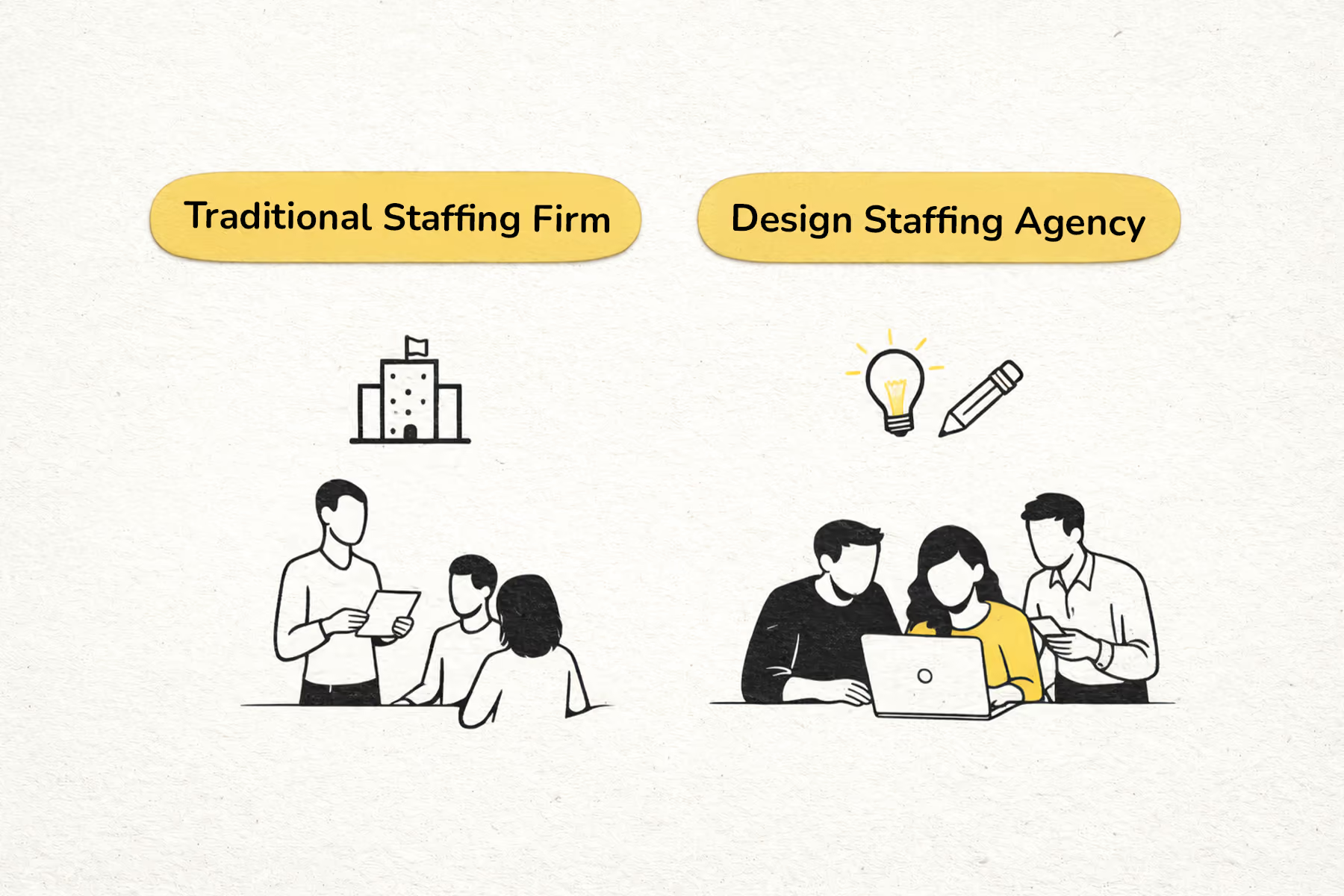
Traditional staffing firms often operate with:
- Resume forwarding
- Reactive replacement
- Minimal operational oversight
A modern Designer Staffing Agency operates with:
- Technical-first vetting
- Defined response times
- Structured escalation paths
- Backup coverage
- Proactive risk identification
This is also why UX staffing is no longer just a temporary fix. It’s a long-term scalability lever (as explained in Why UX Staff Augmentation Isn’t Just a Short-Term Solution Anymore.) And SLAs are what make that sustainable.
What to Ask a Designer Staffing Agency Before Signing an SLA
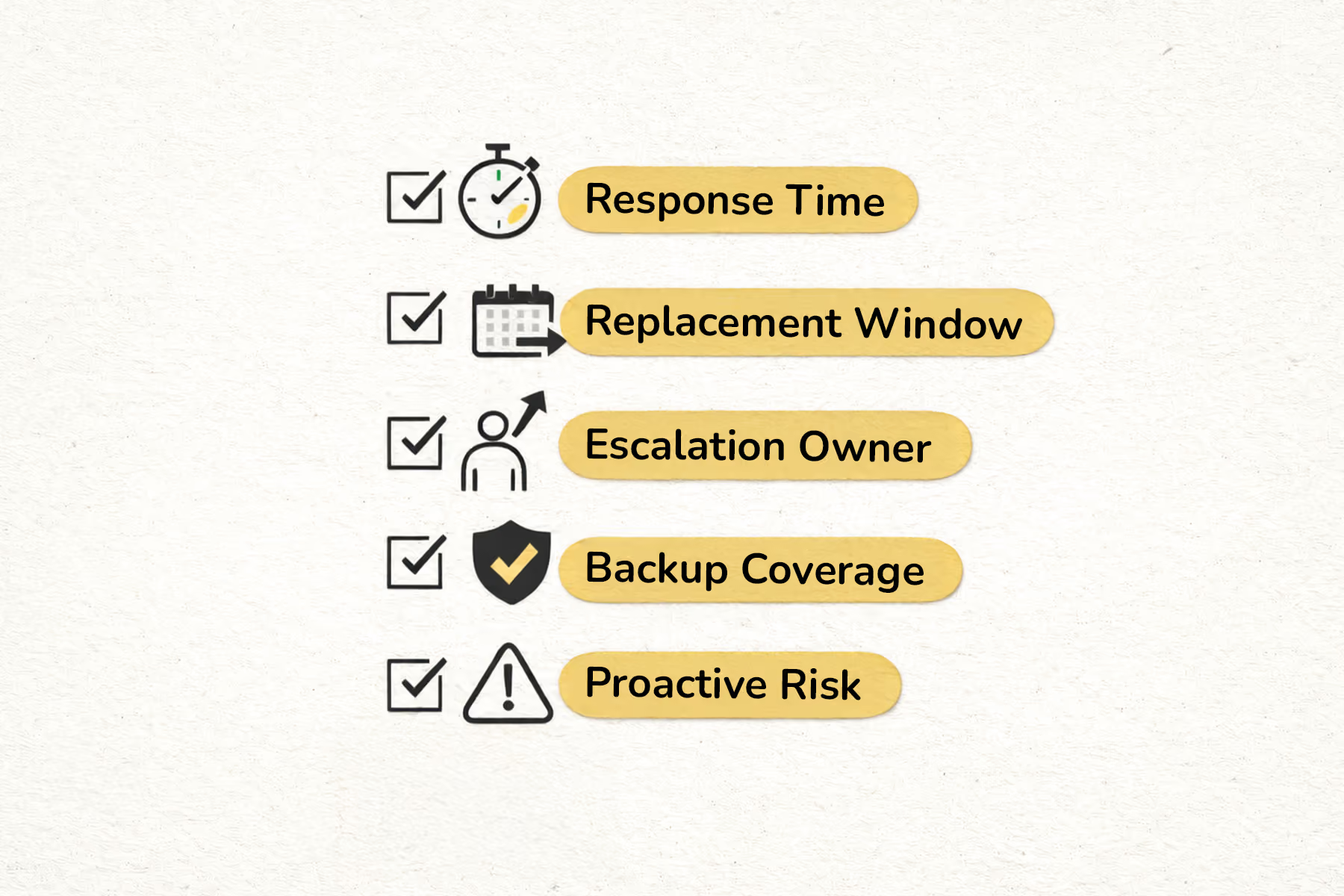
Before partnering with a Designer Staffing Agency, clarify:
- What is your guaranteed response time?
- What is your formal replacement window?
- Who steps in if escalation occurs?
- Is there a structured improvement period?
- Do you proactively identify backup candidates?
If the answers are vague, your risk is high.
For deeper replacement expectations, review When a UX Resource Isn’t the Right Fit: Replacement Expectations from Your Staff Augmentation Company.
Final Thoughts on Choosing a Designer Staffing Agency
An SLA isn’t paperwork. It’s protection.
A Designer Staffing Agency without clear response times and escalation processes puts your roadmap at risk. The right partner:
- Increases first-time match success
- Defines replacement windows upfront
- Provides temporary coverage
- Flags risk before it becomes friction
If you’re evaluating staffing partners, don’t just ask how they recruit and ask how they escalate.
Want a second opinion on your current staffing structure?
Request a strategic staffing assessment. We’ll show you exactly where your SLAs are strong — and where they’re exposed.