

Why Technology Grants Matter More Than Ever
For years, nonprofits were expected to run lean operations, with "overhead" viewed with suspicion by donors and funders alike. That thinking has shifted substantially. Major philanthropic organizations: including the Ford Foundation, MacKenzie Scott, and many community foundations: have made explicit commitments to funding nonprofit organizational capacity, including technology.
The argument is simple: an organization that can't reach donors, communicate its impact, or process gifts efficiently is an organization that can't scale its mission. Technology infrastructure: including the website: is mission infrastructure.
That shift in perspective has opened up real funding channels. Here's where to look.
Types of Funding Available for Nonprofit Website Development
1. Technology-Specific Grants
These are grants explicitly designated for nonprofit technology needs: including website design, digital tools, database infrastructure, and capacity building.
Google for Nonprofits / Google.org
Google offers substantial support to nonprofits in two forms relevant to website development. First, through Google for Nonprofits, eligible organizations get access to Google Workspace (including collaboration and productivity tools), YouTube Nonprofit Program, and: critically: Google Ad Grants, which provides $10,000/month in free Google Search advertising. That last one is not a website development grant, but it is free traffic that increases the ROI of your website investment.
Google.org, the philanthropic arm, also funds technology capacity building projects directly. Applications are competitive and typically require organizational scale, but worth monitoring.
Microsoft Nonprofits / Microsoft Philanthropies
Similar structure to Google: discounted and donated software, cloud infrastructure, and periodic capacity grants. Microsoft for Nonprofits provides eligible organizations with Microsoft 365 licensing and Azure cloud credits. Less directly applicable to website development, but reduces your technology overhead meaningfully.
Capacity Building Grants from Community Foundations
Community foundations in major cities regularly fund organizational capacity building: often explicitly including technology and communications infrastructure. These are underutilized by nonprofits because they require knowing your local foundation landscape.
Search your city + "community foundation capacity building grants" to find what's available in your region. Examples: Silicon Valley Community Foundation, Chicago Community Trust, New York Community Trust.
2. Capacity Building Grants from Major Foundations
Many major foundations have explicit capacity building grant programs that fund website development, communications strategy, and digital infrastructure.
MacKenzie Scott / Yield Giving
While not an application-based grant program in the traditional sense, Scott's giving approach has prioritized organizational capacity for high-impact nonprofits. Understanding this funding model matters because it reflects a broader shift in how major philanthropy thinks about infrastructure investment. → Yield Giving
W.K. Kellogg Foundation
Kellogg funds capacity building across a range of nonprofit issue areas. Technology and communications projects are fundable under their organizational effectiveness programs. → Kellogg Foundation
Robert Wood Johnson Foundation
Primarily health-focused, but their capacity building programs have funded technology infrastructure for health nonprofits. → RWJF
The Wallace Foundation
Strong track record of funding digital communications capacity for arts and youth-focused nonprofits. → Wallace Foundation
Ford Foundation
One of the pioneers in the "fund overhead" movement. Ford's BUILD program and organizational effectiveness grants have funded technology infrastructure explicitly. → Ford Foundation
3. Federal and State Technology Grants
IMLS (Institute of Museum and Library Services)
Libraries and museums are eligible for significant IMLS technology grants, including for digital access and website improvements. → IMLS
NEA and NEH Technology Programs
Arts and humanities nonprofits can access technology-specific grant streams through the National Endowment for the Arts and National Endowment for the Humanities. → NEA | NEH
USDA Community Facilities Program
Rural nonprofits specifically may qualify for USDA Community Facilities grants, which fund infrastructure: and have been interpreted to include digital infrastructure in some applications. → USDA
State Arts and Cultural Councils
Every state has a state arts or cultural council that provides grants to nonprofits, and many have capacity-building streams that include communications and technology. Search "[your state] arts council capacity building grants."
4. Corporate Foundation Grants
Many major corporations have foundation arms that fund nonprofit technology development. These are particularly accessible if your organization's mission aligns with the corporation's priorities or geography.
Salesforce.org
Salesforce is deeply invested in the nonprofit sector: not just through product, but through their philanthropic programs. Their grant programs have funded technology capacity building for nonprofits worldwide. → Salesforce.org
Adobe Foundation
Adobe funds creative and communications capacity for nonprofits, with technology development fundable under their programs. → Adobe Foundation
Verizon Foundation / AT&T Foundation
Both telecommunications giants fund digital inclusion and technology capacity grants for nonprofits, particularly in underserved communities.
5. Pro Bono and Discounted Design Programs
Sometimes the most accessible option isn't a grant: it's a reduced-cost or pro bono engagement from an agency or designer committed to the sector.
Catchafire
Catchafire matches nonprofits with skilled professionals who volunteer their time on specific projects, including website development and digital strategy. For smaller organizations, this can be a meaningful resource. → Catchafire
Taproot Foundation
Similar model: pro bono professional services for nonprofits, including marketing, design, and technology. → Taproot Foundation
TechSoup
TechSoup provides discounted software, cloud services, and technology resources for nonprofits. It doesn't fund custom development, but reducing technology licensing costs can free budget for a design investment. → TechSoup
How to Write a Winning Technology Grant Proposal
Getting the grant is as much about the proposal as the project. Here are the principles that make technology grant applications succeed.
Frame it as mission infrastructure, not operations
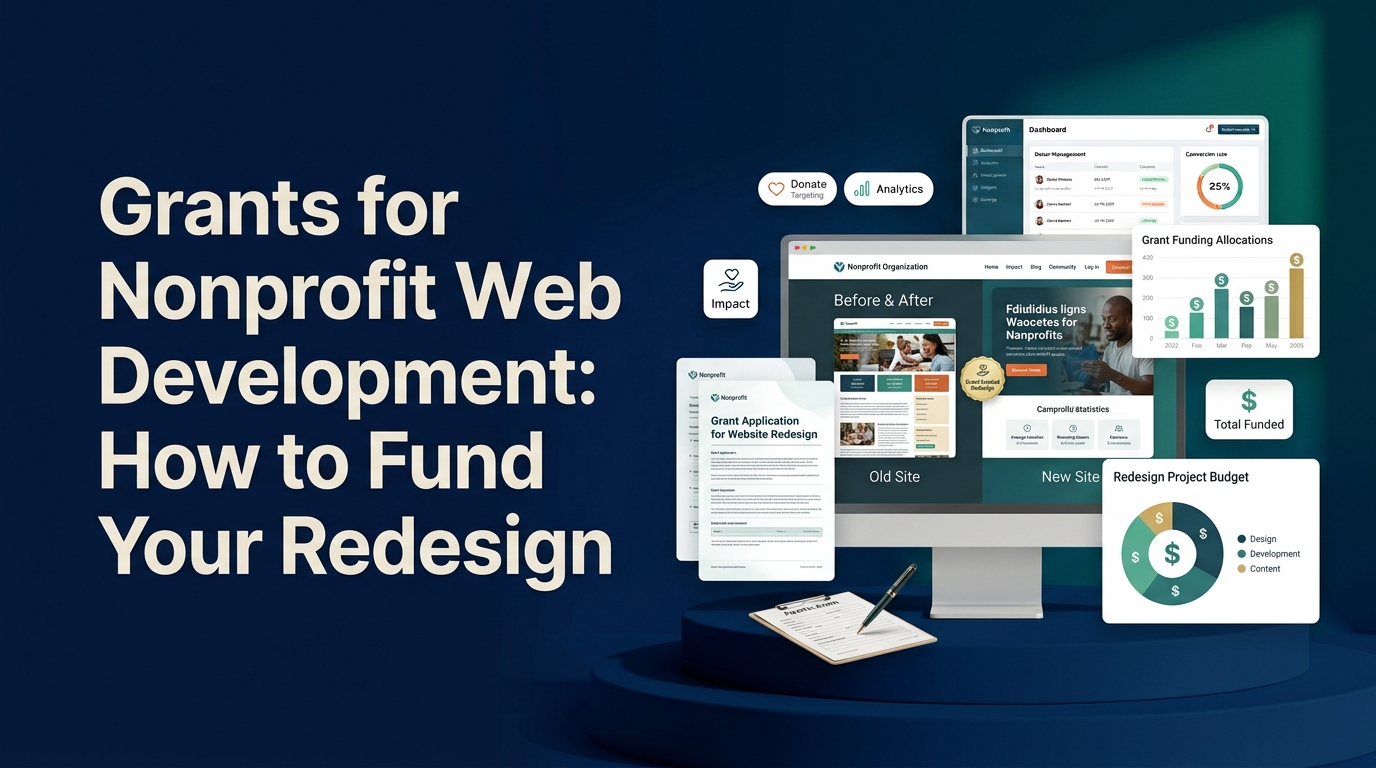
Don't write "we need a new website." Write "our ability to increase donor acquisition and conversion depends on a digital presence that reflects our credibility and makes it easy for supporters to take action." The grant is not about the website: it's about the mission outcomes the website enables.
Include measurable outcomes
Funders want to know how they'll know the investment worked. Be specific: "We aim to increase online donation conversion by 25% within 12 months of launch" or "We expect to reduce donor acquisition cost by 15% through improved SEO and conversion rate optimization." Use data from your current analytics where possible.
Demonstrate organizational readiness
Grant reviewers want to know that the money won't be wasted because your organization isn't ready to use it. Show that you have leadership commitment, staff capacity for the implementation, and a plan for ongoing maintenance post-launch.
Name the agency and their expertise
If you've already identified a partner for the project, include them in the proposal. A partner with a track record in the nonprofit sector adds credibility to the project plan.
Connect to current funder priorities
Read the funder's strategic priorities carefully and connect your proposal explicitly to them. A technology grant from a foundation focused on racial equity should connect your website project to how it will better serve communities of color or amplify equity-focused organizations.
What a Website Grant-Funded Project Can Accomplish
To make the case to funders: and to yourself: here's what a well-executed nonprofit website redesign can deliver:
Increased donations. WANDR's work with Mercy For Animals resulted in a 32% increase in donations in year one. WWF Canada saw a 37% increase in transactions. These aren't anomalies: they're what happens when you take a data-driven approach to conversion.
SEO recovery and growth. When done right, a website migration doesn't cost you the SEO equity you've built: it protects and builds on it. WANDR preserved over 90% of Mercy For Animals' SEO through a major platform migration and recovered the rest in under four weeks.
Operational efficiency. A modern content management system reduces the time your staff spends on website updates, freeing them for mission-critical work.
Improved donor trust. Credibility signals: professional design, clear impact reporting, accessible navigation: directly affect whether first-time visitors choose to give.
Timing Your Grant Application
A few practical notes on process:
Grant cycles vary. Most major foundations have annual grant cycles with specific application windows. Research the deadlines for funds you're targeting and work backwards from those.
Many technology grants require a technology audit or needs assessment as part of the application. If you're planning to apply for website development funding, starting with an audit: of your current site, your conversion performance, and your technology stack: gives you the evidence base the application needs.
At WANDR, our initial engagement typically begins with an audit, scaled to the size and complexity of the site. This document is useful not just for project planning, but as supporting material for grant applications. It shows funders exactly what exists, what's broken, and what a new investment would address.
→ Book a Free Nonprofit Website Diagnostic
Common Mistakes When Applying for Technology Grants
Applying to the wrong funders. If a foundation's priorities are focused on direct service delivery and your application is for a website, it's probably the wrong fit regardless of how good your proposal is.
Underestimating the budget. A website redesign that's properly researched, designed, tested, and launched requires real investment. Underestimating and building a scope that doesn't cover what you need will result in a project that fails to deliver the outcomes you promised the funder.
No plan for maintenance. Funders who've seen technology grants fail know that the #1 reason is organizations that get a new website but have no plan for keeping it current. Your proposal should include a post-launch maintenance plan.
Not tracking outcomes. If you're funded to improve your digital performance, you need analytics configured from day one. This is non-negotiable: both for the mission and for your reporting obligations to the funder.
The Bottom Line
Funding for nonprofit website development is available: more than most organizations realize. The investment in finding and applying for it is real, but so is the payoff: a website that genuinely serves your mission, increases donations, and demonstrates to future funders that technology is a strategic priority for your organization.
A well-executed redesign, properly funded, properly measured, is one of the highest-ROI investments a nonprofit can make.
If you're at the stage where you need to understand what a redesign would cost and what it would accomplish before you can make the grant case: start with a diagnostic.
→ Book a Free Nonprofit Website Diagnostic
WANDR Studio is a woman-owned design, development, and strategy agency that has generated $3.2M+ in additional donations across 15+ nonprofit engagements. Every engagement comes with a warranty: meaningful increase in your key KPIs within year one of launch, or we work for free until you see it.
→ Related reading: Nonprofit Website Development Cost | Nonprofit Website Redesign: When, Why, and How | What Should a Nonprofit Website Include?
Related WANDR case studies: WWF-Canada · Mercy For Animals · CEED Global
Planning a nonprofit website project? Explore WANDR's nonprofit web design services →