

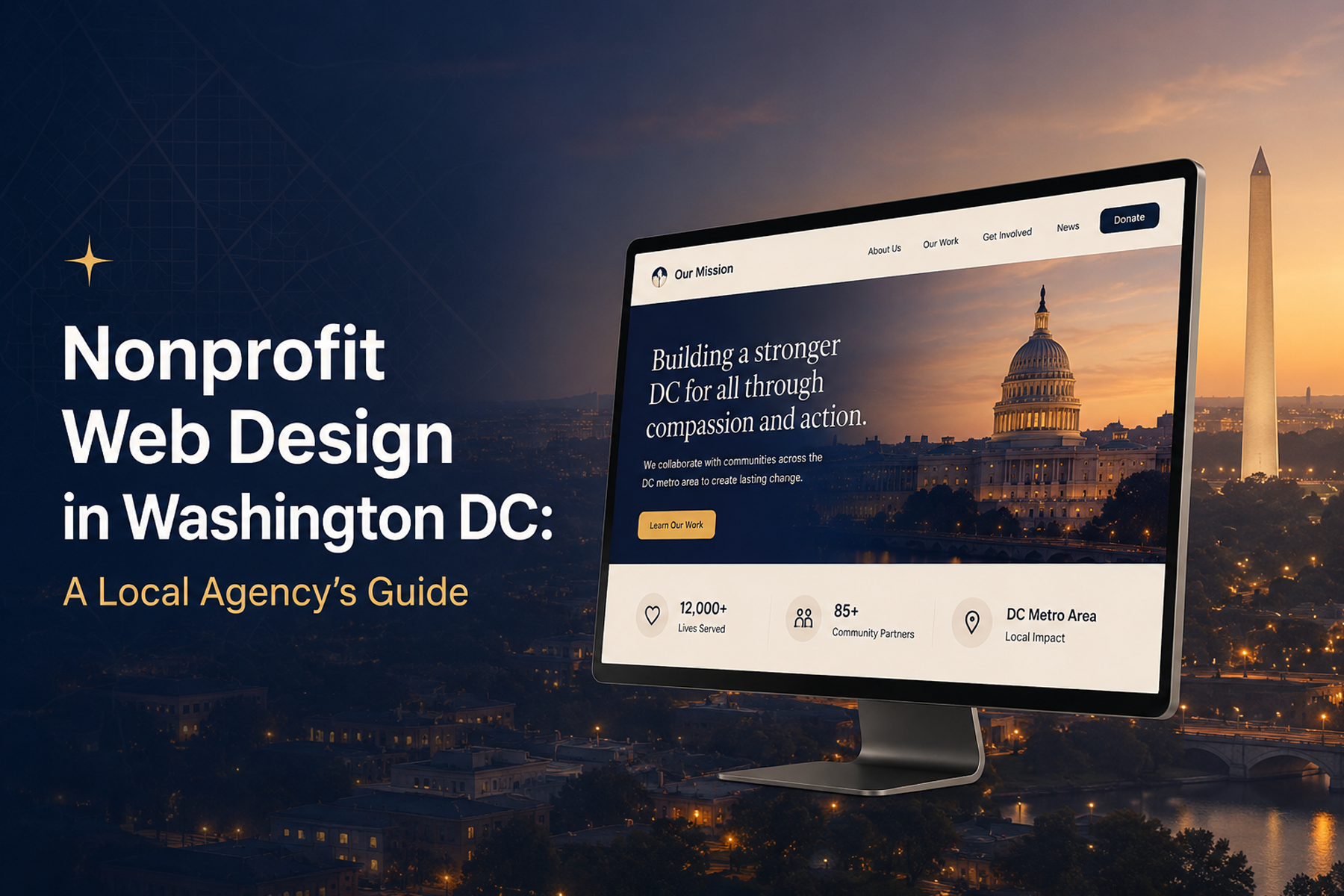
Washington DC has one of the most dense concentrations of nonprofit organizations in the world. That's not an accident: it's a reflection of the city's role as a center of policy, advocacy, international development, and civic engagement.
It also means that DC nonprofits are operating in a uniquely competitive environment: your potential donors, volunteers, and partners are being reached by dozens of other organizations doing adjacent work, many of them with sophisticated digital presences.
Here's what DC-specific nonprofit web design actually looks like, and what local organizations need to consider that national and generic resources don't address.
The DC Nonprofit Landscape
Understanding your context matters for digital strategy.
Washington DC is home to a disproportionate number of:
- Policy and advocacy organizations: From national advocacy groups to small legislative strategy shops, DC's policy world operates on a different timeline than most nonprofit sectors (tied to legislative calendars, election cycles, and policy windows)
- International NGOs and development organizations: Often multi-lingual, multi-regional, and serving complex global stakeholder maps
- Federal grantees: Organizations whose primary revenue is federal grants, with different audience needs (program officers, compliance audiences) than donation-funded organizations
- Association and member organizations: Serving professional communities with member portals, event management, and credentialing
Each of these has specific digital requirements that generic nonprofit web design advice doesn't fully address.
What Makes DC Nonprofit Web Design Different
Credibility Standards Are Higher
In a city where your organization's website might be reviewed by a Senate staffer, a program officer at a major foundation, or a journalist covering policy: the credibility bar is elevated. The design needs to communicate institutional seriousness, not just mission passion.
This doesn't mean cold or bureaucratic. It means that trust signals need to be sophisticated, not just present. It means that copy needs to be precise and substantive, not just emotionally resonant.
Audience Sophistication Is Higher
DC nonprofit audiences: donors, volunteers, partners, and beneficiaries: often have significant issue expertise. They can tell when an organization doesn't know what it's talking about. Website copy that's accurate but superficial fails with this audience. The bar for content quality is elevated.
Multi-Audience Complexity Is Common
DC organizations often serve extremely complex stakeholder maps: federal funders, congressional staff, media, international partners, domestic program beneficiaries, corporate donors, individual supporters. Designing a website that speaks coherently to all of these audiences without confusing any of them requires more sophisticated architecture than a simpler stakeholder map.
Advocacy and Action Features Are Core
For policy and advocacy organizations, the website isn't just a fundraising tool: it's an advocacy platform. Petition signing, letter-writing tools, action alerts, legislative tracking, and event mobilization are often primary functions rather than secondary ones.
Grant Compliance and Reporting Visibility
Organizations with significant federal or foundation funding often need their websites to demonstrate grant compliance: specific reporting pages, acknowledgment of funders, documented outcomes. This is a design requirement that most generic nonprofit guides don't address.
Key Features for DC Nonprofit Websites
Legislative action tools
For advocacy organizations: integration with tools that allow supporters to contact their representatives directly from the website (EveryAction, VoterVoice, and similar platforms).
Policy library / resources section
For policy organizations: a searchable library of reports, briefs, testimony, and research. This is both a credibility asset and an SEO powerhouse: policy research gets cited and linked to.
Event management
DC nonprofits run an enormous number of events: galas, policy briefings, Hill meetings, convenings. Built-in event management (rather than just embedding an Eventbrite link) improves the experience and keeps users on the site.
Multi-language support
For international development and immigrant services organizations: proper multilingual architecture (not just Google Translate) with language-specific content management.
Federal/foundation funder acknowledgment pages
Compliance-friendly pages that properly acknowledge funders and provide grant-required reporting information.
Staff and leadership directory
In the DC policy world, your staff are your credibility. Robust staff profiles with areas of expertise, publications, and bio pages position the organization's thought leadership effectively.
Finding the Right Web Design Partner in DC
You have two primary options: a local DC agency or a remote agency with strong nonprofit specialization.
Arguments for a local DC agency:
- Understands the local nonprofit ecosystem and DC political context
- Easier to schedule in-person meetings during discovery and review phases
- May have relationships with local organizations that can serve as references
- May have specific experience with DC regulatory or compliance requirements
Arguments for a specialized remote agency (like Wandr):
- May have deeper nonprofit-specific expertise than a generalist local agency
- Portfolio of results from comparable organizations nationally
- Often more cost-competitive
- Process-driven approach matters more than geography for most web design work
What matters most: the quality of the process (does it start with user research?), the relevance of the portfolio (have they built comparable organizations?), and the verifiability of the results (can you talk to clients about real outcomes?).
Case Studies Relevant to DC Organizations
Mercy For Animals — Complex Multi-Audience Architecture
Mercy For Animals operates across regions with complex multi-audience requirements: donors, volunteers, advocates, corporate partners, and media: similar to the stakeholder maps many DC organizations navigate. The redesign unified their digital ecosystem without overwhelming any individual user type.
Relevant to: DC advocacy organizations, international NGOs, organizations with diverse stakeholder maps
WWF Canada — Credibility at Scale
WWF operates with the credibility requirements of a globally recognized institution: similar to the standards that major DC policy organizations, think tanks, and international development organizations face.
Relevant to: DC policy organizations, foundations, international development organizations
DC-Specific SEO Considerations
For DC nonprofits, local SEO has some specific dimensions:
Geographic keyword modifiers
Searching "nonprofit web design Washington DC" or "advocacy organization website design DC": if local visibility matters, these geographic terms belong in your content.
Policy and issue-specific authority
For policy organizations, ranking for issue-specific research queries ("housing policy research DC," "criminal justice reform data") establishes thought leadership that attracts media, funder, and partner audiences. This is a content and SEO opportunity most DC organizations underinvest in.
Google for Nonprofits + Google Ad Grants
$10,000/month in free Google Ads for eligible nonprofits. For DC organizations where visibility in policy and advocacy search results matters, this is a significant resource. Apply at google.com/nonprofits.
Budget Expectations for DC Nonprofit Web Design
The pricing range doesn't change based on geography: DC nonprofits shouldn't expect to pay a DC premium for the same scope.
Full nonprofit website redesign: $15,000 to $75,000 depending on size and whether development is included (up to $150,000 or more for enterprise platforms), including research, design, development, and launch support.
Scoped engagement (donation flow optimization, SEO, or CMS migration) only: starting around $15,000.
Staff augmentation / ongoing maintenance: from five-hour monthly packages to full-time embedded support.
What should change based on DC-specific requirements: scope. A DC advocacy organization with legislative action tools, a policy library, multi-language support, and a complex stakeholder map has more scope than a small community nonprofit. The research and architecture complexity goes up: and the budget appropriately reflects that.
Book a free diagnostic for your DC nonprofit website →
Wandr Studio. Woman-owned. Mission-driven. We build nonprofit digital experiences that move missions forward. See our work →
Related WANDR case studies: WWF-Canada · Mercy For Animals · CEED Global