

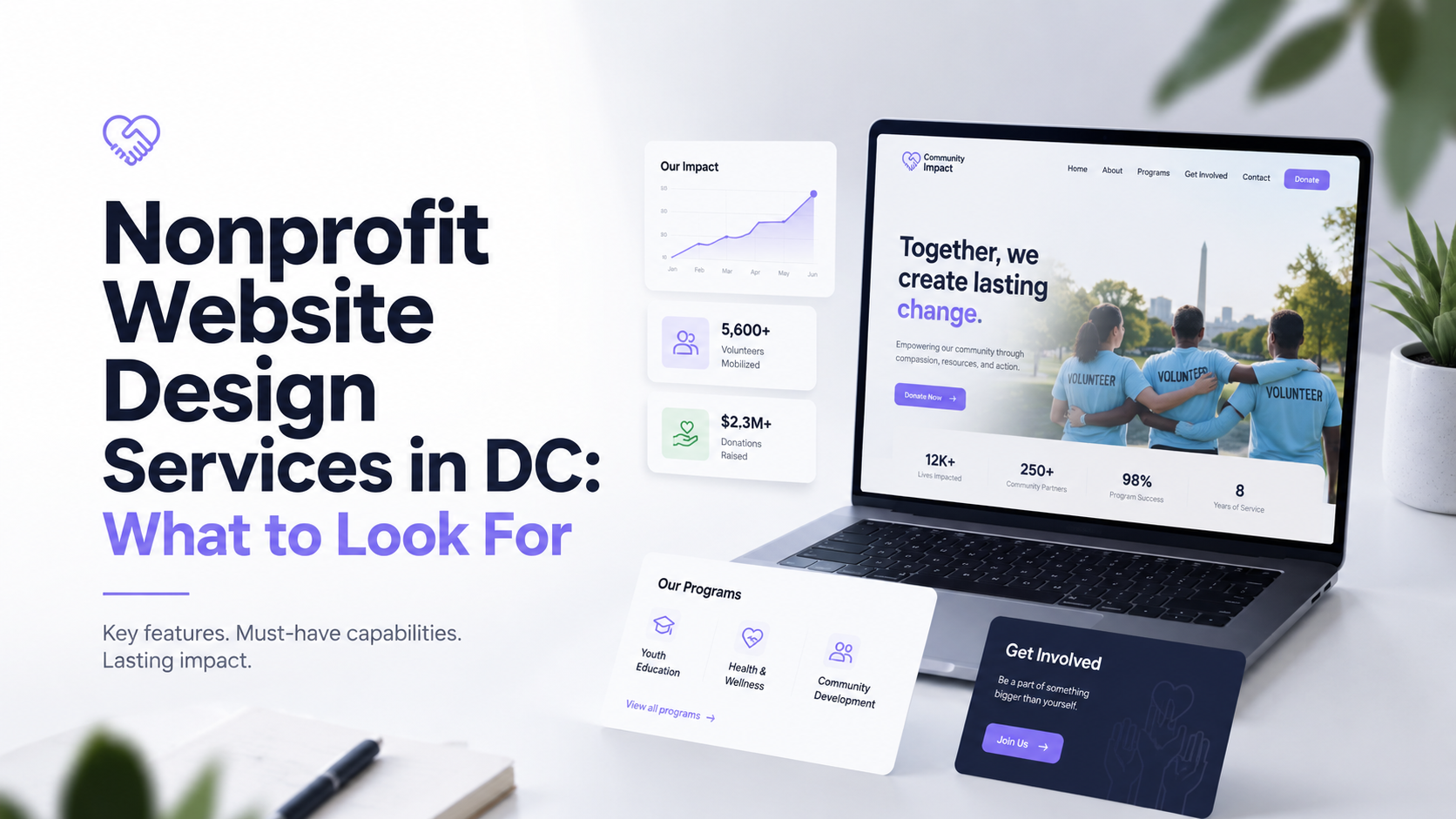
Choosing a website design partner for your DC nonprofit is one of the highest-stakes vendor decisions you'll make. The right choice compounds: good work builds on itself, and a great website becomes an asset that attracts donors, volunteers, and partners for years. The wrong choice costs money twice: once to build something that doesn't work, and again to fix it.
Here's a buyer's guide specifically for DC nonprofits evaluating website design services.
The DC Nonprofit Website Context
Washington DC nonprofits operate with specific requirements that general buyer's guides often miss:
Credibility expectations are elevated. Your website will be reviewed by program officers, congressional staff, foundation funders, and media. The standards for "looks professional" are higher than in most markets.
Audience complexity is high. Advocacy organizations serve legislative, media, donor, volunteer, and beneficiary audiences from the same digital front door. International organizations add geographic and linguistic complexity. Getting the architecture right for multiple sophisticated audiences requires deep experience.
Issue expertise matters. Copy that demonstrates genuine command of the policy or issue area your organization works in reads differently to sophisticated DC audiences than generic nonprofit website copy. Your web partner needs to either bring issue familiarity or be willing to invest in understanding yours.
Compliance requirements exist. Federal grantees and foundation-funded organizations often have acknowledgment and reporting requirements that need to be incorporated into website architecture from the start.
What Nonprofit Website Design Services Should Include
Use this as your minimum requirements checklist when evaluating proposals.
Discovery and User Research
This is non-negotiable. Any proposal that starts with design before discovery is not the right fit.
Discovery should include: stakeholder interviews to understand organizational outcomes, user persona development with validation through real user interviews, competitive and comparable landscape review, and a written brief that informs everything that follows.
For DC organizations specifically: discovery should include understanding the specific audience sophistication and competitive context of your sector.
UX and Flow Architecture
Before a visual design is created, the information architecture and user flows should be documented and reviewed. This is the step that ensures the website is organized around how users navigate, not how the organization thinks about itself.
For DC nonprofits: user flows need to account for the full range of stakeholder types: not just donors, but program officers, media, partners, and potentially beneficiaries: each with different information needs and different decision paths.
Visual Design and Brand Application
The visual design should reflect your organization's credibility and character while being functional: fast-loading, accessible, mobile-first, and clearly structured.
For DC nonprofits: visual design should communicate institutional seriousness while maintaining the mission-driven character that distinguishes nonprofits from government agencies or lobbying firms.
Development
The site should be built on a platform that can be managed long-term without constant developer involvement, integrates cleanly with your donation platform and CRM, performs well on mobile, and is built to accessibility standards.
For DC organizations with advocacy tools: integration with EveryAction, VoterVoice, or similar legislative action platforms should be accounted for in the development scope.
Content Migration
If you're moving from an existing site to a new one, content migration is a critical deliverable. Done incorrectly, it destroys years of accumulated search authority.
Ask any agency you evaluate: what is your SEO preservation track record through platform migrations? A good answer includes specific examples and verifiable outcomes. Wandr preserved over 90% of Mercy For Animals' SEO equity through a complex migration.
Analytics Setup
Google Analytics 4 and Google Search Console should be configured with conversion events before launch. This isn't an add-on: it's how you know whether the website is working after it goes live.
Post-Launch Support
The first 90 days post-launch are critical. Any proposal should address what post-launch support looks like: who's reviewing analytics, what's the process for addressing technical issues, and how are findings translated into improvements.
Questions That Reveal the Right Agency
"What does your user research process look like, and can you give me an example where it changed the design direction?"
This question surfaces whether user research is genuinely foundational to their process or a brief checkbox. The best answer includes a specific example of user research revealing something surprising that changed the project direction.
"What happens if the site doesn't produce results in year one?"
Most agencies have no answer to this. The right answer is a clear warranty commitment. Wandr's: meaningful improvement in key metrics in year one post-launch, or we come back and work for free.
"Can you walk me through how you've handled content migration for a nonprofit that was changing platforms?"
The answer should include specific reference to redirect mapping, SEO preservation metrics, and post-migration monitoring. If they need to look this up or give a generic answer, take note.
"What percentage of your work is nonprofits, and what types of nonprofits?"
Relevant to verifying genuine specialization. An agency where 70% of their work is nonprofit has different pattern recognition than one where it's 15%.
Red Flags to Watch For
Going straight to design. Wireframes in the first week without a discovery phase means they're designing from assumptions.
Proposals without user research as a line item. If "user interviews" or "persona development" isn't in the scope, it's not happening.
Portfolio without results. Beautiful screenshots without outcomes data is marketing, not proof.
No clear post-launch support model. If the engagement ends at launch, who's watching the site perform?
Vague answers to the migration question. If they can't be specific about how they handle SEO preservation, assume they don't have a process.
No references available. A reputable agency should be willing to connect you with past nonprofit clients without hesitation.
Making the Decision
Here's the evaluation matrix we'd use if we were in your position:
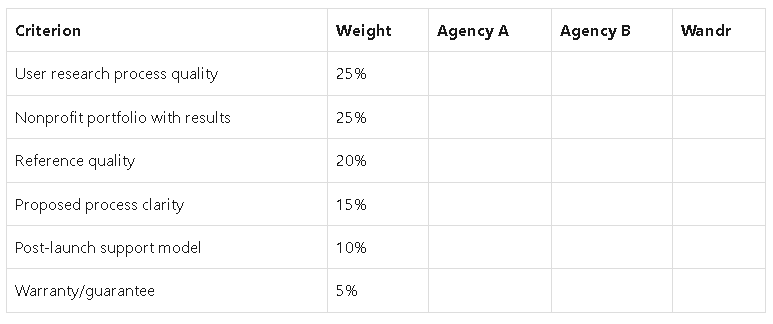
Score each on a 1-5 scale and weight accordingly. The winner should be the agency you'd be most confident presenting to your board as the steward of your digital presence.
Start the evaluation with a diagnostic call from Wandr →
Wandr Studio. Woman-owned. Results-first. See our nonprofit work →
Related WANDR case studies: WWF-Canada · Mercy For Animals ·