

Most nonprofits that set out to build an app do not fail because the code was bad. They fail because they built the wrong thing, hired a vendor who took the brief at face value, and spent the budget before anyone checked whether the app was worth building at all.
Choosing the right partner is the decision that prevents that outcome. This guide covers what good nonprofit app development services actually include, how to evaluate an agency, the questions that separate a real partner from an order-taker, and what the work costs, so you can invest with confidence rather than hope.
What Nonprofit App Development Services Should Include
"App development" sounds like a single deliverable. In practice, the services that actually produce a successful nonprofit app span a much wider arc than writing code, and the gaps between those stages are where most projects quietly go wrong.
A complete engagement starts well before design. It begins with discovery and validation: understanding the problem, the audience, and whether an app is even the right solution rather than a better website or a smarter use of an existing tool. It moves through user research to ground the product in real behavior instead of internal assumptions, then into UX and UI design, prototyping, and usability testing with actual users before development begins. Only then does development happen, followed by testing, launch, and the post-launch support that turns early data into improvements.
The nonprofit app developers worth hiring treat all of that as one continuous responsibility, not a handoff between disconnected vendors. When research, design, and build live in separate silos, the app that ships rarely matches the need that started it.
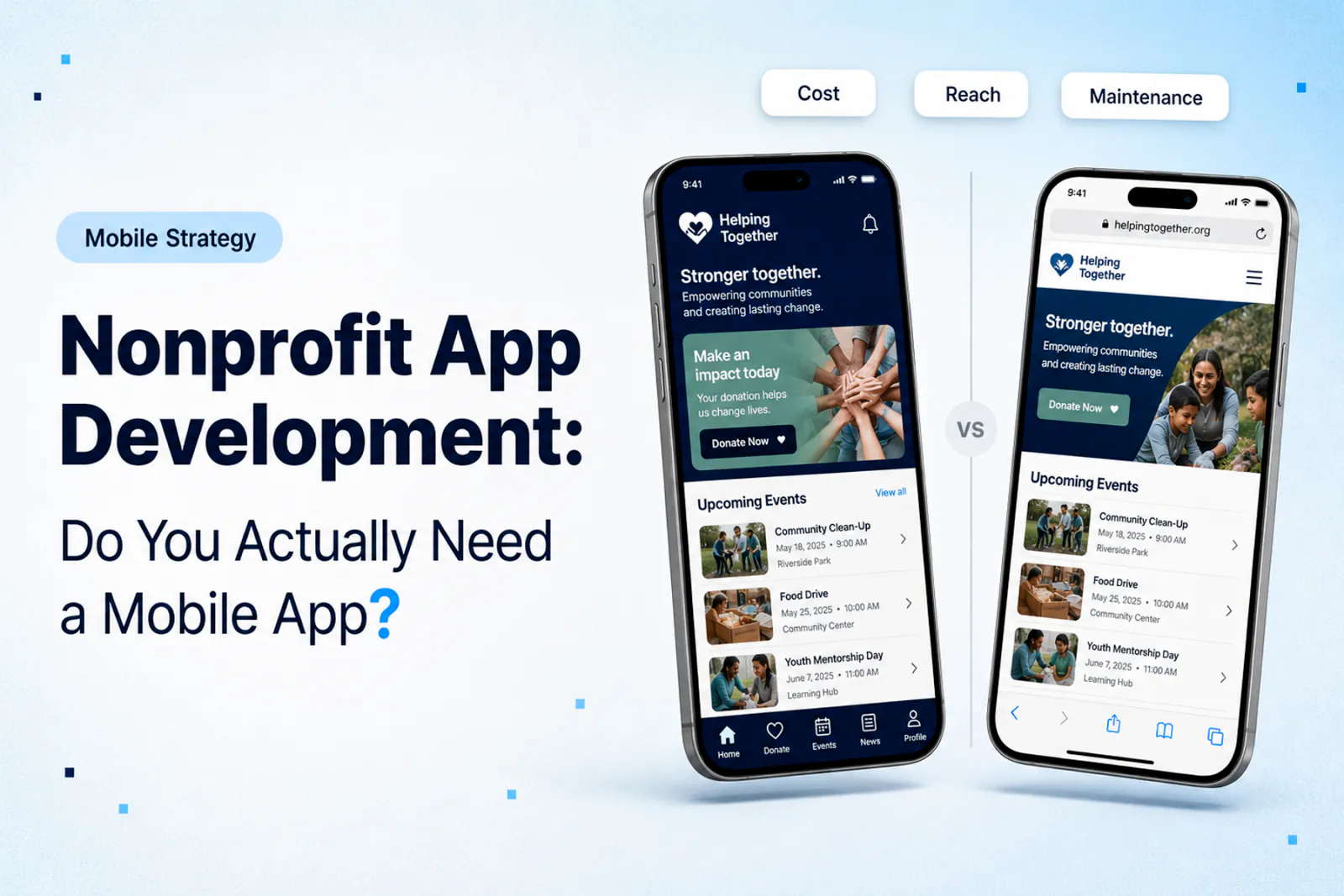
If you are still deciding whether an app is the right move at all, our guide on nonprofit app development and whether you actually need a mobile app is the right place to start before you hire anyone.
How to Evaluate a Nonprofit App Development Agency
Every agency will tell you they build great apps. The way to see past the pitch is to look at how they work, not what they promise.
They validate before they build. The single most important trait of a good nonprofit app development company is a willingness to challenge your idea. Research from CB Insights has repeatedly found that the most common reason products fail is that there was no real market need for what got built. An agency that starts designing screens before it understands your users, or that never asks whether an app is the right solution, is a risk regardless of how polished the work looks.
They can show you shipped work. Ask to see products that actually made it into users' hands and, ideally, in front of investors or funders. Prototypes and validated MVPs tell you more than a portfolio of pretty screens, because they show the agency can take an idea all the way to something real. When WANDR took the Grace Rose Foundation's Checkout app from a founder's concept to a researched, user-tested prototype and an investor pitch in under five weeks, the deliverable was not a design file. It was a product the founder could raise money on.
They design for your team, not just your launch. A beautiful app your small team cannot maintain is a liability. Good app development agencies for nonprofit organizations think about handoff, documentation, and the realistic capacity of the people who will run the product after launch.
They are honest about scope and cost. A partner who quotes a single number for a vaguely defined project is guessing, and you will pay for that guess later. Look for an agency that scopes carefully and explains the trade-offs.
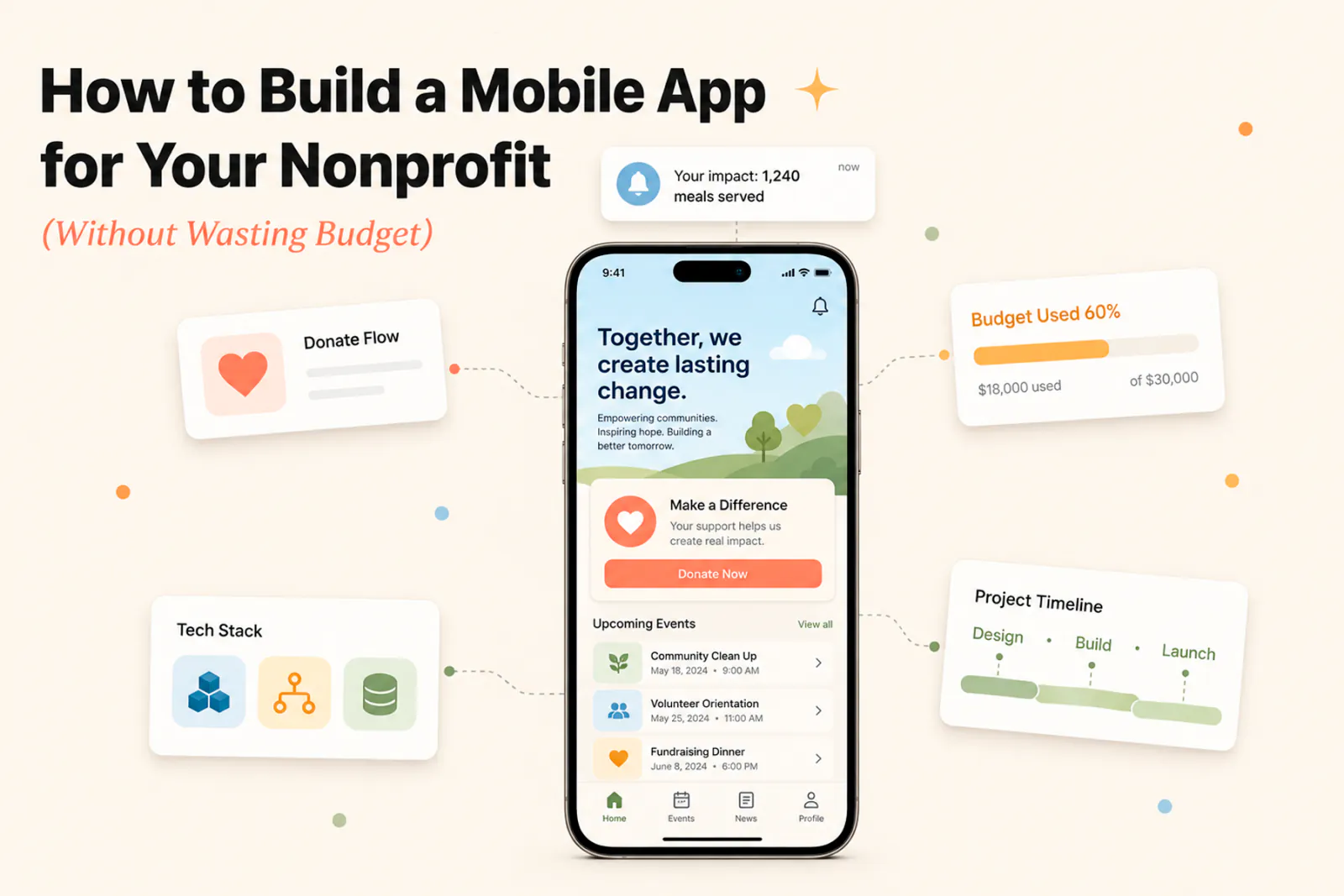
For a deeper look at the mechanics of a healthy build, our walkthrough of how to build a mobile app for your nonprofit without wasting budget breaks the process down phase by phase.
The Questions to Ask Before You Hire Nonprofit App Developers
The right questions surface the difference between a partner and an order-taker quickly. Before you sign with any nonprofit app development agency, ask how they would decide whether you need an app at all. Ask what happens in the first two weeks, and whether that includes research or jumps straight to design. Ask to see a product they took from concept to launch, and what role they played. Ask how they validate that real users want the product before development starts. And ask what you will own at the end, and how your team will maintain it.
An agency that answers those questions with specifics, and occasionally with an honest "you may not need this," is one worth trusting. An agency that treats every question as a green light is one that will happily build you the wrong thing.
Why Validation-First Matters for Custom App Development for Nonprofits
Nonprofits rarely have the budget to build twice. That single constraint is why the validation-first approach matters more for mission-driven organizations than almost anyone else.
The cost of skipping validation is not abstract. Fixing a product direction problem during design is dramatically cheaper than discovering it after development, when the money and the runway are already spent. For a nonprofit, a failed build is not just a financial loss. It is programs that did not get funded and a team that spent months on the wrong thing.
This is exactly why custom app development for nonprofits should start with the hardest questions rather than the fastest wireframes. When WANDR designed DonateHello, a donation platform, the entire engagement was built around validating how donors think and what earns their trust before committing to a full build, so the founders could move forward on evidence rather than assumption. Both that project and the Grace Rose Foundation's app came through our MVP development service, which exists specifically to take an idea to a validated, investor-ready prototype before the expensive part begins.
What Nonprofit App Development Services Cost
App development pricing varies more widely than website work because the scope varies so much. As a rough guide, a simple app with one primary user type and minimal integrations generally starts around $15,000 to $35,000. A mid-complexity app with multiple user types, native device capabilities, and integrations such as a CRM or donation platform typically runs $35,000 to $75,000. A complex platform with sophisticated features and custom backend infrastructure runs $75,000 and up. A focused concept build, research, design, and a validated prototype rather than a full production app, is an earlier-stage and lower-cost investment that many nonprofits use to de-risk the decision before committing to development.
The number that matters most is not the quote. It is the cost of building the wrong thing, which is almost always higher than the cost of validating first. A good nonprofit app development company will help you spend the smaller amount to avoid the larger one.
Final Thoughts: Choosing a Partner, Not Just a Builder
The best nonprofit app development services are not defined by how fast they can build. They are defined by whether they make sure the right thing gets built in the first place. Validation before design. Research before assumptions. A product your team can carry forward, not just launch. And the honesty to tell you when an app is not the answer.
For a nonprofit, that discipline is the difference between an app that advances the mission and an expensive lesson. Choose the partner who protects you from the second outcome.
Ready to Build the Right App for Your Nonprofit?
WANDR is a woman-owned design, development, and strategy studio that has shipped 100+ MVPs and helped mission-driven teams take ideas from concept to validated, fundable products. If you are weighing an app, we can help you figure out whether to build it and how to build it right. Explore WANDR's nonprofit design and development services to start the conversation.
Related WANDR case studies: Grace Rose Foundation · DonateHello · Mercy For Animals