

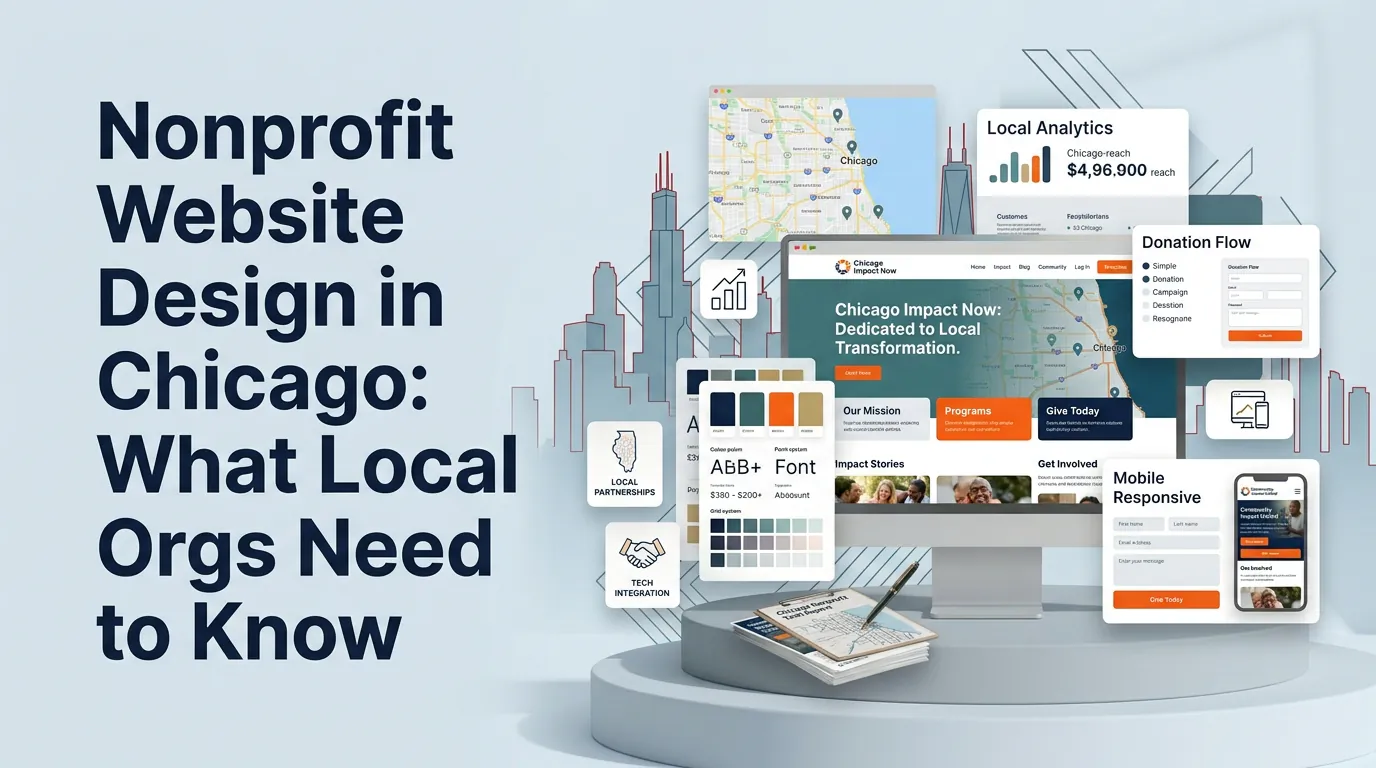
Quick answer: Nonprofit website design in Chicago has to earn trust in a crowded, neighborhood-driven market. The strongest sites state the mission and local impact plainly, serve English and Spanish speakers (and often other languages), make giving and volunteering easy on a phone, meet WCAG 2.1 AA, and show proof that resonates with both community members and regional funders.
The Chicago Nonprofit Digital Landscape
Chicago's nonprofit sector is enormous. According to the Illinois Nonprofit Alliance, there are over 22,000 nonprofits registered in Illinois, with a significant concentration in the Chicago metro area. They range from neighborhood community development corporations to nationally recognized institutions like the Greater Chicago Food Depository and the Metropolitan Planning Council.
What they have in common: a digital presence that, for many, hasn't kept pace with the sophistication of their mission or the expectations of their donors.
Part of this is resource constraints: Chicago nonprofits face the same budget pressures as nonprofits everywhere. Part of it is capacity: without a dedicated digital strategist or web manager, websites accumulate technical debt and content drift. And part of it is simply that "update the website" rarely makes it to the top of a program director's priority list.
The cost of this isn't invisible. It shows up in donation conversion rates. It shows up in volunteer recruitment. It shows up in the credibility signals that major donors and foundations evaluate when deciding where to invest.
What Nonprofit Website Design in Chicago Should Address
Whether you're working with a local agency, a national agency, or building internally, a Chicago nonprofit website needs to address several issues specific to the local context.
For organizations that serve the public, the U.S. Department of Justice publishes guidance on web accessibility and the ADA.
Bilingual and multilingual audiences
Chicago is one of the most linguistically diverse cities in America. Depending on your service population and donor base, Spanish, Polish, Mandarin, Arabic, or other language support may not be optional: it may be essential for reaching the communities you serve.
Bilingual web design isn't just translation. It's designing for two content architectures simultaneously, ensuring that neither the English nor the translated experience feels secondary. WANDR built the WWF Canada site in bilingual English and French: the principle applies directly to Chicago organizations serving multilingual communities.
→ Read the WWF Canada Case Study
Neighborhood-specific and community-based trust signals
For organizations working in specific Chicago neighborhoods: Englewood, Pilsen, Rogers Park, Austin: there's a specific credibility challenge: how do you communicate that you're genuinely embedded in the community, not parachuting in from outside? Website design can support this through authentic photography, community member testimonials, local leadership visibility, and content that reflects the specific geography and culture of the neighborhoods you serve.
Generic stock photography of "volunteers smiling" is particularly damaging for community-based organizations. It signals distance from the communities that matter most.
Donor acquisition beyond the local base
Chicago nonprofits with strong local brands often underinvest in the digital infrastructure for national donor acquisition. If your work is locally focused but your donor potential is national: which is true for many issue-area organizations: your website's SEO, your content strategy, and your conversion flow all need to be built with that broader audience in mind.
Nonprofit Website Design Agencies in Chicago
If you're searching for a Chicago-based agency, here's an honest frame: geographic proximity matters less than expertise in the nonprofit sector and evidence of real outcomes.
An agency that has built twenty nonprofit websites: understanding the conversion design, the donation platform integrations, the SEO considerations specific to nonprofit content: will deliver better results than a local generalist agency that has built great commercial websites but hasn't worked through the specific challenges nonprofits face.
That said, there are legitimate advantages to working with an agency that understands the Chicago nonprofit landscape: familiarity with local foundations and their expectations, understanding of the donor demographics in different parts of the city, and relationships with community stakeholders that can support user research.
What to ask any agency you're evaluating:
- What specific results have your nonprofit clients seen post-launch? (Not "the client was happy." Donation rates. Traffic. Conversion metrics.)
- How do you research and document donor and user types before designing?
- How do you handle content migration and SEO preservation?
- What does your post-launch support look like?
- Do you have experience with the donation platforms our organization uses?
Chicago Nonprofit Website Design Cost
The cost range is consistent with national benchmarks, though local Chicago agencies may have somewhat different pricing structures.
For help applying this to your own site, see how our nonprofit web design agency approaches donor-focused websites.
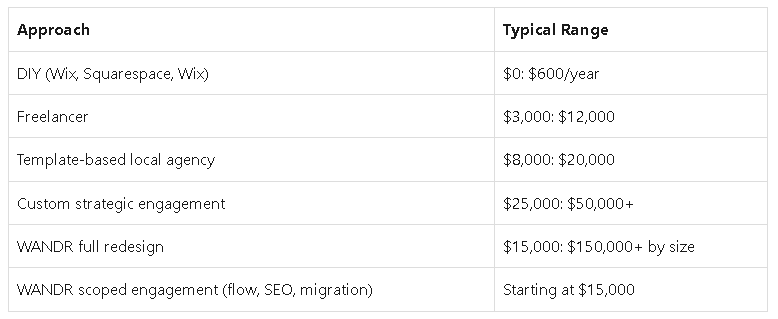
The same principle applies in Chicago as everywhere: the investment in a custom, research-driven engagement pays back quickly when the site actually converts. A nonprofit receiving 8,000 visitors/month to their donation pages with a 0.5% conversion rate is getting 40 donations. A site redesigned to convert at 1.5% from the same traffic gets 120 donations. At an average gift of $75, that's $6,000/month in additional revenue: roughly $72,000/year from the same traffic.
Against a $25,000 redesign investment, the payback period is less than five months.
Chicago-Specific Resources for Nonprofits
A few resources particularly relevant to Chicago nonprofit digital strategy:
Chicago Community Trust: Major local foundation with capacity building grant programs that have funded technology infrastructure. → Chicago Community Trust
Illinois Nonprofit Alliance: Advocacy and resources organization for Illinois nonprofits, with connections to technology support programs. → Illinois Nonprofit Alliance
Forefront: Chicago-based association of funders and nonprofits, with resources on organizational capacity and technology. → Forefront
Catchafire: Available nationally but particularly active in the Chicago nonprofit community for pro bono design and digital support. → Catchafire
The Process for a Chicago Nonprofit Website Redesign
Whether you're working with a local agency or a specialized national one, the process should look roughly the same:
1. Audit. Three to five days documenting what exists, what's working, and where the biggest gaps are. This includes analytics review, SEO assessment, content audit, and conversion flow analysis.
2. User research. Identifying and validating who your donors, volunteers, advocates, and corporate partners actually are: not who leadership assumes they are. This phase often surfaces surprises that reshape the design strategy.
3. Architecture and flow design. Mapping the site structure and user pathways before any visual design begins.
4. Visual design. Building the interface around the strategy.
5. Development. Building with attention to donation integration, mobile performance, accessibility, and SEO infrastructure.
6. Content migration. Carefully moving existing content with proper redirects to preserve search equity.
7. Post-launch. Analytics monitoring, performance optimization, and iteration based on real user behavior.
Nonprofit website design in Chicago, step by step
Whether you are a neighborhood organization or a regional institution, the redesign process works best in this order.
Step 1: Define your audiences by neighborhood and role
Chicago organizations often serve specific communities, so list them: residents of the neighborhoods you serve, donors across the metro area, foundations, corporate partners, volunteers and policymakers. Note the language each group prefers and the device they are most likely to use. Many community members will reach you on a phone, sometimes with limited data.
Step 2: Plan language access early
Decide which pages need full translation (services, how to get help, events) and which can stay in English. Machine translation widgets are a stopgap, not a strategy. Plan human-reviewed translations for critical content and a clear language switcher on every page.
Step 3: Show local proof
Funders and residents both want to see real impact in real places. Use neighborhood-level outcomes, photos of your actual programs (with consent) and partner logos from local institutions where you have permission. Generic stock photos weaken trust quickly in a city where people know their neighborhoods.
Step 4: Design the giving and volunteering paths
Keep donation forms short, offer monthly giving, show what a gift does and confirm clearly. For volunteers, list current opportunities with dates, locations and a simple sign-up. Test both flows on a phone from start to finish.
Step 5: Build accessibility into the templates
Design to WCAG 2.1 AA from the start: readable contrast, keyboard access, labeled form fields and captions on video. Accessibility matters for the communities you serve and is increasingly expected by funders and public partners.
Step 6: Plan for local search
Create a page for each location or program area with the address, hours and services, keep your Google Business Profile consistent with the site and use neighborhood names naturally in content. Local search is often how residents find help.
Step 7: Launch with an owner and a rhythm
Assign a content owner for each section, set a monthly review for events and programs and track donations, volunteer sign-ups and help requests after launch.
Practical examples for Chicago organizations
Community development organization: a homepage that leads with "Get help" and "Get involved" in English and Spanish, program pages with eligibility and contact details, and a donation page that shows neighborhood impact.
Arts or cultural nonprofit: an events calendar that works on mobile, easy ticketing or RSVP, membership options and a strong visual identity that reflects the community it represents.
Regional advocacy group: issue pages with plain-language summaries, a clear action for each issue and a resource library that funders and policymakers can browse quickly.
Common mistakes to avoid
- Relying only on an automatic translation widget for critical service information.
- Using stock photos that do not reflect the communities you serve.
- Hiding the donate and volunteer buttons below long mission statements.
- Forgetting location pages and local search basics.
- Launching without anyone responsible for keeping events and programs current.
What to include on a Chicago nonprofit homepage
- A one-sentence mission that says who you serve and where, in plain language.
- Two or three primary actions, such as Get help, Donate and Volunteer, visible without scrolling on a phone.
- Local impact proof: a few clear outcomes from the neighborhoods you serve, with a link to your annual report.
- A language switcher at the top of every page for the languages your community uses.
- Upcoming events with dates, locations and an easy RSVP.
- Partner and funder recognition where you have permission to show it.
- Contact details and hours for each location, consistent with your Google Business Profile.
Questions to ask a Chicago nonprofit web design partner
- Have you designed multilingual sites, and how do you handle translation workflow?
- How do you test accessibility, and with which assistive technologies?
- Which donation platforms and CRMs have you integrated?
- How will you protect our existing search traffic during the redesign?
- What training will our staff receive so we can update the site without a developer?
- How will we measure success after launch?
A partner who answers these clearly, with examples, is far more likely to deliver a site that serves your community and your funders for years.
How to measure success after launch
Pick a few numbers that reflect your mission, not just traffic. Track donation conversion rate and average gift, monthly donor sign-ups, volunteer registrations, help requests or program inquiries by language, event RSVPs and the share of visitors on mobile who complete each of these actions. Review them monthly for the first six months. If Spanish-language visitors convert at a much lower rate than English-language visitors, for example, that points to a translation or content gap worth fixing. Pair the numbers with a short quarterly check-in with frontline staff, who often hear about website problems from community members before analytics shows them.
Timeline for a typical Chicago nonprofit redesign
A focused redesign for a small or mid-size organization often takes two to four months: a few weeks of discovery and content planning, several weeks of design and testing, then development, translation, accessibility checks and launch. Multilingual content, complex integrations and many stakeholders add time, so plan translation and approvals into the schedule from the start rather than leaving them for the final weeks.
Building review time for community partners into the plan is worth it. A site that the people you serve have helped shape will earn more trust, and more use, than one designed only around internal priorities.
WANDR's Commitment to Nonprofit Clients
WANDR is based in Los Angeles, but our nonprofit practice serves organizations across North America. Our client relationships with WWF Canada, Mercy For Animals, and DonateHello represent exactly the kind of national and international organizations we specialize in: complex, multi-user-type, high-stakes digital environments where getting the conversion design right directly impacts mission.
For Chicago nonprofits, the work is the same: understanding who your users are, building flows that serve each of them specifically, and measuring the outcomes from day one.
Our commitment: within year one of launch, you'll see a meaningful increase in the KPIs that matter most to your mission: or we come back and work until you do.
→ Book a Free Nonprofit Website Diagnostic
WANDR Studio is a woman-owned design, development, and strategy agency with 15+ nonprofit engagements, including a 32% lift in donations in year one for Mercy For Animals and a 37% increase in site purchases for WWF-Canada.
→ Related reading: Nonprofit Website Design: The Complete Guide | How Much Does a Nonprofit Website Cost? | Nonprofit Website Redesign: When, Why, and How
Related WANDR case studies: WWF-Canada · Mercy For Animals · Swipe Out Hunger
Planning a nonprofit website project? Explore WANDR's nonprofit web design services →