


How Much Does a B2B Website Cost in 2026?
TL;DR: How Much a B2B Website Really Costs
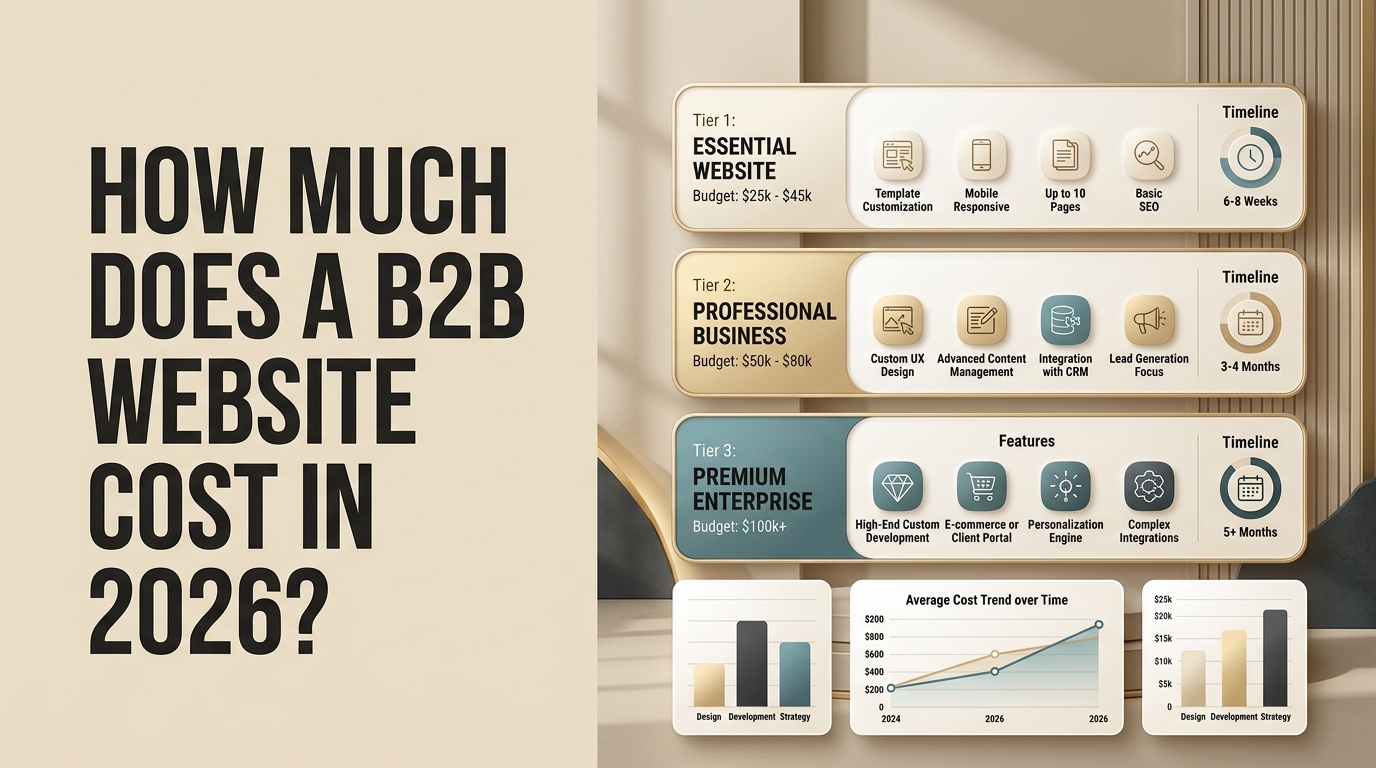
B2B website costs in 2026 range from roughly $5,000 for a template-based freelancer build to $250,000 or more for an enterprise-scale redesign, with most growth-stage projects landing between $25,000 and $100,000. The price gap is not about quality alone. It reflects genuinely different scopes: a cheap site gives you a template with your logo on it, while a strategic investment gives you research, information architecture, a design system, conversion optimization, and proper analytics.
The more useful question is not "how much does a B2B website cost?" but "what is our current website costing us in missed pipeline?" When you frame the decision around conversion improvement, deal value, and payback period, a well-scoped redesign usually pays for itself in under a year. Below we break down every price tier, the variables that move cost, and how to frame the investment for executive approval.
The honest answer to "how much does a B2B website cost?" is: it depends. But that answer isn't useful, so let's get specific.
B2B website costs in 2026 range from around $5,000 to $250,000+, depending on scope, complexity, the caliber of the agency or team, and how much strategic work is included versus just design and build. Most legitimate B2B website projects for growth-stage companies fall somewhere between $25,000 and $100,000.
We're going to break down what you actually get at different price points, what the variables are that drive cost up or down, and the question we think matters more than "what does it cost?", which is "what is this investment worth?"
Why Cost Ranges Are So Wide
The B2B website market has enormous price variance because the deliverables are genuinely different at different price points, not just in quality, but in what's included.
A $10,000 website and an $80,000 website aren't the same deliverable at different quality levels. They're different scopes entirely. The $10,000 project produces a functional website on a template. The $80,000 project produces a strategic foundation, a custom design system, a conversion-optimized page architecture, proper analytics setup, and a platform your team can own and maintain.
Understanding what you're buying, not just what it costs, is what makes comparison meaningful. This is closely related to understanding B2B website development costs specifically, which is where much of the variance in agency proposals actually originates.
B2B Website Cost Tiers in 2026
$5,000 - $15,000: Template-based or freelancer builds
At this price point, you're working with a freelancer or a small team using a pre-built template (typically Webflow, WordPress, or Squarespace) with custom content applied. The design is constrained by the template. SEO setup is basic. Strategy, if it exists, is minimal.
This tier is appropriate for early-stage companies that need a credible web presence before they have the budget for a full custom build. It's not appropriate for companies competing in established categories where design quality affects deal conversion rates.
What you get: A functional, reasonably polished website. Template layout with your branding applied. Basic on-page SEO. Usually 5-10 pages.
What you don't get: Custom information architecture, B2B website conversion optimization, a strategic foundation, or anything that differentiates you visually from competitors using the same templates.
$15,000 - $40,000: Custom design, modest scope
This tier gets you a custom-designed website, built from scratch rather than from a template, with a real design process, page-level strategy, and proper development. Typical scope is 10-20 pages with custom components.
This is where most growing B2B companies make their first real investment. The result is a site that looks professionally differentiated and has been designed with some level of conversion intent.
What you get: Custom visual design. A design system with reusable components. Responsive development. Basic analytics and conversion tracking setup. CMS so your team can update content.
What you don't get: Deep user research, extensive conversion optimization, content strategy, or enterprise-scale information architecture.
$40,000 - $100,000: Strategic design and development
This is where serious B2B website projects live for growth-stage and mid-market companies. You're paying for a full design and strategy process: user research, information architecture, conversion optimization, custom design, and quality development.
This tier typically includes pre-launch work like user interviews, competitive analysis, and conversion architecture planning, not just design execution. The result is a site built around a clear strategic foundation, not just visual preferences. This is the scope range where our B2B website strategy framework is fully applied.
What you get: User research and ICP definition. Information architecture planning. Custom design with a full design system. Conversion-optimized page structure. Quality development. Analytics and conversion tracking setup. Post-launch optimization.
$100,000 - $250,000+: Enterprise-scale redesigns
Enterprise website projects at this scale involve large site architectures (50-200+ pages), multiple stakeholder inputs, extensive content strategy, and often multi-phase delivery. The complexity isn't just in the design, it's in coordinating across internal teams, managing content migration, and ensuring SEO continuity through a major redesign.
Gartner's research on enterprise digital investment shows that companies treating digital infrastructure as a strategic asset see significantly better business outcomes than those treating it as a commodity.
What Actually Drives B2B Website Cost
Scope of pages
The most straightforward cost driver. More pages mean more design, more development, and more content strategy. An 8-page site costs significantly less than a 50-page site.
For most B2B companies, the pages that matter most are: homepage, services/product pages (one per core offering), case studies (3-5), about/team, blog architecture, and contact. Everything else is secondary.
Strategic depth
The biggest variable that's invisible in proposals: how much strategic work is included before design starts?
A project that starts with user research, ICP mapping, competitive analysis, and conversion architecture planning will produce a better-performing website than one that jumps straight to design. It will also cost more, because that work takes time.
At Wandr Studio, we don't skip this step. A B2B website redesign that starts without strategy is redesigning for aesthetics, not for performance.
Platform and development complexity
A Webflow site with standard CMS is significantly less expensive to develop than a custom React build with complex integrations. The right platform choice is about what the client's team can maintain and what the technical requirements are, not about what's most impressive to build.
We're platform-agnostic at Wandr Studio. We recommend the platform that makes the most sense for the client. Our Webflow for B2B guide explains why we recommend Webflow for most B2B marketing sites.
Content and copywriting
Who writes the copy? If the agency writes it, that's additional cost. If the client provides it, the project moves faster and the budget goes further. Most mid-market B2B websites should plan for professional copywriting, the cost is usually 15-25% of total project budget and the impact on conversion rates justifies it.
Integrations and analytics
Each integration adds development scope. Proper analytics configuration, GA4 conversion events, Search Console setup, tag manager, is often not explicitly included in proposals and causes problems after launch. Always ask whether analytics setup is included.
The Question That Matters More Than Cost
"How much does it cost?" is the wrong first question. The right first question is: "What is the current website costing us?"
Here's how to think about this:
Your B2B website generates a certain number of qualified leads per month. Each of those leads has a conversion rate through your sales process and an average contract value. The website's current performance translates directly to pipeline and revenue.
A 28% improvement in book-a-demo conversions, which is what MedTrainer achieved after working with us on a full site redesign, isn't a design metric. It's a revenue metric. If MedTrainer's average contract value is $30,000 and they were booking 10 demos per month, a 28% improvement means roughly 3 additional demos per month, and at a typical B2B SaaS close rate, that's real incremental revenue that compounds month over month. We saw the same pattern in our work with Zoe Financial, where a strategy-led redesign turned a credibility problem into measurable pipeline.
At that math, a $75,000 website redesign investment pays back in less than a year. And the improvement is permanent.
Understanding our B2B website benchmarks for conversion rates helps you estimate what a realistic improvement might be worth for your specific situation.
What a B2B Website Investment Includes Beyond Design
When you invest in a B2B website with a strategic agency, you should expect the deliverables to go beyond visual design:
Discovery and strategy: User research, ICP definition, competitive analysis, conversion goal mapping. This phase usually takes 2-4 weeks and produces a strategic brief that guides everything else.
Information architecture: A map of the site's pages, their hierarchy, and their interconnections. This is the blueprint that prevents expensive structural changes during design.
Design system: Reusable components, typography, color system, button styles, card layouts, navigation patterns, that allow the site to be maintained and extended consistently over time.
Conversion-optimized page design: Each page designed with a specific user intent and desired action in mind. Not just visual polish, conversion architecture.
Development: Clean, maintainable code or CMS build on the chosen platform.
Analytics setup: GA4 conversion events, Search Console configuration, and a tracking plan that connects website behavior to business outcomes.
Post-launch review: An honest look at what's working and what to optimize, typically 30-60 days after launch.
Questions to Ask Before Signing a B2B Website Contract
Is strategy included, or just design? An agency that starts with design without a strategic foundation is selling you execution.
What platform do you recommend, and why? An agency that recommends the same platform for every client regardless of requirements is optimizing for their workflow, not yours.
How do you measure success? If the answer is "beautiful design" or "client satisfaction," that's a warning sign. A strategic B2B web agency should be measuring conversion rate improvement, qualified lead volume, and organic traffic growth.
Do you write copy? Copywriting and design are equally important for conversion. Many design agencies outsource copy or leave it to the client entirely. Know what you're getting.
What does post-launch support look like? A website is not a one-time project.
The ROI Conversation: Framing Website Investment for Executives
One of the most important things a B2B website cost conversation has to address is how to frame the investment for internal approval. "We need a better website" rarely gets budget. "Our current website is costing us X in missed pipeline per month" does.
Here is the framework: take your current qualified lead volume from website, estimate a realistic 25-30% conversion improvement, multiply by average deal value and close rate, and compare that annual revenue impact to the one-time design investment.
If your website generates 10 qualified leads per month at a $40,000 ACV and 25% close rate, you are generating $1,200,000 in annual pipeline from the website. A 25% improvement in conversion rate adds $300,000 in pipeline for the year. A $75,000 redesign investment has a four-month payback, and the improvement persists indefinitely.
As a B2B web design agency that scopes projects around ROI rather than page count, we can help you figure out exactly where your investment should go.
Book a free discovery call and we'll give you an honest sense of what scope and investment makes sense for your situation.
The Hidden Costs Most Proposals Don't Mention
When comparing B2B website proposals, the line items that are frequently missing, and that cause problems after launch, are worth asking about explicitly.
Analytics configuration. Setting up GA4 conversion events, verifying Google Search Console, and configuring tag manager takes real development time and is often assumed to be "the client's responsibility." Without it, you launch a new site with no ability to measure whether it's performing better than the old one.
Redirect implementation. For a redesign, every URL that changes needs a 301 redirect. A missed redirect on a high-authority page can cause organic traffic drops that take months to recover. This is careful, methodical work that should be an explicit line item.
Copywriting. Many design-focused agencies leave copy to the client or outsource it. Professional copywriting typically runs 15-25% of project budget and has a direct impact on conversion rates. Know whether it's included.
Post-launch support. No site launches bug-free. A defined support period (usually 30-60 days) for addressing issues that emerge from real user behavior should be part of the scope.
ROI Framing: What the Investment Actually Returns
The most useful way to think about B2B website cost is as an investment with a measurable return, not an expense.
Take your current qualified lead volume from the website. Estimate a realistic conversion improvement from a strategic redesign, 20-30% is typical for a well-executed project. Multiply by your average deal value and close rate. That's the annual pipeline impact.
For a company generating 10 qualified leads per month at a $40,000 average deal value and 25% close rate, the website is generating roughly $1.2M in annual pipeline. A 25% improvement adds $300,000 in annual pipeline. Against a $75,000 redesign investment, that's a payback period under four months, and the improvement compounds every month afterward.
This framing, covered in more depth in our B2B website strategy guide, is how website investment gets executive approval. The question isn't "can we afford a better website?" It's "what is the current site's underperformance costing us per month?" Gartner's research on digital investment consistently shows companies treating digital infrastructure strategically outperform those treating it as a commodity cost.
The Measurement Layer: Proving What Works
Building or improving a B2B website is only half the work. The other half is knowing whether the changes are working, and that requires a measurement infrastructure most B2B companies haven't fully set up.
The measurement hierarchy runs from least to most useful:
Traffic metrics (sessions, pageviews) tell you whether your site is being seen. They're the easiest to measure and the least connected to revenue.
Engagement metrics (time on page, scroll depth, pages per session) tell you whether visitors are interacting with content. Directionally useful, still not tied to business outcomes.
Conversion metrics (form completions, demo requests, trial signups) tell you whether your website is producing qualified leads. This is where measurement starts to matter commercially.
Pipeline metrics (opportunities sourced from website, revenue attributed to website) tell you what the website is actually worth to the business.
Most B2B companies measure the top two layers with precision and have almost no visibility into the bottom two. The investment should be flipped. As Steve Harrison, a product lead at Wandr, puts it, the job is "choosing the right KPIs, having your strategy aligned, and then what you do with that information afterwards." Our B2B website KPIs guide covers the full setup, configuring GA4 conversion events, connecting Search Console, and building CRM attribution so you can answer the question that matters: how much pipeline is your website actually generating?
HubSpot's research on marketing measurement consistently shows that companies with proper conversion tracking make better investment decisions than those flying blind on vanity metrics.
Why Strategy Has to Come Before Design
The most common reason B2B website projects disappoint isn't a failure of design craft, it's a failure to answer the strategic questions before design begins.
Who is this website for? What is the single most important action it should drive? What does the buyer need to see, in what order, before they take that action? What objections stall deals at the consideration stage, and how does the site address them?
When those questions have clear answers, design work moves quickly and produces something that performs. When they're vague, even beautiful design ends up on a site that doesn't convert.
This is why every serious B2B website strategy starts with discovery, stakeholder interviews, analytics review, ICP mapping, competitive analysis, before a single design decision is made. The strategy is the foundation. The design executes it. Reversing that order is the single most expensive mistake in B2B web design, and it's the reason so many redesigns produce sites that look better but perform about the same.
The output of a proper discovery process is a strategic brief that guides every subsequent decision. It also creates internal alignment, resolving competing stakeholder priorities before they become expensive design debates. When the strategy is documented and approved, feedback cycles are shorter, the design work is faster, and the outcome is measurably better.
The Mobile and Performance Reality
Whatever your B2B website's specific goals, two technical factors affect them across the board: mobile experience quality and page performance.
Google's mobile-first indexing means Google evaluates the mobile version of your site to determine rankings. If your mobile experience is inferior to your desktop experience, your search visibility is limited by your mobile quality, regardless of how good the desktop site looks.
And Core Web Vitals, Google's measures of loading performance (LCP under 2.5 seconds), interactivity (INP under 200ms), and visual stability (CLS below 0.1), are direct ranking factors. A site that fails these on mobile competes at a disadvantage in organic search.
The most impactful performance improvement for most B2B sites is image optimization: compressing images and converting to WebP format typically resolves the majority of load time issues. Run your site through Google PageSpeed Insights to see your specific issues and their impact. Our responsive B2B website design guide covers the full mobile and performance playbook.
Beyond SEO, mobile and performance directly affect conversion. B2B buyers research on mobile throughout their consideration cycle, during commutes, between meetings, in the evenings. A slow or broken mobile experience leaks pipeline at every stage of the journey. Complete your primary conversion flow on your own phone: whatever friction you encounter, your mobile prospects encounter too.
Final Thoughts on What a B2B Website Costs
The real answer to what a B2B website costs is that the number only means something once you know what sits behind it. A price tag with no strategy attached is a gamble, while the same budget scoped around research, conversion architecture, and measurement is one of the highest-return investments a growth-stage company can make. Anchor the decision to pipeline rather than page count, ask the hard questions before you sign, and insist that measurement is built in from day one. Do that, and the cost conversation stops being about expense and starts being about return.
Work With a B2B Web Design Agency That Scopes Around ROI
If you want an honest read on what your project should actually cost, partner with a B2B web design agency that starts with strategy, not a template. See how a strategy-led redesign played out in our Zoe Financial case study, then dig into the numbers behind conversion in our B2B website benchmarks and B2B website KPIs guides. When you're ready to talk scope and budget for your own site, Book a free discovery call and we'll give you a candid recommendation.
