


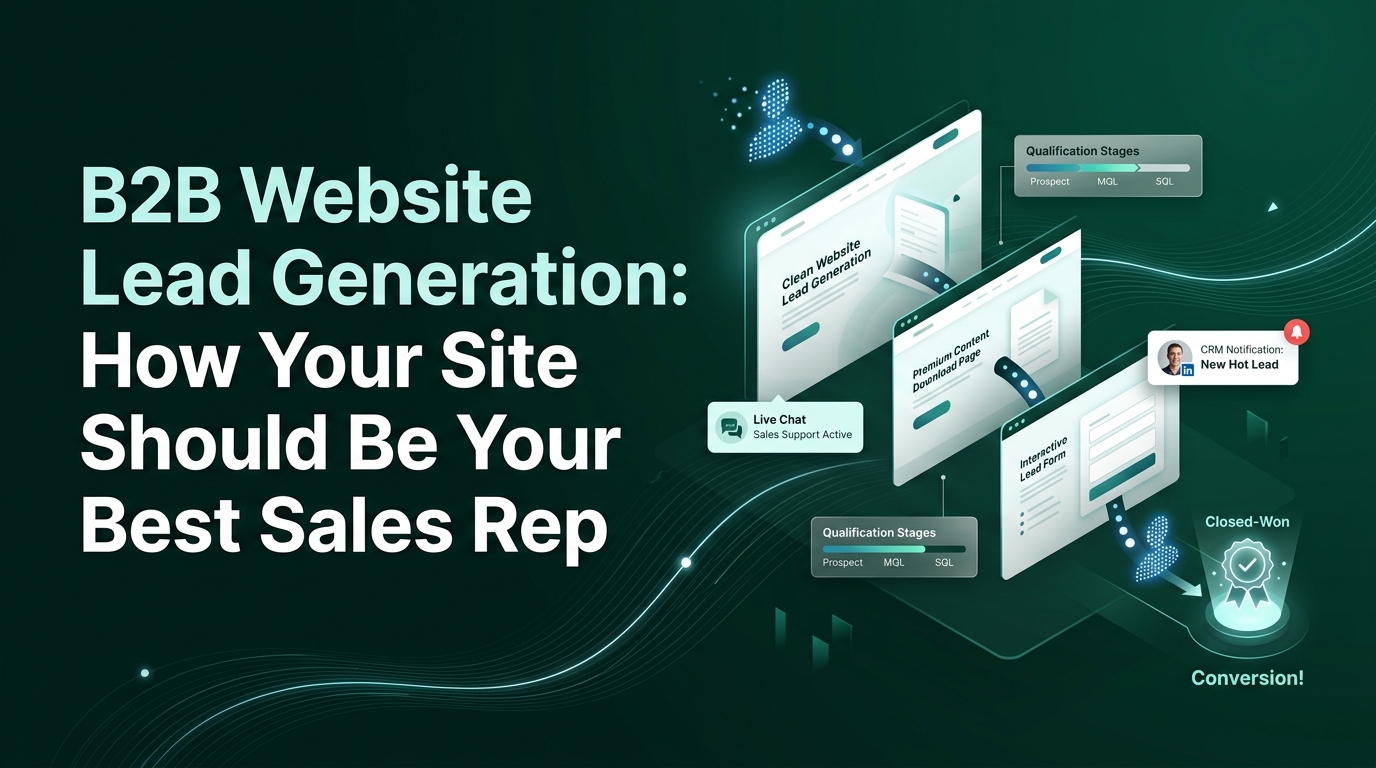
B2B Website Lead Generation: How Your Site Should Be Your Best Sales Rep
TL;DR: What Effective B2B Website Lead Generation Requires
B2B website lead generation works when your site is engineered to qualify, route, and convert the right buyer, not when it functions as a digital brochure that simply describes the company and waits. The difference between a passive site and an active lead engine is strategy and architecture, not budget.
The essentials: choose one primary conversion event based on your unit economics, build a homepage that qualifies and routes, write service pages around buyer outcomes, connect your blog to a commercial pathway, strip friction from every conversion surface, and measure leads and pipeline rather than pageviews. Do those things and your website starts closing like your best sales rep.
Your best sales rep doesn't take vacations. They don't have an off day. They're available at 2am when a VP of Marketing at a target account is doing competitive research from their couch. They work your entire target market simultaneously.
That's what a well-designed B2B website is supposed to be. For most B2B companies, it's not.
The typical B2B website is a digital brochure: it describes what the company does, shows some social proof, and offers a "contact us" option for visitors brave enough to initiate. It waits. It doesn't sell.
The difference between a passive B2B website and an active lead generation engine is strategy and architecture, not budget. We've built both, and we can tell you exactly what separates them.
Start With the Right Conversion Goal
Lead generation from a B2B website almost always comes down to one primary conversion event. For most companies, that's either:
Book a discovery call / book a demo. The website generates a qualified meeting request. Sales closes from there.
Sign up for a free trial. The product experience drives eventual conversion to paid. The website gets the right person into the trial.
The mistake most B2B companies make is treating these as interchangeable or trying to optimize for both simultaneously on the same homepage. They're not the same. The buyer psychology, the information needs, the page architecture, and the CTA design are different for each.
Know which one is primary. Design for that one. Create a secondary path for the other.
And here's the nuance that changes everything: the conversion event that generates the most volume isn't necessarily the one most worth optimizing. If your 300 monthly free sign-ups have an average LTV of $400 and your 8 monthly demo requests convert into enterprise deals with an average ACV of $40,000, you are dramatically better served optimizing for demo requests, even at much lower volume.
Know your economics before you design your conversion architecture. This is foundational to any real B2B website strategy.
The B2B Lead Generation Architecture
A B2B website that generates consistent qualified leads has five components working together:
1. A homepage designed to qualify and route
The homepage is not a general introduction to your company. It's a qualification and routing engine.
Its job is to answer three questions for every visitor within the first ten seconds:
- Is this for me and my situation?
- Does this company know what it's doing?
- What should I do next?
The "is this for me?" question requires specific positioning, naming the customer type, the industry, or the problem with enough precision that the right visitor immediately recognizes themselves and the wrong visitor self-selects out. Both outcomes are good.
The "does this company know what it's doing?" question is answered by social proof, visual quality, and the confidence of the copy. Enterprise logos, specific outcome metrics, and design that looks considered rather than templated all contribute to credibility.
The "what should I do next?" question requires a clear primary CTA, visible above the fold, with a secondary path for visitors who aren't ready for the primary step.
2. Service and product pages built around buyer problems
Your service pages are where high-intent visitors go to make their final decision. These pages need to earn the conversion.
The most common failure: service pages that describe what the service is rather than what the buyer gets. "We provide end-to-end digital marketing services" describes an offering. "We help B2B SaaS companies generate 30% more qualified pipeline from organic search" describes an outcome. The second version is a lead generation page. The first is a brochure.
Every service page should include:
- The specific problem it solves, in language the buyer uses
- The outcome the buyer can expect
- The process, briefly described
- Social proof specific to this service/outcome
- A clear CTA toward the primary conversion event
3. A blog connected to your commercial relationship
The B2B blog is the highest-leverage organic lead generation tool available, when it's built for conversion. When it's not, it's an expensive traffic acquisition program with no revenue impact.
A post that generates 2,000 monthly visitors and has no CTA, no internal link to a service page, and no pathway toward conversion is acquisition spend with zero return. A post that generates 500 monthly visitors, has a contextual internal link to a relevant service page, and ends with a specific CTA generates leads every month.
Volume matters less than architecture. A smaller blog with proper conversion architecture outperforms a large blog with none. This is the central principle of B2B website content strategy.
The content strategy for B2B lead generation maps to the buyer journey:
Awareness-stage content: Posts that answer questions buyers ask at the beginning of their problem awareness. These build organic traffic from buyers who don't yet know you exist.
Consideration-stage content: Posts that help buyers evaluate options. These reach buyers who are actively looking.
Decision-stage content: Case studies, ROI frameworks, implementation guides. These address the specific questions that come up right before a purchase decision.
Each stage needs internal links to the next stage and to the primary service page.
4. Conversion surfaces that reduce friction, not add it
Every place on your website where a visitor could take the primary conversion step is a conversion surface. These include: the header CTA, the homepage hero CTA, the bottom-of-page CTA, the in-post CTA, and the contact/booking page itself.
The most common mistake at each conversion surface is adding friction: too many form fields, too many decisions to make, copy that sounds like a legal contract rather than a human invitation.
Baymard Institute's research is clear: every additional required field reduces completion rate. Ask for the minimum: name, company, email, and what they want to talk about.
If you're using Calendly or a similar booking tool, put it directly on your contact page rather than hiding it behind a form. Let people book the time they want without having to wait for a response. The friction reduction alone increases conversion.
5. A measurement system connected to pipeline, not just traffic
If you're measuring your website's lead generation performance by pageviews, you're measuring the wrong thing.
The metrics that matter for B2B lead generation are:
- Qualified leads from website per month: How many of your inbound leads have first-touch attribution to the website?
- Conversion rate by source: Is organic search converting to leads at a different rate than paid or direct?
- Which pages generate leads: Not which pages get the most traffic, which pages are generating the most lead-generating actions.
- Pipeline from content: How much of your sales pipeline traces back to blog content that the buyer read before becoming a lead?
To measure this properly, you need GA4 conversion events configured, UTM parameters on all campaigns, and ideally a CRM integration that captures first-touch source data.
But start with Google Search Console. It tells you which queries and pages are generating organic visibility. If you're not visible in search for the queries your buyers use, no conversion architecture will help.
The Highest-Leverage Lead Generation Improvements
If your B2B website isn't generating consistent qualified leads, here are the improvements with the highest leverage-to-effort ratio:
Add a specific, low-friction CTA to every service page. If your service pages have no conversion path, or have "contact us" as the only option, you're losing high-intent visitors daily. Add a specific CTA tied to the service: "Book a free B2B website audit" or "See how we helped [similar company] book 40% more demos."
Add a contextual CTA to your highest-traffic blog posts. Find your top 5 organic traffic posts in Google Search Console. Add a contextual paragraph at the end that connects the post topic to a relevant next step. This is the highest ROI improvement most B2B websites can make in a day.
Simplify your booking/contact flow. Remove form fields. Add a direct calendar booking option. Rewrite the page copy in plain, specific language. Test it on mobile. You will see immediate improvement in conversion rate.
Fix your highest-impression, lowest-CTR pages in Search Console. Rewriting title tags to better match search intent is a quick win that increases organic traffic without changing anything about the site itself.
Case Study: How Lead Generation Architecture Changed MedTrainer's Pipeline
MedTrainer, a healthcare compliance SaaS, had a website that was getting traffic but not converting at the rate their pipeline required.
The analysis revealed several structural issues: the homepage hero was generic, the services pages described features rather than outcomes, and the demo request form had seven required fields including budget range, information that was neither necessary nor trust-building at that stage of the relationship.
We rebuilt the conversion architecture: a specific ICP-focused hero, services pages organized around the compliance problems healthcare organizations actually face, a simplified three-field demo request form, and a Calendly integration on the contact page that let prospects book directly.
The result was a 28% increase in book-a-demo conversions post-launch. This is what B2B website conversion optimization actually looks like in practice, not button color tests, but structural changes to the conversion architecture.
The reason those structural changes matter so much comes back to the buyer's experience after they arrive. As Paula Lopez, Wandr's Head of Product, puts it, "you cannot fix customer retention without fixing the service first," and a service, she notes, is "never finished." A website is the front door to that service, and every point of friction you remove keeps more of the right buyers moving forward instead of quietly leaving.
The Analytics Layer: Knowing What's Generating Leads
You can't improve B2B lead generation without knowing which parts of your website are generating leads and which aren't.
The measurement infrastructure for B2B lead generation has three layers:
Layer 1: Search Console. Which queries bring qualified visitors to your site? Which pages are getting high impressions but low clicks?
Layer 2: GA4 conversion events. Configure a conversion event for your primary lead generation action. Then segment conversion rate by traffic source, landing page, and device type.
Layer 3: CRM attribution. Tag every inbound lead with its first-touch source. After 90 days, look at which sources are generating not just leads but revenue. This is the data that connects website investment to business outcomes.
Our B2B website KPIs guide explains the full measurement architecture.
This is precisely the kind of lead generation architecture our B2B web design agency builds for growth-stage B2B companies.
Book a free discovery call to talk through your website's lead generation performance and what a concrete improvement would look like for your business.
The Measurement Infrastructure for Lead Generation
You can't improve lead generation you can't measure. The infrastructure has three layers, each answering a different question.
Search Console answers: are qualified buyers finding us in search? Google Search Console shows which queries bring visitors and which pages get impressions without clicks, a title tag problem that's usually a quick fix.
GA4 conversion events answer: which pages and sources generate leads? Configure a conversion event for your primary action, then segment by source, landing page, and device. This shows where leads come from and where the conversion gaps are.
CRM attribution answers: which leads become revenue? Tag every inbound lead with first-touch source. After 90 days, you can see which sources generate not just leads but opportunities and closed deals. This is the layer that connects website investment to business outcomes, covered fully in our B2B website KPIs guide.
Intent Data: Turning Anonymous Traffic Into Pipeline
Most B2B website visitors leave without identifying themselves. Visitor tracking tools like Clearbit and Dealfront use IP matching to identify which companies are visiting, even without a form fill.
A target-account company visiting your pricing page three times this week is a signal worth acting on. This data enables intent-based outreach (warmer than cold outreach), account-based ad targeting, and content prioritization based on which industries are actually engaging. We cover the full approach in our B2B website visitor tracking guide.
Why Strategy Has to Come Before Design
The most common reason B2B website projects disappoint isn't a failure of design craft, it's a failure to answer the strategic questions before design begins.
Who is this website for? What is the single most important action it should drive? What does the buyer need to see, in what order, before they take that action? What objections stall deals at the consideration stage, and how does the site address them?
When those questions have clear answers, design work moves quickly and produces something that performs. When they're vague, even beautiful design ends up on a site that doesn't convert.
This is why every serious B2B website strategy starts with discovery, stakeholder interviews, analytics review, ICP mapping, competitive analysis, before a single design decision is made. The strategy is the foundation. The design executes it. Reversing that order is the single most expensive mistake in B2B web design, and it's the reason so many redesigns produce sites that look better but perform about the same.
The output of a proper discovery process is a strategic brief that guides every subsequent decision. It also creates internal alignment, resolving competing stakeholder priorities before they become expensive design debates. When the strategy is documented and approved, feedback cycles are shorter, the design work is faster, and the outcome is measurably better.
The Mobile and Performance Reality
Whatever your B2B website's specific goals, two technical factors affect them across the board: mobile experience quality and page performance.
Google's mobile-first indexing means Google evaluates the mobile version of your site to determine rankings. If your mobile experience is inferior to your desktop experience, your search visibility is limited by your mobile quality, regardless of how good the desktop site looks.
And Core Web Vitals, Google's measures of loading performance (LCP under 2.5 seconds), interactivity (INP under 200ms), and visual stability (CLS below 0.1), are direct ranking factors. A site that fails these on mobile competes at a disadvantage in organic search.
The most impactful performance improvement for most B2B sites is image optimization: compressing images and converting to WebP format typically resolves the majority of load time issues. Run your site through Google PageSpeed Insights to see your specific issues and their impact. Our responsive B2B website design guide covers the full mobile and performance playbook.
Beyond SEO, mobile and performance directly affect conversion. B2B buyers research on mobile throughout their consideration cycle, during commutes, between meetings, in the evenings. A slow or broken mobile experience leaks pipeline at every stage of the journey. Complete your primary conversion flow on your own phone: whatever friction you encounter, your mobile prospects encounter too.
Final Thoughts on B2B Website Lead Generation
B2B website lead generation is not a design problem or a budget problem. It's an architecture problem. When you choose a single primary conversion event grounded in your unit economics, build a homepage that qualifies and routes, write service pages around buyer outcomes, connect your blog to a real commercial pathway, remove friction at every conversion surface, and measure pipeline instead of pageviews, your website stops waiting and starts selling. The MedTrainer rebuild is the proof: the same traffic, restructured around the buyer, produced a 28% lift in demo conversions. Nothing about that outcome required a bigger audience, only a better path through the one you already have.
Turn Your Website Into Your Best Sales Rep With Wandr
If your site is generating traffic but not qualified leads, the gap is almost always in the conversion architecture, and that is exactly what we fix. See how we rebuilt the lead engine behind our MedTrainer case study, explore what our B2B web design agency builds for growth-stage companies, and when you're ready, Book a free discovery call to map the highest-leverage improvements for your own pipeline.
