


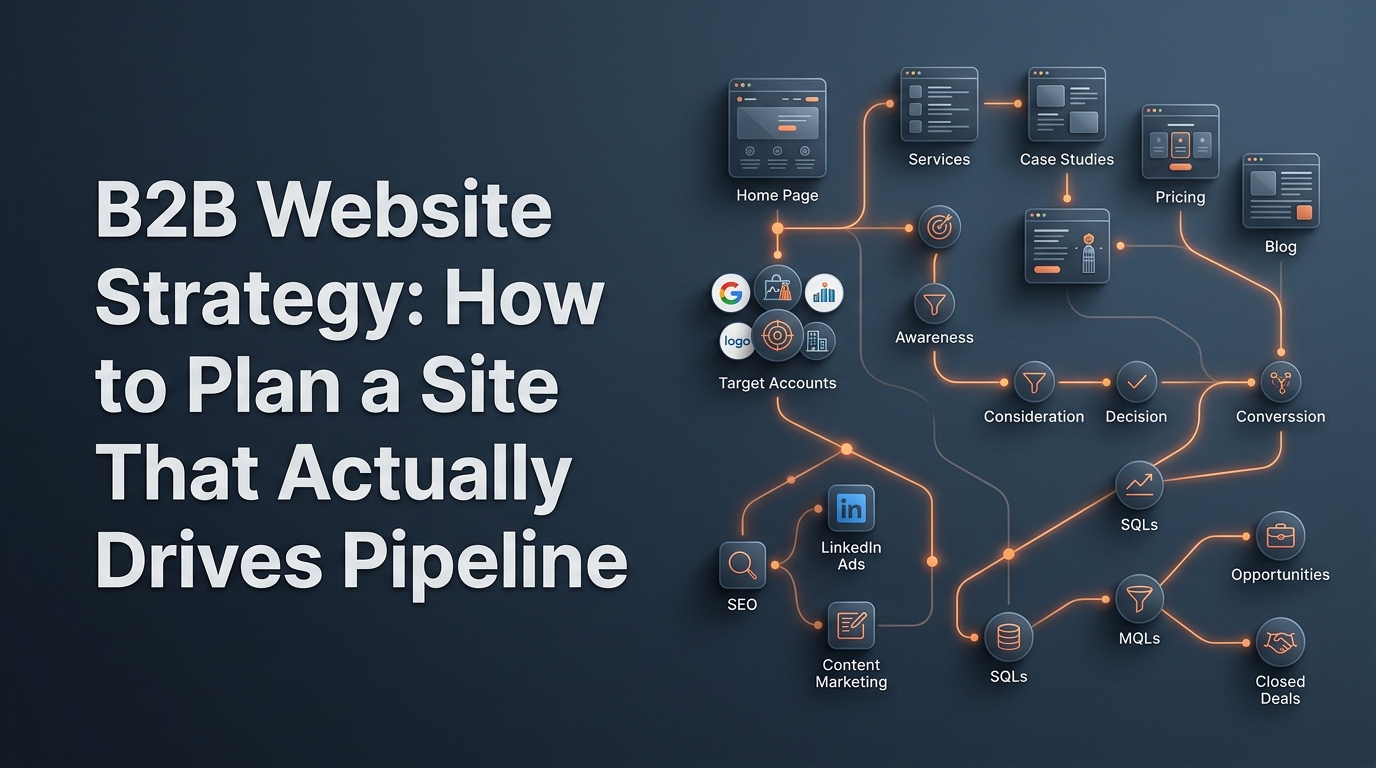
B2B Website Strategy: How to Plan a Site That Actually Drives Pipeline
TL;DR: The B2B Website Strategy That Drives Pipeline
A high-performing B2B website strategy starts with a clear conversion goal, not a visual direction. Before choosing a color palette or hero image, define the single action you want your highest-value buyer to take, identify who that buyer is, and map the information journey that gets them from first click to conversion.
Ground the work in data you already own. Start in Google Search Console, fix the quick wins, build information architecture around buyer problems, and connect every page to a next step. The design executes the strategy. The strategy is what creates the pipeline.
Most B2B website projects start with design. They start with references, visual directions, color palettes, and the inevitable debate about whether the hero image should be a product screenshot or an abstract illustration.
That's the wrong starting point. And it's why so many B2B websites look better after a redesign but don't perform significantly better.
A B2B website strategy starts with a single question: what does success on this website actually look like?
Not "how do we want it to look?" Not "what should be on the homepage?" The question is: what specific action do we want a specific visitor to take, and why?
Everything else, the design, the content architecture, the navigation, the calls to action, flows from the answer to that question. The strategy is the foundation. The design executes it.
Why Strategy-First Is Non-Negotiable
According to Forrester Research, over 70% of B2B buyers complete more than half of their research independently before contacting a vendor. That means your website is your most active salesperson for the majority of your pipeline, and it needs a strategic brief, not just a visual direction.
The companies that invest in website strategy before design consistently see better outcomes. HubSpot's State of Marketing research shows that businesses with documented strategies generate significantly more qualified leads than those that rely on intuition.
The cost of skipping strategy shows up in two ways: websites that look good but don't convert, and redesign projects that produce a beautiful site built around the wrong conversion goal. Both are expensive. Both are preventable.
Step 1: Define What Success Looks Like on Your Website
The first and most important decision in B2B website strategy is defining your primary conversion event. This is the single action that, if a visitor takes it, represents a meaningful step toward revenue.
For most B2B companies, this is one of two things:
Book a discovery call / book a demo. The website's job is to generate qualified meeting requests. The deal happens offline. The website is the top of a sales-assisted funnel.
Complete a self-serve signup. The website's job is to get the right user into the product. The deal happens through product experience, with sales stepping in for enterprise.
Some companies have both. If you do, you need to be clear about which one is primary, which user type represents the highest long-term value, and which conversion event is the main thing your website is optimizing for.
Here's the nuance that most B2B websites miss: success isn't the same as volume. We've seen companies celebrate 200 free signups per month while their highest-value customers are finding the site through organic search, landing on a blog post with no clear next step, and leaving without ever requesting a demo. This is a B2B website lead generation failure, not a design failure.
The strategic question is: what is the conversion event that, if we improved its rate, would have the highest revenue impact?
Step 2: Know Your Users, and Know Which One to Optimize For
B2B websites typically have multiple user types: a marketing leader doing initial research, an IT director evaluating security requirements, a finance director checking compliance, a founder trying to understand fit.
All of these people might land on your homepage. You can't design for all of them equally.
The framework we use at Wandr Studio: identify your user types, map their goals and information needs, and rank them by ROI. Who converts fastest? Who has the highest LTV? Who is most likely to refer additional business?
This is why real research beats internal guesswork every time. As Claudia Mérigo, a UX researcher at Wandr, puts it, "instead of designing based on assumptions, we design based on real challenges, needs, and problems." That principle is what turns a list of stakeholders into a ranked, revenue-weighted priority.
Design the primary experience for that user. Create supporting content for the others. Don't try to build a homepage that simultaneously addresses every stakeholder, it will end up addressing none of them clearly.
Gartner's B2B buying research shows that the average enterprise purchase involves 6-10 decision-makers. Your website can't serve all of them on a single page. It can create a clear primary path and clear secondary paths, but it needs to prioritize.
Step 3: Map the Information Journey
Once you know who you're designing for and what you want them to do, you can map the journey from first landing to conversion.
This is content architecture work, not design work. For each user type, ask:
- Where do they find us? (Organic search, paid, referral, LinkedIn?)
- What page do they land on first?
- What information do they need before they'll consider taking the primary conversion step?
- What are the objections that typically stall them?
- What proof do they need to see?
The answers create a map. From that map, you can see which pages need to exist, what they need to contain, and how they need to connect.
Most B2B websites have strong individual pages but weak connections between them. A great case study page with no link back to the service it demonstrates. A pricing page that doesn't address the most common cost objection. A blog post with no CTA. The journey is broken. This is the core problem our B2B website audit process is designed to uncover.
Step 4: Start with Search Console Before You Touch the Site
Before any redesign work, before any content strategy decisions, look at your Search Console data.
Google Search Console tells you which queries are currently bringing visitors to your site, which pages those visitors land on, and how often they click through versus scrolling past. This data is free, specific to your actual site, and most companies barely look at it.
The most common finding: pages that generate thousands of impressions per month but very few clicks, because the title tag or meta description doesn't match what the searcher was actually looking for. This is a quick fix, rewrite the title tag to better reflect search intent, that can meaningfully increase organic traffic without touching design at all.
The second most common finding: traffic arriving on pages that have no pathway to conversion. Blog posts that get substantial organic traffic with no internal links to service pages and no CTA. The acquisition is working. The conversion architecture doesn't exist.
Both findings are actionable. Neither requires a redesign. Look at Search Console first.
Step 5: Define Your Information Architecture
Information architecture (IA) is the structural design of a website, what pages exist, how they're organized, how they connect. It's the most important strategic decision in B2B web design and the one most often rushed.
For a B2B website, the IA should be organized around buyer problems and use cases, not your internal product structure or service categories.
Nielsen Norman Group's research on IA is clear: navigation organized by user mental models outperforms navigation organized by organizational logic. Users abandon sites when they can't predict where to find information.
In practice, this usually means:
- For SaaS companies: Navigation by industry, team type, or use case, rather than by feature set
- For agencies and professional services: Navigation by client type, problem, or outcome, rather than by service line
- For enterprise software: Navigation by solution/industry on the primary nav, with product details accessible but not foregrounded
The IA decision also shapes SEO architecture. Pages in the primary navigation accumulate more internal link equity and get crawled more frequently. Your highest-value service pages should be in the navigation.
Step 6: Define the Conversion Architecture
Every page on your B2B website should answer two questions:
- What is this page trying to help the visitor understand or decide?
- What is the next step we want them to take after they've gotten what they came for?
The "next step" doesn't have to be "book a demo" on every page. It might be "read this related case study" or "see how other [industry] companies use this." The conversion architecture is a chain of steps, not a single leap from homepage to meeting request.
What it can't be is nothing. A page with no next step is a dead end. Dead ends leak pipeline.
For the pages closest to conversion, pricing, contact, services, the next step should be the primary conversion event, presented clearly and with low friction. No 10-field forms. No requirement to read three pages of legal terms. Name, company, email, and what you want to talk about is enough. This is the specific focus of our B2B website conversion optimization work.
Step 7: Build a Content Strategy That Feeds the Funnel
A B2B content strategy is a search acquisition strategy. You create content around the questions your buyers are asking, rank for those queries, and build a pathway from that content into your commercial relationship.
The content strategy has three components:
Top-funnel content: Informational posts that answer questions buyers have early in their awareness phase. These drive organic traffic from people who are problem-aware but not yet vendor-aware.
Mid-funnel content: Comparison and evaluation content. "Best [category] tools." "How to choose a [category] vendor." These reach buyers who are actively evaluating solutions.
Bottom-funnel content: Decision-stage content. Case studies. Pricing guides. ROI calculators. Implementation timelines. These address the specific questions that come up right before a purchase decision.
The blog posts you write should be mapped to keywords at each of these levels and connected by internal links that lead buyers progressively toward conversion. This is covered in detail in our B2B website content strategy guide.
This isn't complicated. It requires consistency and discipline more than creativity. The companies that win on organic search in B2B publish steadily and build topical authority over time.
Step 8: Measure What Actually Matters
The metrics most B2B websites track, pageviews, sessions, and bounce rate, are visibility metrics, not performance metrics.
The performance metrics that matter:
- Primary conversion rate: What percentage of visitors take the primary conversion action?
- Conversion by traffic source: Which channels are generating qualified conversions?
- Pipeline from website: How many qualified opportunities have website as first touch?
- Blog-to-conversion rate: What percentage of content readers become leads?
Getting to these metrics requires proper analytics configuration, conversion events in GA4, UTM tracking on all campaigns, and ideally CRM integration. Our B2B website KPIs guide explains the full measurement architecture.
But before any of that: Search Console first. It's the baseline that tells you whether your site is visible in search at all, which is the precondition for everything else.
Building Competitive Moat Through Organic Search
One of the highest-leverage outputs of a strong B2B website strategy is topical authority in organic search.
Topical authority is what happens when your website consistently publishes high-quality content around a specific subject area. Google rewards sites that demonstrate comprehensive expertise on a topic by ranking them preferentially for queries in that topic, even new queries they haven't specifically targeted.
Moz's research on topical authority shows that sites with deep coverage of a topic outperform sites with broad, shallow coverage for competitive queries in that topic area. The implication for B2B website strategy: depth in your specific category beats breadth across adjacent categories.
This is why a content cluster strategy, a pillar page supported by a cluster of related posts, all internally linked, outperforms a collection of disconnected articles on loosely related topics.
The Strategic Mistakes Most B2B Websites Make
Starting with design instead of strategy. A beautiful website built around vague positioning and no clear conversion goal will not outperform a simpler website built around a sharp strategic foundation. This is the core principle behind every B2B website redesign we run.
Designing for everyone. A B2B website that tries to speak to every possible buyer type simultaneously speaks clearly to none of them.
Treating the blog as a publishing obligation. Content that has no conversion architecture generates traffic that has no business value.
Ignoring the Search Console data you already have. Before any redesign, before any content investment, look at what the data is already telling you. Most companies are sitting on quick wins they don't know exist.
Measuring vanity metrics. Pageviews are not pipeline. An increase in organic traffic that doesn't translate to qualified demo requests is not a B2B website success metric.
What a Strong B2B Website Strategy Produces
When B2B website strategy is done right, when you've defined the right conversion goal, identified the right user, built the information journey that gets them there, and connected the content to the commercial relationship, the website becomes an actual sales and marketing asset.
Not a digital brochure. Not a portfolio. A pipeline generator that works 24 hours a day, pre-qualifying visitors, building credibility, and routing the right people toward conversations with your team.
MedTrainer saw a 28% increase in book-a-demo conversions after we rebuilt their site with this approach. Not because we made it more beautiful, because we rebuilt the conversion architecture around who their highest-value buyer was and what they needed to see.
Understanding what a project like this costs is important. Our B2B website cost guide breaks down what you're paying for at each investment tier and how to think about the return.
Ready to Build a B2B Website Strategy?
At Wandr Studio, we start every B2B web project with strategy before design. We want to understand your conversion goals, your buyer types, your pipeline data, and your current analytics before we touch a color palette.
Book a free discovery call to start the conversation. We'll give you an honest picture of where your current site stands and what a strategic approach to improving it looks like.
Implementation: Where to Start
The principles in this guide are most valuable when they're translated into a specific, sequenced action plan for your actual website. The companies that see the biggest improvements from B2B web design investments are the ones that approach it systematically, starting with data, moving to strategy, then to design.
Before touching anything on your site, spend one hour in Google Search Console. Look at your Performance report and filter for pages with more than 200 monthly impressions. For each of those pages, check the CTR. Any page with a CTR below 2% on a relevant query has a title tag or meta description problem that a quick rewrite can fix, no design required.
Then look at your top five organic traffic blog posts. Open each one and ask: does this post have a contextual internal link to a relevant service page? Does it end with a CTA toward your primary conversion event? If either answer is no, add them. This is the highest-leverage, lowest-effort improvement available to most B2B websites.
After those quick wins, you'll have better data and better visibility into where the structural gaps are. That's when the conversation about a deeper redesign, and the investment it requires, is worth having from a more informed position.
The Wandr Approach
At Wandr Studio, we work with B2B companies that want their website to generate pipeline, not just look good. Our process starts with data, your Search Console, your GA4 configuration, your current conversion rates, before any creative work begins. The design executes a strategy. The strategy is what creates the ROI.
We've helped B2B SaaS companies like MedTrainer achieve 28% improvements in demo conversion rates, and we've restructured onboarding flows like Zoe Financial's to meaningfully improve completion rates by sequencing information requests in the right order.
If you recognize the challenges described in this guide in your own website, that's a solvable problem. The data you need to diagnose it is already available in your analytics. The improvements are systematic, not magical.
Building this kind of strategic foundation before a single design decision is made is the starting point for every project our B2B web design agency takes on.
Book a free discovery call to get an honest assessment of where your site stands and what the highest-leverage improvements would look like for your specific situation.
Final Thoughts on B2B Website Strategy
A strong B2B website strategy is not a design exercise dressed up with better taste. It is a sequence of decisions about who you are serving, what you want them to do, and how every page moves them toward that action. When you start with the conversion goal and the highest-value buyer, then let information architecture, content, and analytics fall in behind that, the website stops being a brochure and starts behaving like a pipeline engine that works around the clock.
The proof is in the outcomes. MedTrainer's 28% lift in demo conversions and the rebuilt onboarding flow in the Zoe Financial case study both came from strategy, not decoration. If you want the full playbook for turning traffic into qualified conversations, our B2B website content strategy guide is the pillar that ties these pieces together.
Partner With a B2B Web Design Agency That Starts With Strategy
If your site looks fine but isn't generating pipeline, the gap is almost always strategic. Working with a specialist B2B web design agency means the conversion goal, buyer priority, and measurement plan are defined before a single pixel is placed. Book a free discovery call and we'll give you an honest read on where your current site stands and the highest-leverage improvements for your specific situation.
