

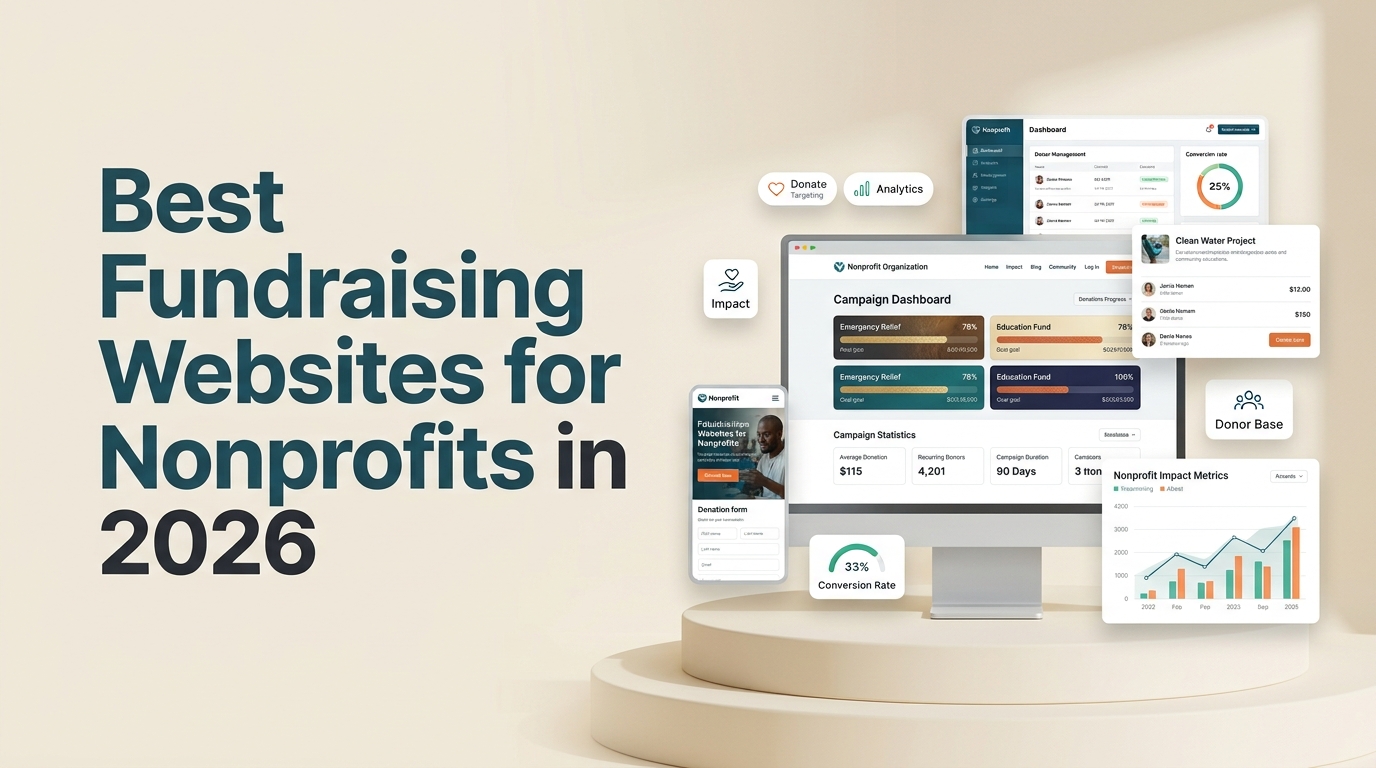
What Makes a Fundraising Website "Best" in 2026?
Before we get to the list, it's worth defining the criteria. A lot of "best of" lists in this space rank platforms based on features and pricing alone. We care about something more specific: does it actually help nonprofits raise more money?
The metrics that matter:
Conversion rate: What percentage of visitors who reach a donation page complete a gift?
Average gift size: Does the platform's design and UX nudge donors toward larger gifts?
Recurring giving adoption: Does it make monthly giving feel like the obvious choice?
Donor retention: Are donors coming back? Does the platform support relationship-building?
Analytics integration: Can you actually measure what's working?
Mobile experience: Because more than half of your donors are on their phones.
A platform or website that scores well on these measures is a fundraising asset. One that doesn't: no matter how polished it looks: is quietly costing your mission real money.
Best Fundraising Platforms for Nonprofits
These are the tools you integrate into your nonprofit website to power donation flows. WANDR has worked inside this category directly: we designed and built the donor-facing flow for GiveSmart, one of the most widely used mobile fundraising and auction platforms, which shapes how we evaluate the tools below.
1. Fundraise Up — Best for Conversion Optimization
Fundraise Up has earned its reputation as one of the highest-converting donation platforms in the nonprofit space. It uses AI-powered smart asks to suggest the right giving amount for each donor based on behavioral signals, which tends to increase both conversion rates and average gift size.
What we like:
- AI-optimized giving amounts
- Excellent recurring donation UX (makes monthly giving feel natural, not pushy)
- Embeds cleanly into your existing website without breaking the branded experience
- Strong analytics and reporting
- Solid integrations with major CRMs (Salesforce, HubSpot, Raiser's Edge)
Best for: Organizations with significant fundraising goals that are serious about conversion optimization.
2. Give Butter — Best for Campaigns and Events
Give Butter is a strong choice for nonprofits that run fundraising campaigns, galas, peer-to-peer fundraising drives, and live events alongside their general giving program. It does a good job of making campaign-specific fundraising feel cohesive with your broader donor experience.
What we like:
- Excellent peer-to-peer fundraising tools
- Campaign pages with real-time progress tracking (creates urgency and social proof)
- Clean, modern UI that doesn't feel like a generic donation tool
- Good mobile experience
- Competitive pricing for smaller organizations
Best for: Campaign-driven fundraising, giving days, event-based organizations.
3. Donor Box — Best for Smaller Nonprofits on a Budget
Donor Box is the go-to for organizations that want solid fundraising functionality without enterprise-level pricing. It's not the most feature-rich option, but it handles the fundamentals well and integrates reasonably cleanly with most website platforms.
What we like:
- Affordable (free tier available for smaller organizations)
- Supports one-time and recurring donations
- Embeds as a form on your site
- Supports multiple currencies (useful for international nonprofits)
- Stripe and PayPal payment processing
Worth noting: the design is somewhat generic, and customization is limited. If brand consistency and donor experience quality are priorities, you may want to invest in a more robust platform.
4. Classy — Best for Mid-to-Large Organizations
Classy (now part of GoFundMe's nonprofit arm) is a full-featured fundraising platform built for mid-to-large nonprofits. It handles everything from general giving to peer-to-peer fundraising to event registration to recurring giving programs.
What we like:
- Comprehensive feature set
- Strong recurring giving program management
- Peer-to-peer and team fundraising tools
- Professional support team
Worth noting: Classy is at the more expensive end of the spectrum. For smaller organizations, the cost may not be justified by the volume.
→ Classy
5. Bloomerang — Best CRM + Fundraising Integration
Bloomerang is primarily a donor management CRM, but its giving portal and integration capabilities make it worth including here. For organizations that want their fundraising platform and donor database to speak the same language natively: without complex integrations: Bloomerang is a strong contender.
What we like:
- Donor retention focus (built-in engagement scoring)
- CRM and giving in one platform
- Good reporting and analytics
- Peer-to-peer fundraising support
What to Stay Away From
PayPal Donate buttons. This comes up a lot. PayPal is a purchasing platform. The user experience, the language, the visual design: it all signals "buying something," not "supporting a cause." Beyond the credibility issue, PayPal limits your analytics and makes it harder to build the donor relationship over time. We recommend moving away from PayPal as your primary donation mechanism.
Stripe payment links used as donation forms. Same issue: built for commerce, not philanthropy.
Custom-built donation systems from a decade ago. If your organization is running a donation system built in 2012 that nobody has touched since, the UX gap between your site and donor expectations has grown significantly. The maintenance burden and the conversion cost are both worth calculating.
Best Nonprofit Website Examples Built for Fundraising (2026)
Beyond platforms, it's worth looking at full nonprofit websites that are designed with fundraising at their core: not as an afterthought, but as the organizing principle of the entire experience.
WWF Canada
WWF Canada's website, redesigned by WANDR, is a strong example of a major nonprofit putting conversion strategy at the center of the design process. The site serves multiple user types: one-time donors, recurring supporters, corporate partners, advocates: with flows built specifically for each.
Results post-launch: transactions up 37%, unique users up 25%, time on page up 18%. Bilingual (English and French) throughout, with a shop and peer-to-peer fundraising integrated into the experience.
What makes it work: the credibility signals are present everywhere, the donation journey is clear and uncluttered, and the content architecture supports both the cause-driven visitor and the potential corporate partner.
→ Read the WWF Canada Case Study
Mercy For Animals
Mercy For Animals operates globally across multiple regions and languages. The digital challenge was consolidating what had been a fragmented ecosystem of tools, pages, and campaigns into a unified, high-performing platform.
WANDR's work on this project is a good example of what happens when you take SEO, accessibility, and conversion design seriously at the same time. Donations increased by 32% in year one. Accessibility compliance achieved across the board. Over 90% of SEO preserved through a major migration: and the rest recovered in four weeks.
What makes it work: every region's users get a coherent, accessible experience. The flows for different supporter types (donor, activist, newsletter subscriber) are distinct without being confusing. And the platform is built to be measured, so the team knows what's working.
→ Read the Mercy For Animals Case Study
Trends Shaping Fundraising Website Design in 2026
AI-powered personalization
Platforms like Fundraise Up are already using AI to optimize giving amounts. The next wave is personalization at the content level: different fundraising messages for different visitor profiles based on behavioral and referral source signals. Nonprofits with the infrastructure to implement this will see meaningful lifts in conversion.
Transparency as a design principle
Donors in 2026 expect to know exactly how their money is used. Organizations that surface this information prominently: not buried in an annual report linked from the footer, but on the donation page itself: will outperform those that don't. Impact dashboards, real-time fundraising totals, and donor recognition all serve this function.
Recurring giving as the default ask
The shift from one-time to recurring giving is one of the most important fundraising trends of the decade. Monthly donors typically give 50-100% more annually than one-time donors, and they're much easier to retain. The best fundraising websites in 2026 are designed with monthly giving as the primary ask, with one-time giving as the alternative: not the reverse.
Mobile-first donation flows
This is no longer a trend: it's a baseline requirement. If your donation flow isn't fully optimized for mobile, including Apple Pay and Google Pay integration, you're leaving money on the table with every campaign you run.
Peer-to-peer integrated into core campaigns
Peer-to-peer fundraising has been around for a while, but the integration between P2P campaigns and main website experiences has gotten significantly more seamless. The best implementations make it easy for donors to become fundraisers without leaving the branded ecosystem of the main site.
Choosing the Right Platform for Your Organization
There's no single "best" fundraising platform for every nonprofit. The right choice depends on:
Your fundraising volume. Enterprise platforms like Classy make sense at scale. At smaller volumes, the cost doesn't justify the features.
Your primary fundraising model. Campaign-heavy? Give Butter. Conversion-optimization focused? Fundraise Up. Budget-constrained and just getting started? Donor Box.
Your technical infrastructure. If you're on WordPress, some platforms integrate more cleanly than others. If you're on Webflow, the same. The technical fit matters for the donor experience.
Your CRM. If you're running Salesforce or Raiser's Edge, choose a platform with native integration. Manual data syncing is a friction point that costs time and introduces errors.
If you're not sure which combination is right for your organization, an audit is the fastest way to find out. At WANDR, our initial audit, which can run from a few days to several weeks depending on scope, covers the current technology stack, the donation flows, and the analytics: and gives a clear, prioritized recommendation.
The Bottom Line
The "best" fundraising website for your nonprofit is one that was built with your specific donors in mind, designed around their motivations and their barriers, and measured from day one so you can keep improving it.
The platforms listed here are tools. They're only as good as the strategy behind them, the design around them, and the analytics tracking their performance.
Our warranty, applied to every nonprofit engagement: within year one of launch, you'll see a meaningful increase in the metrics that matter most to your mission: or we come back and work until you do.
→ Book a Free Nonprofit Website Diagnostic
WANDR Studio is a woman-owned design, development, and strategy agency that has generated $3.2M+ in additional donations across 15+ nonprofit engagements.
→ Related reading: Fundraising Websites for Nonprofits: Design That Converts | How to Design a Nonprofit Website That Increases Donations | Nonprofit Website Development Cost
Related WANDR case studies: WWF-Canada · Mercy For Animals
Planning a nonprofit website project? Explore WANDR's nonprofit web design services →