

Medical Website Design That
Turns Searching Patients IntoBooked Appointments.

A decade designing for practices, clinics, and health organizations. Not templates. Research-led UX, HIPAA-ready builds, and booking flows patients actually finish.

"WANDR simplified our complex platform into a website that finally communicates what we do, and improved conversion."
Evan Fehler, Head of Marketing, MedTrainer
"Their ability to understand our unique business was very impressive. They quickly built an understanding of who we are."
Marc Yount, President & Chief Commercial Officer, Field Agent
"Their process has been very easy to understand and efficient. I am really surprised with their turnaround times."
Isabella Guerrero, Founder, Sponzo
LA - Silicon Valley - Austin - Miami - Mexico City

A Medical Website Design Agency Built on a Decade of Results

Ten years. 500+ products shipped. Long enough to know that a patient choosing a provider is not making a purchase decision. They are deciding whether to trust you with something they are already worried about, usually on a phone, usually at night, usually after reading reviews first.

We have worked across primary care, dental, dermatology, behavioral health, medical devices, and healthcare technology, alongside fintech, enterprise software, and government. Different specialties, same problem: sites that look credible but do not convert.

We don't just make medical websites look more professional. We make them fill the schedule.

Dotted world map showing Wandr locations
Proven impact

Medical website design that moves the needle on new patients.

Two case studies that illustrate what embedded UX with research, strategy and execution looks like when it ships.

HEALTH TECH · COMPLIANCE PLATFORM

MedTrainer

23%improvement in lead flow within the first month post-launch.

A healthcare compliance platform whose site looked credible but never explained what the product actually did, leaving qualified visitors to work it out for themselves. We rebuilt the value hierarchy for each visitor type, surfaced trust signals before the ask, and rebuilt the conversion paths that had been letting buyers leave without acting.

"WANDR simplified our complex platform into a website that finally communicates what we do, and improved conversion." Evan Fehler, Head of Marketing, MedTrainer
See full case study
HEALTH TECH · COMPLIANCE PLATFORMHEALTH TECH · COMPLIANCE PLATFORM
HEALTHCARE · PRIOR AUTHORIZATION PLATFORM

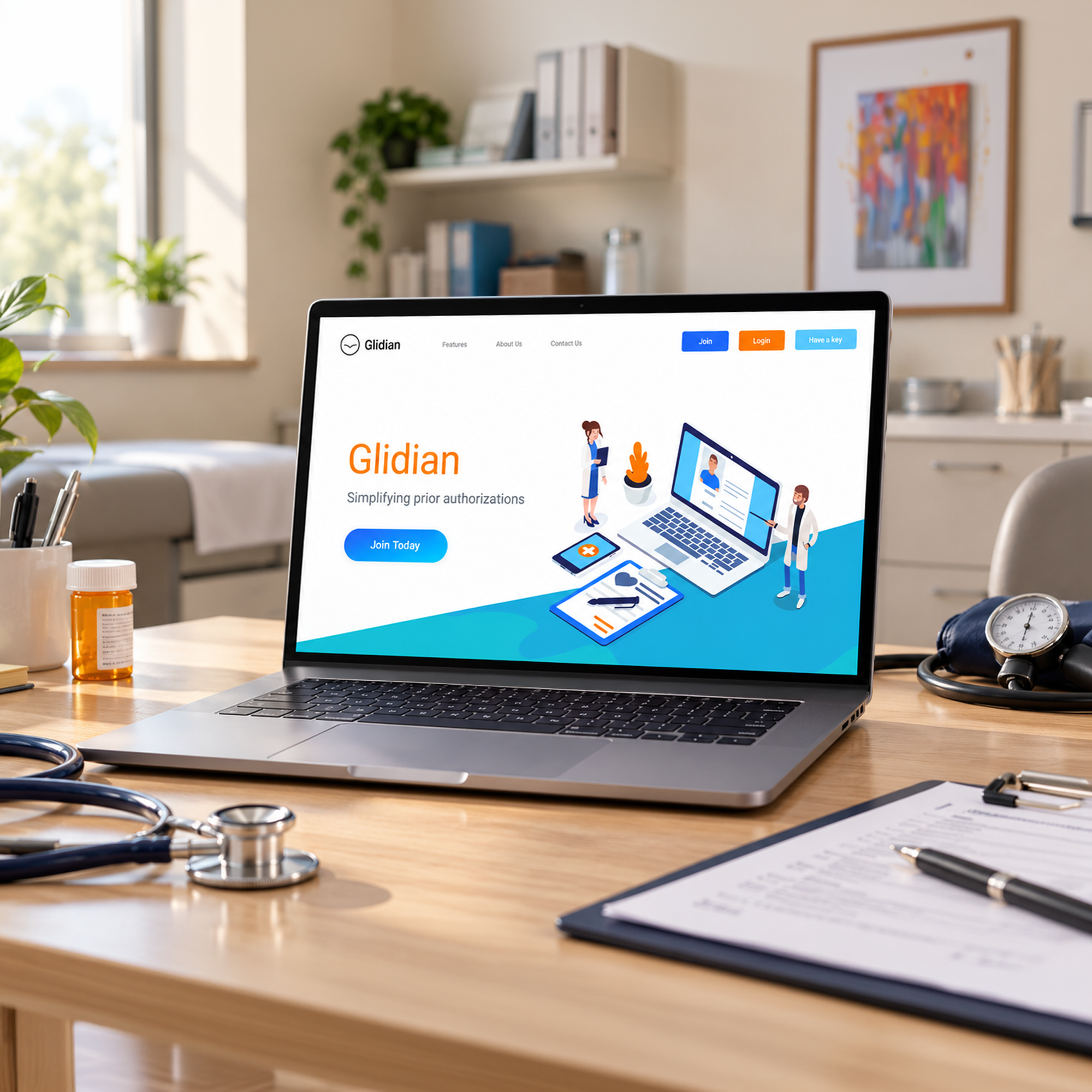
Glidian

4 weeksfrom wireframes to a coded, responsive site the company grew into.

At eight paying customers, Glidian had a working product and a site that could not explain an invisible, three-way insurance process to a skeptical healthcare buyer. We pulled the dashboard out from behind the login, drew the process as a graphic system, and built the site to a software standard that read as credible to hospital buyers and Silicon Valley investors at once.

"They wireframed, designed, and coded the whole site in about a month, and handed over the source files and the codebase without us having to chase anything."Maxwell Wu, Co-founder & CTO, Glidian
See full case study
Glidian · HealthcareGlidian · Healthcare
Case 01 / 02
Drag / scroll
By the numbers

A decade of medical website design, quantified.

500+
products designed and delivered
across a decade
Millions

of new visitors to the sites
we've designed

03Case Study
23%

improvement in lead flow within the first month post-launch (MedTrainer).

04CONVERSION
31%

avg increase in appointment requests and new patient leads.

05CASE STUDY
4 Wks

from wireframes to a coded, responsive site, handed over with the source files (Glidian).

06Guarantee
15%
reduction in cancellation rate after A/B testing (Synchrony).
See case study
Trusted by
WWFMFAMFAMFAMFAMFAMFAMFAMFAMFAMFAMFAMFAMFAMFAWWFMFAMFAMFAMFAMFAMFAMFAMFAMFAMFAMFAMFAMFAMFA
The reality

Patients decide before they call.

Usually on a phone, usually at night.

01 / 04
72%

of patients read online reviews as the first step in finding a new doctor, which means your website is the second stop and the one that has to close.

Software Advice, via TechTarget Patient Engagement
01 / 04
71%

of patients feel their healthcare provider's website is failing them, from unclear information to no easy way to book.

Patient survey via DMNews
01 / 04
60%

of younger patients say they will switch healthcare providers over a poor digital experience.

Consumer survey via Fierce Healthcare
01 / 04
35%

of patients overall would switch doctors over a poor digital experience.

eMarketer
Data first. Design second.

Every medical website engagement starts the same way. We look at your analytics, talk to your patients and your front-desk team, audit the current site, and find the friction that is costing you appointments. Then we fix it.

5 phases →
Phase 01Discover
01

Diagnose

We audit your site against patient-conversion benchmarks. Where do patients drop off? Where is information unclear? Where does booking get hard? We find it before we design anything.

Phase 02Plan
02

Strategy

A prioritized roadmap tied to new-patient outcomes. Messaging, patient journey mapping, accessibility requirements, and SEO structure agreed before a single page is designed.

Phase 03Design
03

Design & Prototyping.

Conversion-focused pages, clear calls to book, trust and credibility signals, HIPAA-aware forms, and accessible mobile-first layouts. Everything a patient touches is designed intentionally.

Phase 04Deliver
04

Testing & Validation.

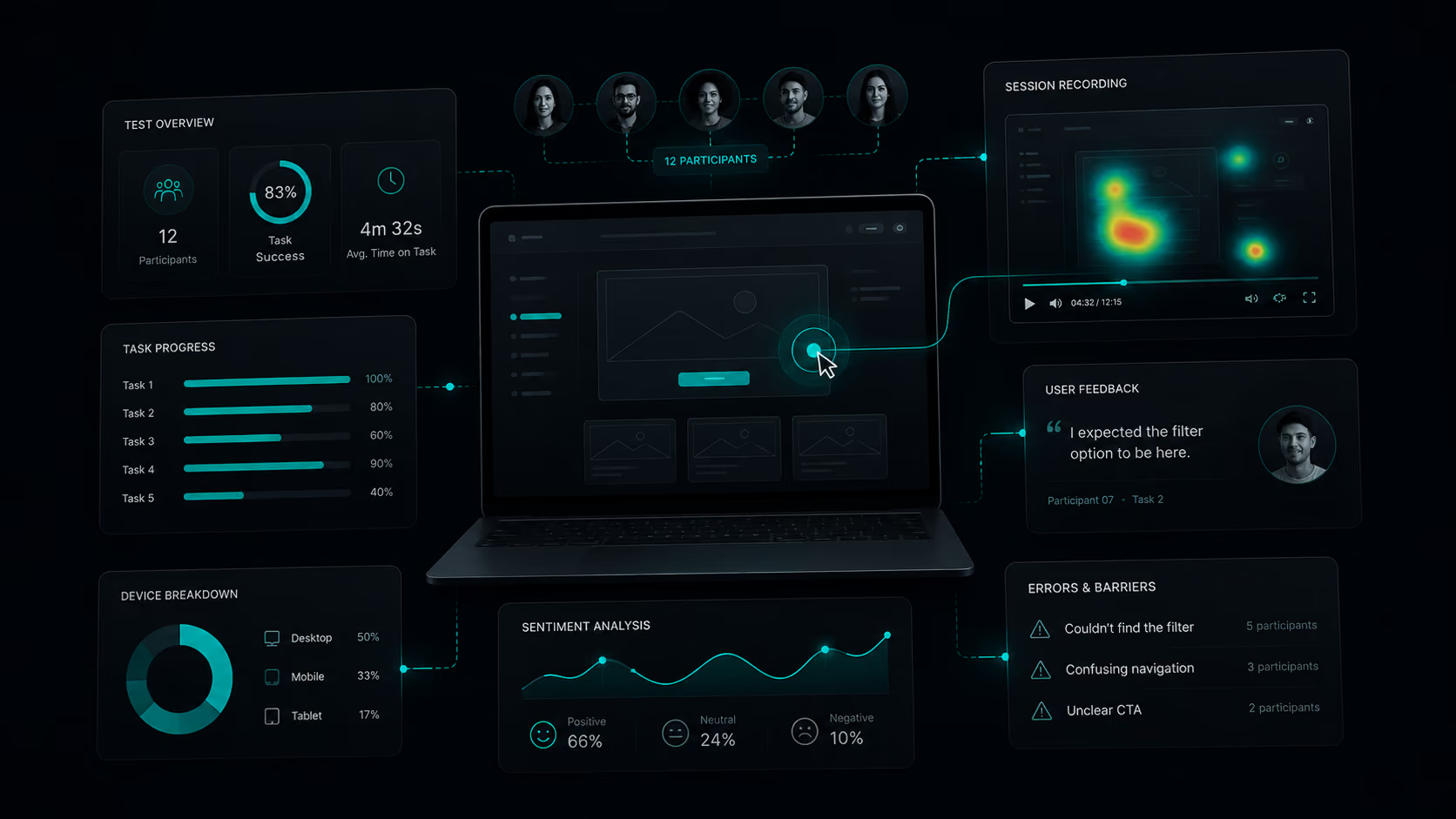
We test the booking flow with real patients and with the front-desk staff who field the calls when it fails. Friction gets found before launch, not in your appointment numbers three months later.

Phase 05Measure
05

Build & Measure

We build, or hand off to your developers with design-quality auditing throughout. Then we track appointment requests, new-patient lead quality, time on page, and bounce rate. If it is not moving the number, we change it.

Phase 01 of 05
→ Continue scrolling
Deliverables

What you get with WANDR's
medical website design services

End-to-end design for practices, clinics, and health organizations, scoped to your specialty, your patient mix, and how people actually book with you.

Wireframing and prototyping preview
01 / 06Patient & Caregiver Research

Patient & Caregiver Research

interviews and behavioral analysis covering patients, families, and referring providers

Wireframing and prototyping preview
02 / 06Conversion & Messaging

Conversion Strategy & Messaging

positioning built around what patients need to feel confident, not what the org chart wants to say

Wireframing and prototyping preview
03 / 06Booking & Appointment

Booking & Appointment Flow Design

the path from search result to confirmed appointment, designed for the fewest steps that still qualify

Wireframing and prototyping preview
04 / 06HIPAA & Accessibility

HIPAA & Accessibility Compliance

forms, chat, scheduling, and analytics configured correctly, and WCAG conformance reviewed across the site

Wireframing and prototyping preview
05 / 06Local & Medical SEO Structure

Local & Medical SEO Structure

page hierarchy, URL structure, service-area pages, and content planning built into the IA

Wireframing and prototyping preview
06 / 06UI Design, Design System & Build

UI Design, Design System & Build

high-fidelity screens and a component library, built by our developers or handed to yours with design-quality auditing throughout

Compare

How our medical website
Design Agency compares

Healthcare Template BuilderGeneral Marketing Agency
Starting pointA layout, filled with your logoYour brand guidelinessYour patients and your booking data
Patient researchNoneRarelyInterviews on every engagement
HIPAA & accesibilityYour problem after launchHandled if you askFirst-class requirement from wireframe one
SEOGeneric, bolted onSeparate worksteamBuilt into information architecture
Booking flowWhatever the plugin doesLeft to the developerDesigned and tested with real patients
AccountabilityNoneEnds at handoff15% conversion guarantee, year one
What our clients say
Verified Clutch reviews.

Their ability to understand our unique business was very impressive. We have a fairly complex business model and were concerned that they wouldn't be able to understand it enough to create an effective design — but they quickly built an understanding of who we are.

Marc YountPresident & CCO · Field Agent
See full Clutch review

The communication and support were top-notch, and that made for an enjoyable experience. We're moving onto the development phase now, and WANDR is still willing to answer our questions and provide additional services as needed.

Dillon FergusonHead of Product, Zoe Financial
See full Clutch review

We couldn't be happier with the website they put together. People pay it compliments regularly. Wandr was quick with the work, open to new ideas, and responsive to emails and phone calls. They offer the perfect package and we were so happy with their services that we continue to use them even if someone else gives us a lower quote.

Vin VomeroFounder, Foxy AI
See full Clutch review
Why Wandr?

A Medical Website Design Agency Needs to Fill the Schedule. And We Guarantee It.

01 · The team

Designers who understand how patients choose care.

You work directly with senior designers and strategists who have designed inside healthcare's real constraints: HIPAA, accessibility, and a trust bar higher than any consumer category. Primary care, dental, dermatology, behavioral health, medical devices, and health tech. No juniors learning healthcare on your budget.

01
02 · The Method

Research-driven, not brand-guideline-driven.

We start with your patients, not your brand book. We audit existing performance, map the real path to booking, and build messaging around what patients need to feel confident rather than what you assume they want to hear. We challenge assumptions, including yours, including ours.

02
03 · Terms

Performance guarantee.

Most practices see measurable improvement within the first few months. If your website does not improve conversions by at least 15% within the first year post-launch, we keep working at no additional cost until it does. We agree on the success criteria at kickoff so there is no ambiguity about what we are working toward.

03
The difference

Same practice. A website that
books the appointment.

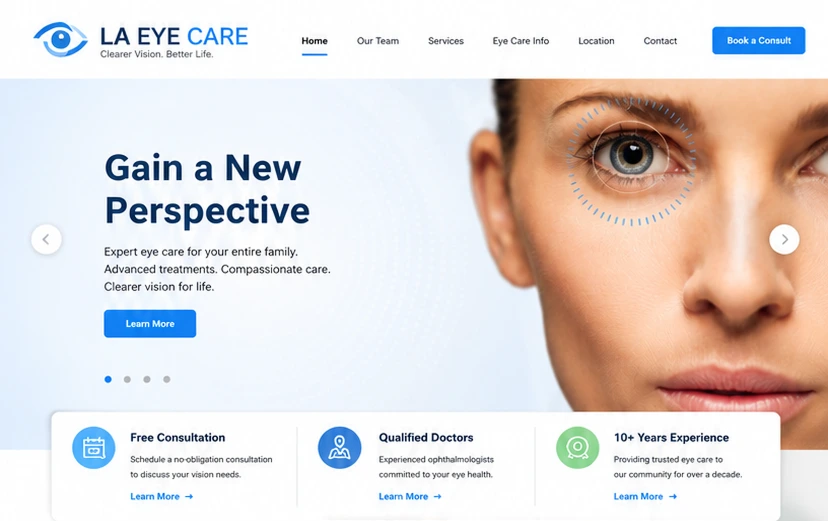
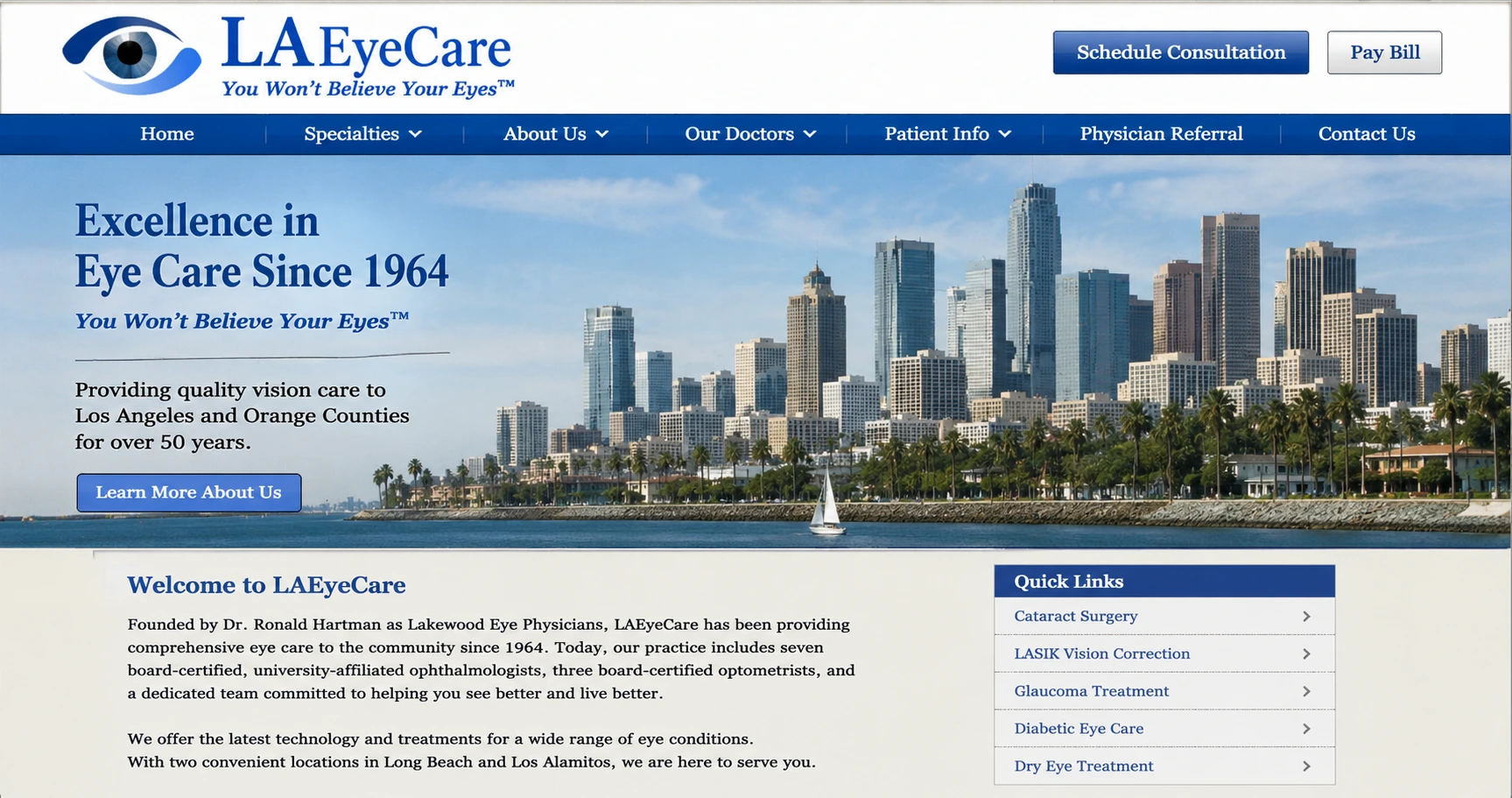
WANDR partnered with LA Eyecare, a Los Angeles ophthalmology practice, to redesign a website that finally matched the standard of care patients met in the exam room. Full brand identity, patient-language procedure pages, and an integrated booking flow built to turn searching patients into scheduled appointments.

BeforeAfter
Before WANDR
  • Dated branding that did not match the standard of care patients met in the exam room
  • Little explanation of the procedures patients were being asked to consider, from LASIK to cataract surgery
  • Surgeon credentials buried, with nothing to help a patient choose a provider before calling
  • No booking path on the site, so every appointment ran through a phone call during office hours
After WANDR
  • Appointment booking integrated directly into the site, so patients could reserve a time without picking up the phone
  • Full redesign and a refreshed brand identity, logo included
  • Procedure and eye care pages written in patient language, with surgeon profiles and testimonials surfaced as trust signals
  • Local SEO, Google Business Profile, and 30 pages of optimized copy built to capture search in the service area
LAEYECARE·OPHTHALMOLOGY·LOS ANGELES, CA
Who this is for

You understand that your website is your highest-volume front desk, open every hour of every day, with no script and nobody to catch the confusion. Every unclear headline, every abandoned booking form, every visitor who left without scheduling is a patient who chose someone else.

We work with practice owners, healthcare marketing directors, and administrators who know their practice deserves more than the current site is delivering. Whether you are a multi-location group modernizing an outdated platform, a specialty practice competing against a DSO or hospital system, or a health tech company whose product is better than its homepage suggests, we start with your patients and design backward from there.

First step
Not ready to commit? Let us audit your site first.

Send us your site. We'll identify the top 3 friction points costing you appointments and new patients. Free, no pitch, no obligation.

Start your free audit
Sample report
your-product.com/signup

Get started in seconds.

1No value prop above fold
2No password rules shown
3CTA hierarchy unclear
Medical Website Design Agency
Frequently asked.

Click any question to expand. If yours isn't here, write to us.

  1. Medical website design has to earn trust under compliance constraints, and it has to do it for four different people at once.  A retail site optimizes for an impulse purchase from one buyer. A medical website serves the patient weighing whether to trust you with their health, the family member or caregiver who is often making or influencing the decision, the returning patient who just wants the portal or a quick reschedule, and the referring physician checking that you are a safe place to send someone. Each arrives with different questions and a different threshold for trust, and the site has to create a path for all of them without diluting the primary goal of filling the schedule with the right patients.  On top of that it has to keep forms and analytics HIPAA-compliant and meet accessibility standards, neither of which a consumer site carries.  The practical difference shows up in sequencing. On a consumer site you can ask early. On a medical site the ask has to come after trust has been established, or the visitor leaves and books with someone else.
  2. Because they were built to look credible rather than to convert a real patient into a booked appointment. Two failures account for most of it.  Missing trust signals. Before someone books a first appointment they need three answers: Does this practice understand my problem? Have they cared for people like me? Can I trust them with something this personal? The best medical websites answer all three early, through credentials, real reviews, specific conditions treated, and credibility signals that appear before any ask is made. Most sites answer them on an about page nobody reaches.  A booking flow built by developers rather than conversion specialists. These flows are technically functional and friction-heavy: too many fields, unclear next steps, no momentum toward the appointment. A well-designed booking experience reduces effort, reinforces why the next step is worth taking, and makes reserving a time feel like the obvious move. It also has to respect HIPAA and protect patient information from the first form field.  The pattern to watch for is a site with healthy traffic and a flat appointment number. That combination is almost always a conversion problem rather than a marketing one.
  3. Scope drives the number, and the variables are predictable.  An audit of one major flow is a fixed, contained engagement. A full practice website scales with how many locations and specialties you cover, how much patient research is required, and whether scheduling or EHR integrations are in scope. Development, if you need it from us, is priced separately from design.  Four things move the number more than anything else:  How many locations and service lines the site has to carry. One practice is not the same problem as a twelve-location group with different providers at each. Whether integrations are in scope. Scheduling systems, patient portals, and EHR connections add build time. How much primary patient research is needed. If you already have booking analytics and access to patients, we move faster. Timeline. Compressed schedules require more people working in parallel.  We scope and price before work starts, and we will review your site and identify the top friction points at no cost first.
  4. Improvements usually show up in appointment requests, new-patient lead quality, time on page, and bounce rate, in roughly that order of importance.  As one data point from our work, MedTrainer saw a 23% improvement in lead flow within the first month post-launch.  We agree on the primary metric at kickoff, and we measure what fills your schedule rather than what makes the traffic graph look good. If the site does not improve conversions by at least 15% within the first year, we keep working at no additional cost until it does.
  5. Yes to both, and they are designed in rather than added at the end.  We design forms, chat, scheduling, and analytics to handle patient information correctly, including tracking configuration, which is where most practices unknowingly create exposure. We build to WCAG standards so patients with visual, motor, or cognitive impairments can actually find and book care with you.  Accessibility matters more in healthcare than almost anywhere else. A meaningful share of your patients have a visual, motor, or cognitive impairment, and older patients are a core audience for most practices, so WCAG conformance widens the audience who can actually find and book care with you.  It is also a risk question. Lawsuits over inaccessible healthcare sites have become common enough that treating conformance as optional is a business decision, not a design one.
  6. Yes. Search intent and content structure are part of design, not a separate phase afterward.  Page hierarchy, URL structure, local SEO for your service area, condition and service pages, and content planning are built into the information architecture from the start. That matters more in healthcare than most categories, because the majority of new patients find a provider through search before they ever call.
  7. Most projects run from several weeks to a few months, depending on scope.  A focused engagement on a booking flow is faster. A multi-location site with provider pages, service lines, and scheduling integration takes longer, and integrations are usually the variable that moves the date rather than the design itself.  We give you a firm estimate during discovery, once we understand your goals, content readiness, integrations, and whether development is included.
  8. Yes, from single-location practices to multi-location specialty groups, med spas, and healthcare technology companies.  We adapt to your specialty, your patient mix, and how people actually book with you. A dermatology practice competing on aesthetics and a behavioral health group competing on discretion need very different sites, and the difference is not cosmetic.
  9. Either. Our team can build the site, or we hand off to your in-house developers with design-quality auditing throughout the build so what ships matches what was designed.  The handoff failure is the most common way agency engagements go wrong, so engineering is in the conversation before design decisions are locked rather than after.
  10. A template is the right call when you need a credible presence quickly, you have one location and one service line, and booking happens mostly by phone. Lower cost, faster launch, and for that situation it is the sensible option.  An agency is the right call when patients are finding you through search, when the schedule has capacity you are not filling, or when you are competing against a hospital system or DSO with a real digital budget. At that point the site is a revenue channel and template constraints start costing more than the license saves.  The honest test: if you already know exactly what your site should say and just need it built, that is a production problem and there are cheaper ways to solve it.
  11. Evidence of thinking, not just visual polish. Most healthcare portfolios show finished screens. Very few show the reasoning that produced them, and the reasoning is what you are buying.  Five questions worth asking before you sign:  Have you designed for a practice at my stage, in my specialty? Health tech experience does not transfer cleanly to a multi-location dental group. How do you handle HIPAA and accessibility? If the answer arrives after the design phase, it will be a retrofit. How do you decide what to fix first? If the answer is a design opinion rather than booking data, you will get a redesign instead of a result. Who is actually doing the work? Senior people in the pitch and juniors on the project is common. Ask who is assigned. What does success look like, and when do we measure it? An agency unwilling to name a metric before starting is unlikely to be measured against one afterward.  The strongest signal is an agency willing to tell you when a smaller engagement would serve you better.  At WANDR the process starts with a diagnostic. We audit where patients are dropping off, what information is creating confusion, and which trust signals are missing. And we back it: if your medical website does not improve conversions by at least 15% within the first year post-launch, we keep working at no additional cost until it does.
Let's look at your site together.

Show us your site.

We'll show you what's costing you patients.

Request your free audit and within 72 hours we'll schedule a 30-minute call to walk you through exactly where your website is losing patients and what it is costing your schedule. No commitment required. If it makes sense to work together, great. If not, you leave with everything we found and a clear roadmap to fix it.

Ready to go further?

Our blog

Medical Website Design related reading.