

Persona 01

The Instant Saver.
Wants rewards now, with minimal effort. Put off by waiting, expiry, and unclear value.
new-to-app
speed-first
Instant redemption
Ten months from idea to funded product, Trust ID is now the identity platform behind an NVIDIA Inception startup.



Trust ID is the consumer brand of Tracer Labs, a privacy-technology company on a mission to replace cookies, passwords, and repetitive age checks with a decentralized, privacy-first identity and consent layer. Where a person once accepted hundreds of cookie pop-ups a year, Trust ID lets them carry portable, revocable consent and manage rewards across brands in a single wallet.
When Tracer came to Wandr, that vision existed only as an idea. There were no flows, no prototype, no brand, and no site, nothing a user or an investor could see. The technology was ambitious, but it could not yet be shown, used, or funded.
A category-defining idea that No one could yet see.
The consent economy was broken for users and businesses alike, and Tracer's fix still lived only in the founders' heads.
Users faced more than 700 consent pop-ups a year, a wall of friction that drove fatigue, abandonment, and quiet data leakage on nearly every site they touched.
More than 100 logins per person meant reused credentials, higher breach risk, and an identity layer working against the very people it was meant to protect.
Global privacy compliance was heading toward an estimated $55 billion a year, while cookie deprecation and bot traffic ate into marketing ROI on top of it.
The founders were aligned on the mission but had no flows, prototypes, or brand. The idea could not be shown to a user, an investor, or a pilot partner.
Decentralized technology, done wrong, feels more confusing than the problem it solves. The complexity had to disappear behind something people instantly understood.
To build on evidence rather than the founders' assumptions, Wandr ran twelve in-depth interviews with U.S. rewards users, 45 minutes each, spanning ten active rewards users and two who avoid rewards programs entirely. Every core concept was put in front of them before a screen was designed.
Nine of twelve users said one trusted account across brands would change how they manage rewards, validating the core Trust ID idea before design began.
Sixty percent of participants default to accepting all cookies, a measured psychological bias the onboarding had to reframe as a benefit, not a threat.
Granularity, security and traceability, guided immediacy, and personalization emerged from the interviews and guided every design decision.
Wants rewards now, with minimal effort. Put off by waiting, expiry, and unclear value.

Accumulates points for a meaningful payoff. Worn down by expiry and rewards locked to one brand.

Thrives on feeling recognized by brands. Let down when membership feels no different from anyone else's.
Every screen signaled control, clarity, and consent at a glance, so users always knew what they were sharing and could take it back at any time.
The cryptography stayed under the hood. Complex infrastructure was distilled into onboarding and wallet flows anyone could follow on the first try.
Components and architecture were built to evolve across regions, industries, and platforms without a rebuild each time.
One visual identity ran across tools, tiers, and touchpoints, so Tracer Labs, Trust ID, and DCID read as one coherent ecosystem.
Decentralized identity is a hard sell precisely because it is invisible infrastructure. Users would not adopt what they could not understand, and investors would not fund what they could not see.
The breakthrough was not a feature, it was clarity: turning an abstract, cryptographic idea into a single trusted account a person could use in a tap and an investor could grasp in a minute. That is what made Trust ID both usable and fundable.
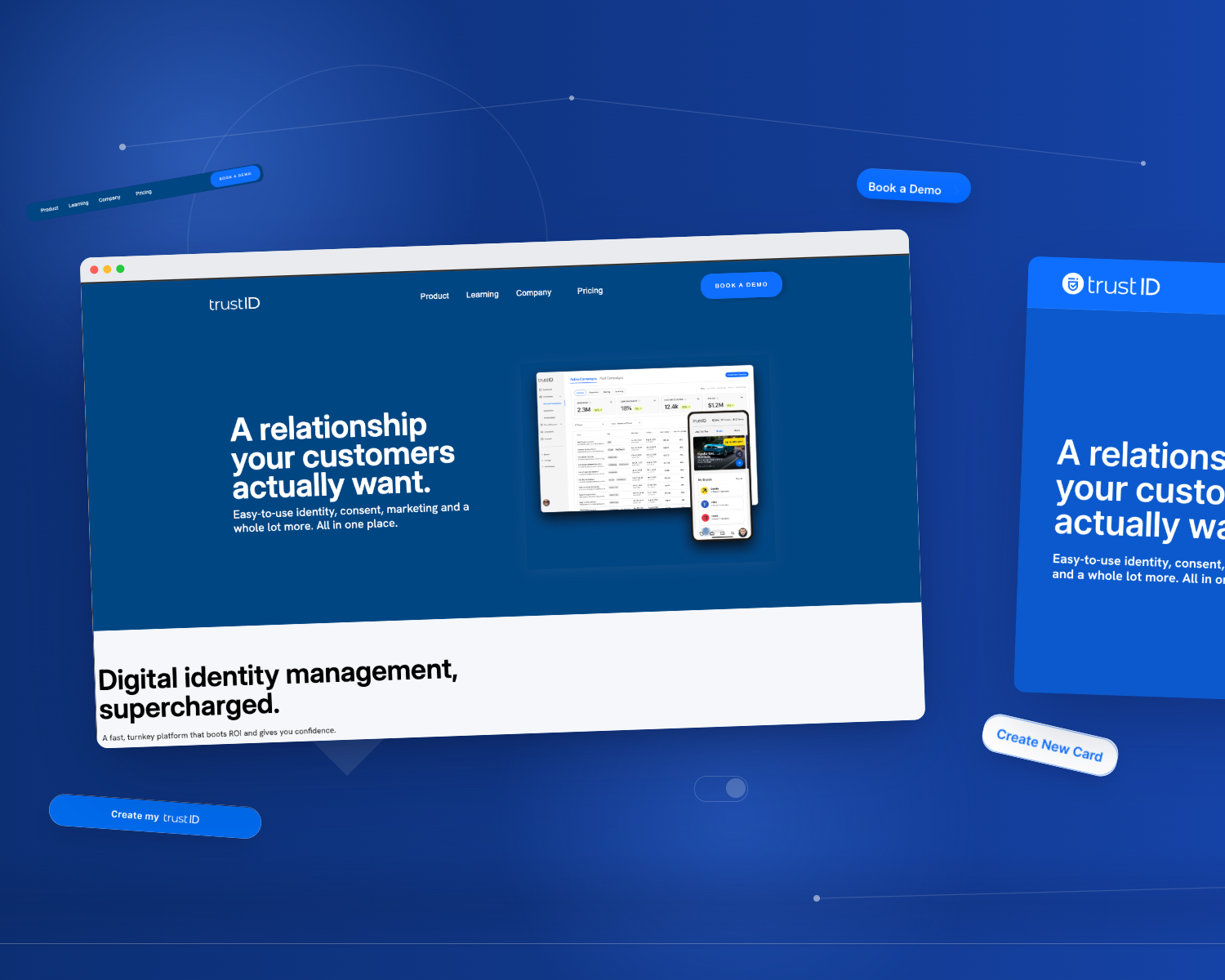







What the work produced.
In ten months, Trust ID went from scattered ideas to a research-validated product suite in front of investors and enterprise pilots.
Partnering with Wandr has been transformational. They understood the complexity of our vision and brought it to life with precision, creativity, and deep UX expertise. Their ability to translate groundbreaking technology into intuitive, human-centered experiences has been critical to our success with both investors and early adopters.