Team SoloMid

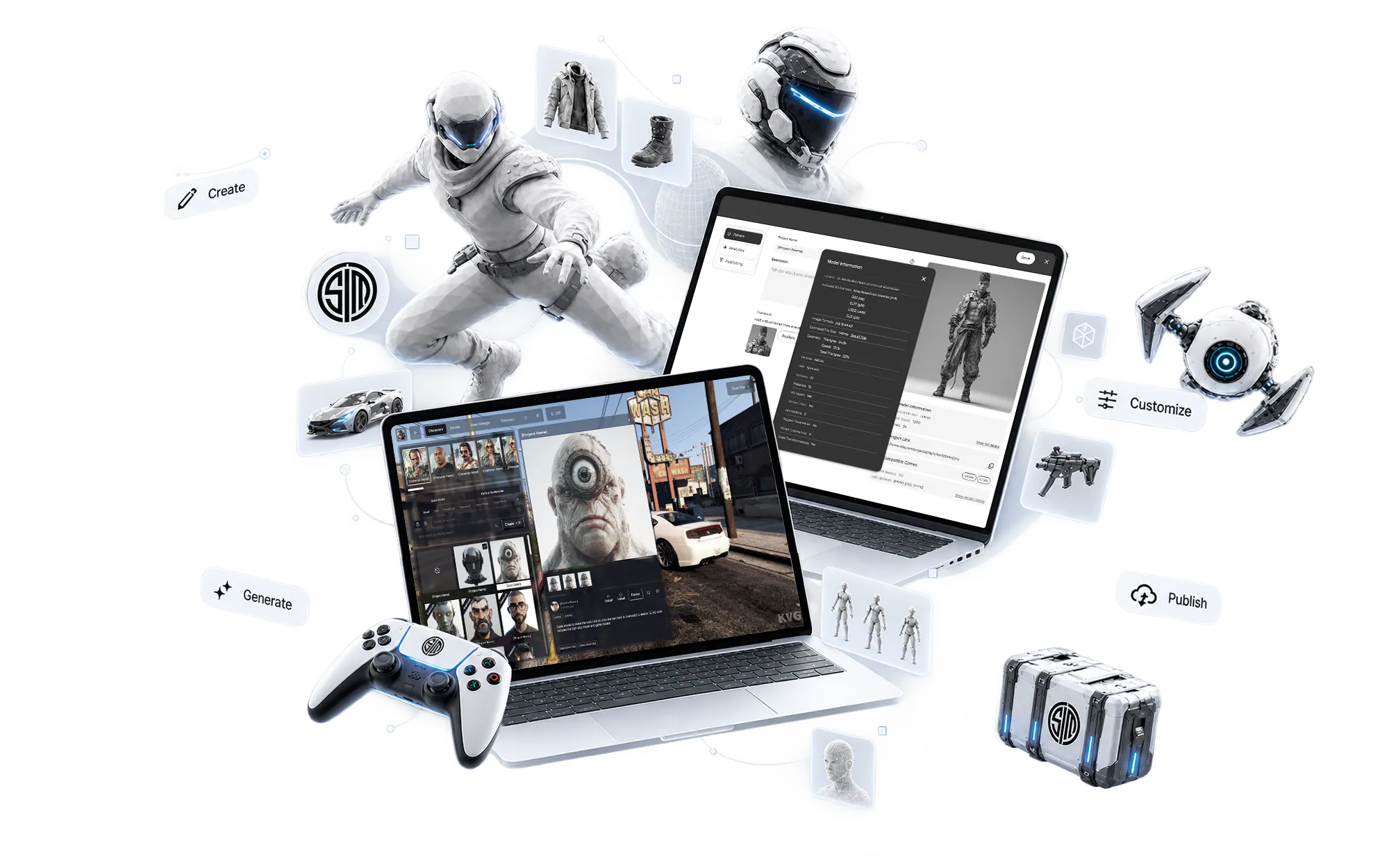
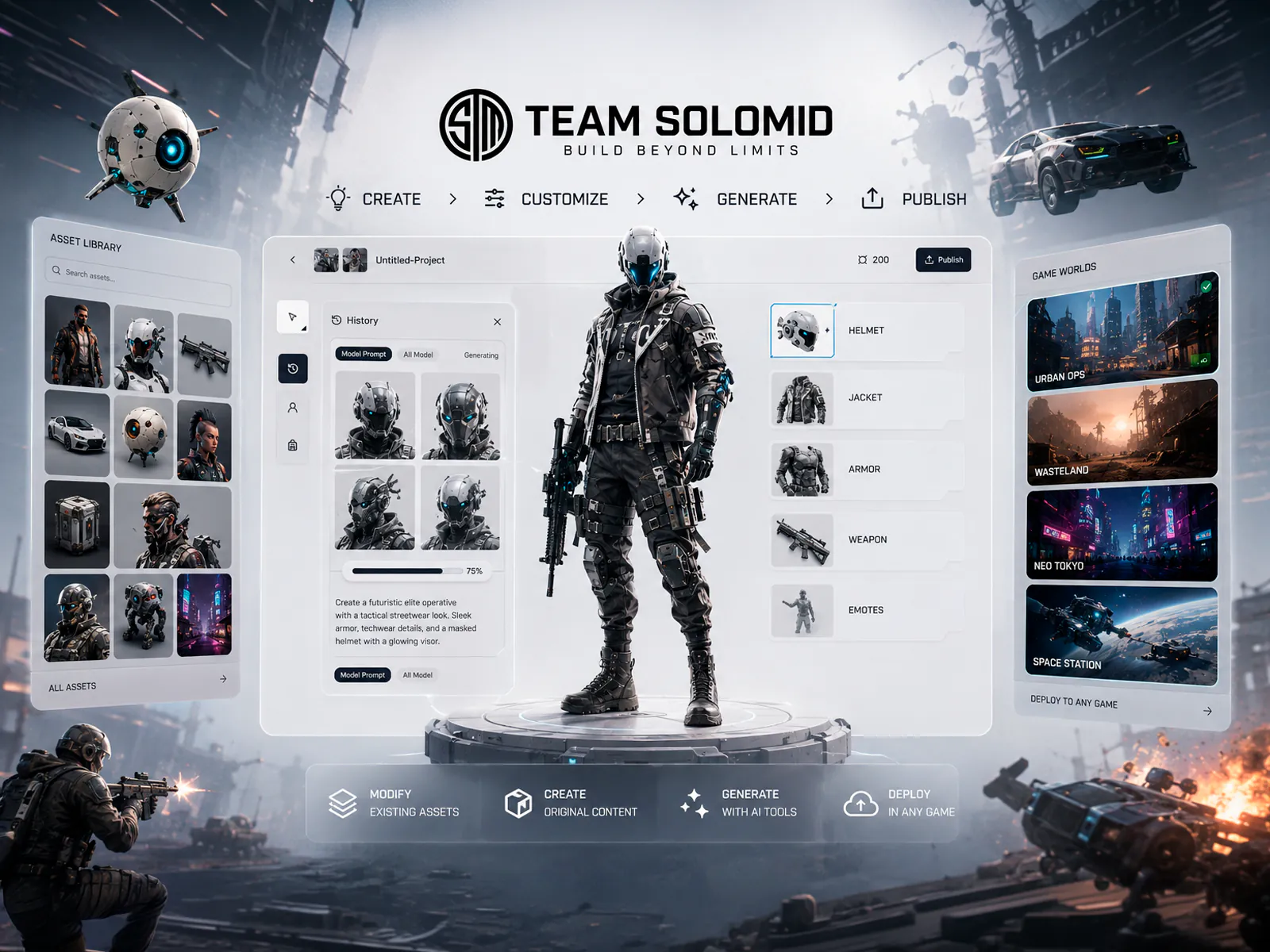
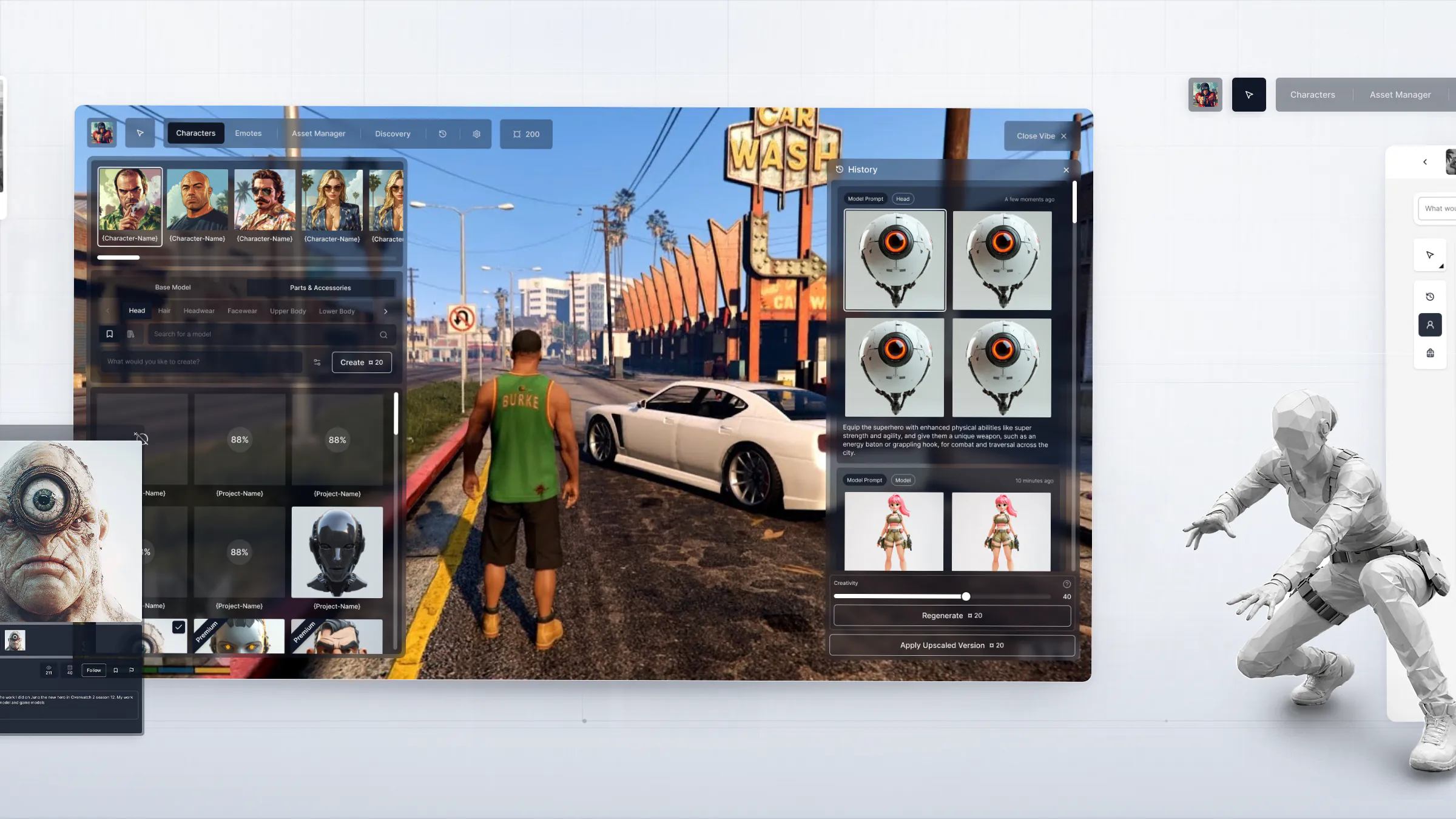
We gave Team SoloMid the product its technology had been waiting for, four AI creation studios and an in-game overlay, designed before a line of code existed.

INDUSTRY
gaming
PLATFORM
desktop
SIZE
growth
gaming
·
‍desktop
·
ui/ux design
At a glance

An idea with no precedent, designed four times over.

01
Frame. 
Benchmark the field, interview modders, and map four user journeys, so "democratize modding" meant something specific enough to design against.
02
Skin. 
The model studio: prompt-driven reskinning, texture and material control, part selection, stickers, emotes, and character personas with voice.
03
Attach. 
Anchor points that let players bring in 3D meshes the game never shipped with, then skin those too, with the engineering notes to build it.
04
Color and hand off. 
Per-part color mapping for bespoke variants, then transfer of every Figma file, one per product vertical, to the Team SoloMid engineering team.
Drag / scroll →
team
3-person
Two on research, one on design
groundwork
13 platforms
Benchmarked across 29 criteria
output
4 studios
Model, persona, animation, audio
Engagement
23 weeks
June 10 to November 18, 2024
The Client

The most valuable name in esports.

GAMING · UI/UX DESIGN
MPL Gaming player base

Team SoloMid is one of the best-known organizations in competitive gaming. Andy Dinh founded it in 2009, and by 2022 Forbes ranked it the most valuable esports company in the world at $540 million, ahead of every other org on the list.

Its product arm matters as much as its teams. TSM owns Blitz, a desktop companion that coaches competitive players in real time across League of Legends, Valorant, Teamfight Tactics, CS2, Fortnite, and Marvel Rivals, reported at more than ten million active users in September 2024 across eight countries. After the organization stepped back from competitive esports in 2023, that software business became its engine.

Vibe was the next bet. In February 2024, four months before this engagement began, the company advertised publicly for an AI Research Engineer to lead "custom model development for a game modding platform," at a base salary above $500,000. The conviction, the budget, and the underlying technology were already in place. The product was not.

2009
Los Angeles, California
$540M
Forbes, world's most valuable esports org, 2022
10M+ Users
Blitz, company-stated, September 2024
The Challenge

Working technology, and nothing a person could actually use.

Engineering could already reskin a character into Batman inside Grand Theft Auto V. What did not exist was any way for a human being to ask for it. There was no interface, no flow, no precedent to copy, and no settled definition of what the product was.

Problem 01

Nothing like it existed to design against.

There was no competitor flow to benchmark, no established pattern for prompting a 3D asset into a running game, and no user expectation to meet. Every screen had to be argued from first principles and then defended.

Problem 02

A brief that moved almost weekly.

Several senior stakeholders each held a different picture of the product, and direction reversed between sessions: make it feel like Fortnite, make it simpler, make it like nothing on the market, make it like everything on the market. The product was designed four separate ways before it settled.

Problem 03

Game mechanics set a hard ceiling.

You cannot swap a human character for a dragon without breaking the game that has to animate it. The original ask, generate any 3D model and drop it into any game, had to be pared back in some directions and expanded in others to stay buildable.

Problem 04

No design team, and no way to keep one.

Team SoloMid tried repeatedly to hire designers in-house and could not retain them. There was no design capacity, no product practice, and no brand to work from. The visual system had to be built from typography and components up.

Problem 05

Modding is a skilled craft, and the target user was ten years old.

Modders today leave the game, visit a specialist site, download a file, install it, and hope. Making that accessible to a child without insulting the people who already do it was the core design tension of the entire project.

Drag / scroll →
Before / After

Modding used to mean
Leaving the Game.

Drag the handle to compare the workflow modders live with today, a specialist site, a download, an install and a risk, against the Vibe overlay, opened over the running game with a keyboard shortcut.

Before redesignBefore redesign
After redesignAfter redesign
Before
After WANDR
Our Role

From an abstract ask to something an engineer Could build.

01
Competitive benchmark of 13 AI creation platforms scored across 29 criteria
02
User research with modders, screened down from 81 applicants
03
Four documented user journeys, seven stages each, from discovery to advocacy
04
A written design philosophy: five principles and nine specified screen flows, each with its assumption stated
05
Concept exploration across four complete product directions
06
UX design for the model, persona, animation, and audio studios, plus emotes, stickers, and mesh attachment
07
In-game overlay design, a plugin layer opened over the running game
08
Typography and component standards aligned to the engineering team's existing build, delivered as a Figma file per product vertical
Research

We mapped the field
before we drew a pixel.

With no precedent to design against, the research had to build one. WANDR scored the entire adjacent market, recruited from a community that is genuinely hard to reach, and wrote four user journeys that gave the team something concrete to argue about.

01
benchmark

The market was full of generators and empty of platforms.

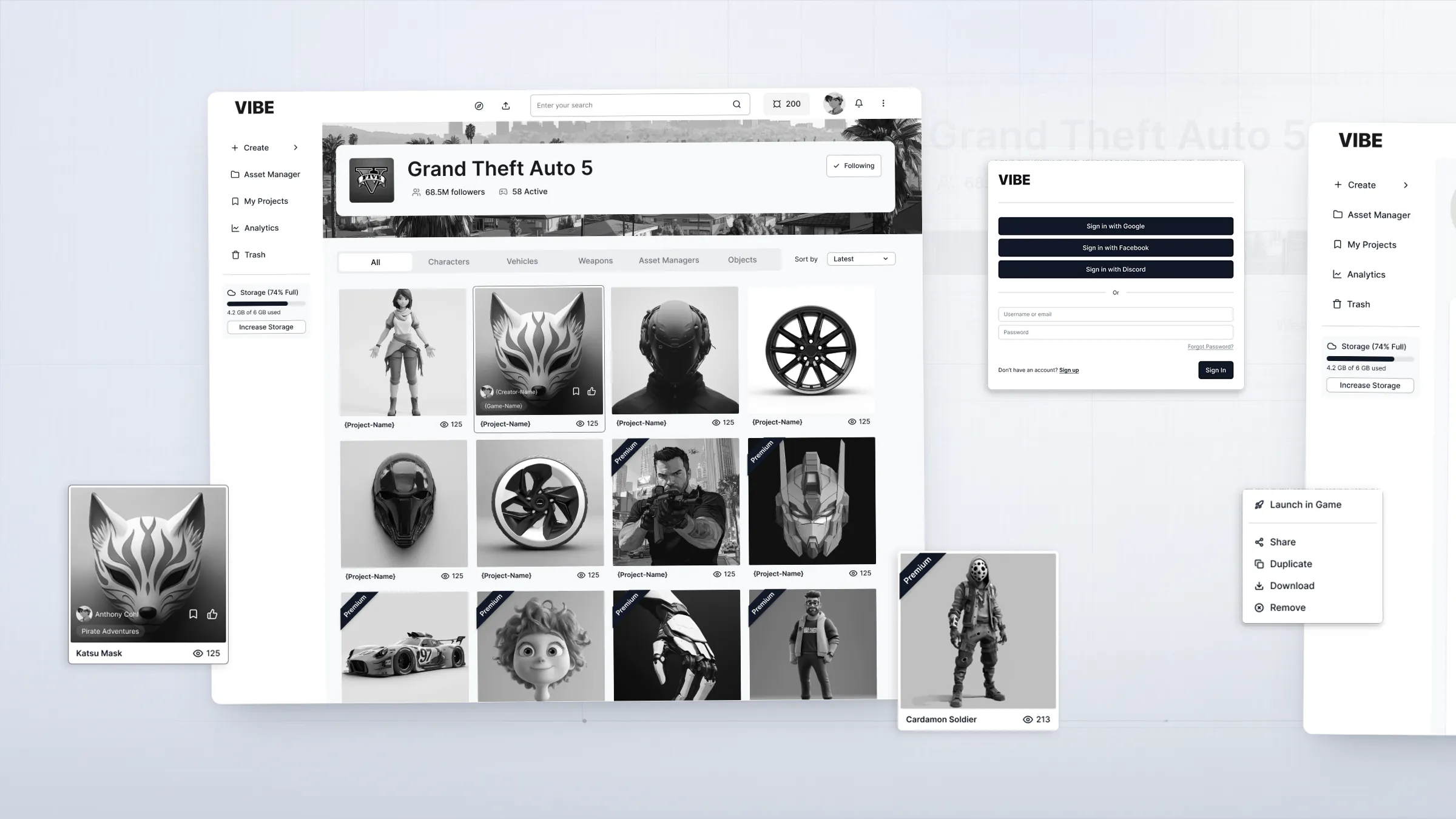
Meshy, Leonardo, Tripo, Spline, Luma Labs, Kaedim, ArtStation, 3DFY, Masterpiece X and others, scored across 29 criteria covering generation, customization, file formats, marketplace, revenue sharing, community, onboarding, and pricing. Almost everyone could generate an asset. Almost nobody solved discovery, sharing, and in-game use together. That gap was the opportunity.

02
recruitment

Four rounds to reach eleven real modders.

The first wave returned seventeen responses and not one respondent belonged to a modding community. Later waves brought fraudulent applicants and no-shows, flagged and removed one by one. Recruitment was rebuilt and re-run four times before the panel was defensible.

03
journeys

One platform, four different ambitions.

A 14-year-old Minecraft player, a 22-year-old creative professional, a 32-year-old 3D artist, and an independent game studio, each mapped across seven stages with the emotion, pain point, opportunity and outcome named at every step. The spread from schoolchild to studio is what forced the product into separate studios rather than one generic tool.

4 very different ambitions.

Persona 01
Casual gamer persona

Alex.

High-school student who plays Minecraft with friends and customizes skins. Wants to make something cool without advanced skills, and quietly worries the AI will not understand what he types.

BEGINNER
MINECRAFT
Needs a guided first win
Persona 02
Committed player persona

Emily.

Creative professional across Fortnite, GTA V, and Minecraft who wants one signature style expressed in all of them. Found the platform through a social ad. Sharing is not an afterthought, it is the point.

INTERMIDIATE
Cross-game identity
Shares socially
Persona 03
Office-context player persona

Max.

Professional 3D artist who already mods. Skeptical that AI can meet his standards and wary of losing creative control, but drawn by the time it saves and the marketplace he could sell into.

ADVANCED
QUALITY-FIRST
Wants manual override
Persona 03
Office-context player persona

Acme Studios.

Independent game studio weighing the platform as production tooling. Wants to import its own models, cut asset-creation cost, and iterate fast, and needs the whole team onboarded, not one person.

studio
Imports own models
cost and speed
The Strategy

Five principles, written down, so the argument had somewhere to land.

3 Principles →
Principle 01Trust
01

Simplicity.

Clean, intuitive interfaces where every step is streamlined to cut friction. The measure was whether a ten-year-old could start modding without reading anything.

Principle 02Segment
02

Consistency.

The same visual and functional logic on mobile and desktop, so generating an asset on the move and applying it at the desk feel like one product rather than two.

Principle 03Bingo
03

Inspiration.

Open with the magic. Put AI-generated work in front of people immediately, before signup, before explanation, because seeing what is possible is the only reliable way to explain a category that does not exist yet.

Principle 04
04

Community.

Discoverability and sharing built into the structure, not bolted on. Users rate, remix, and build on each other's creations, which is how the asset library grows faster than any one team could fill it.

Principle 05
05

Integration.

The deepest experience belongs inside the game. Overlay editing tools let people change what they are looking at while they are looking at it.

Principle 01 of 03
→ Continue scrolling
THE KEY INSIGHT

Democratizing modding did not mean a better modding site. It meant never leaving the game.

Every version of the brief described the problem as difficulty: modding is hard, so make the tools easier. The research pointed somewhere else. Modding is not primarily hard, it is separate. You stop playing, open a browser, find a specialist site, download a file, install it, and hope nothing breaks. That break in context is what keeps the hobby at a few million skilled people instead of everyone who owns a game.

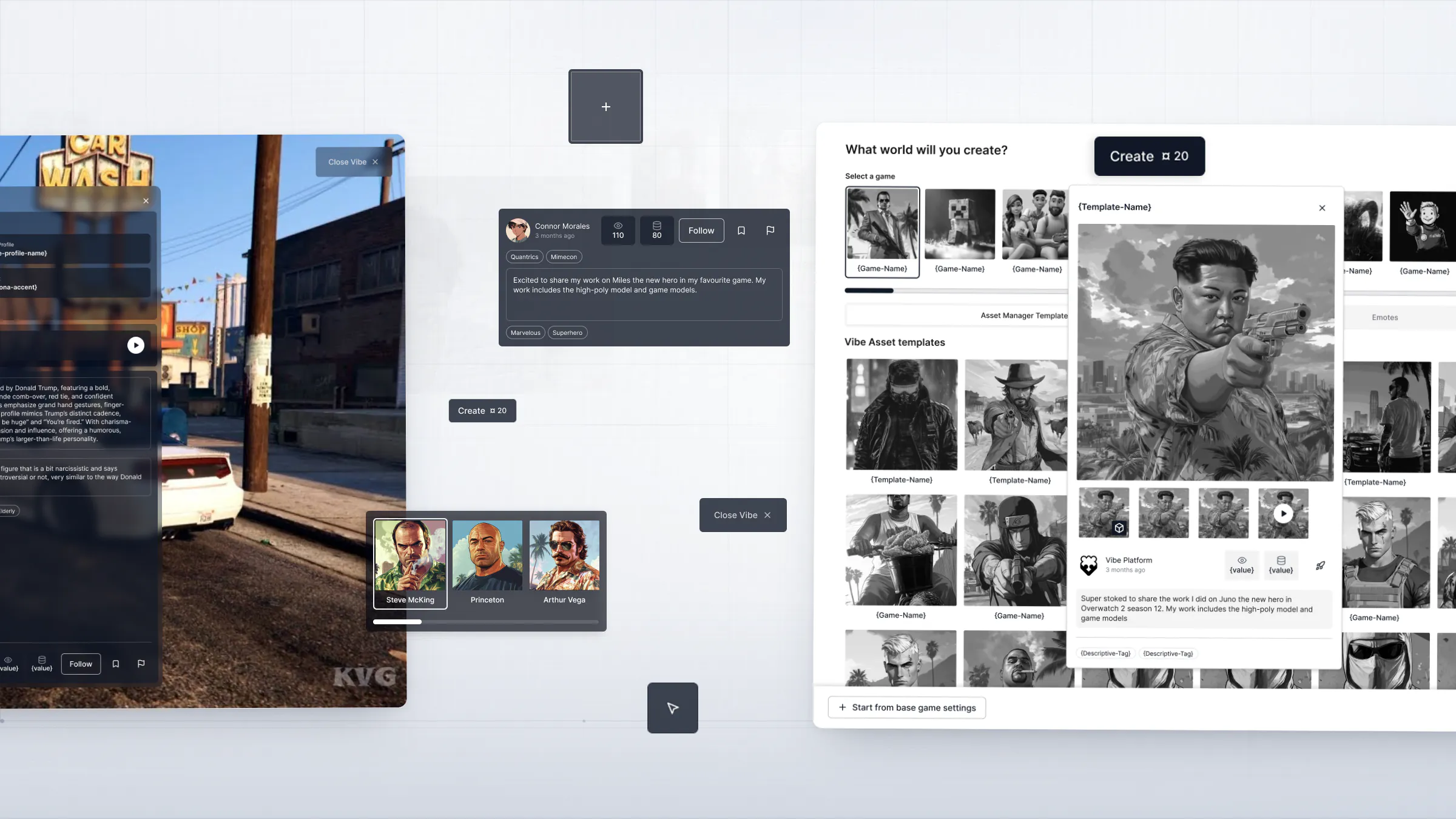
So the product's center of gravity moved from the studio to the overlay: a panel opened over the running game where you point at a character, describe what you want, and watch it change. Once that became the spine, the rest of the platform had a reason to exist and an order to be built in.

MPL redesign surface
Screen 01 of 08
→ Scroll horizontally
Outcomes

What the work produced.

Team SoloMid ended the engagement with a coherent product where it had an abstract ambition, and a design record complete enough to hand to engineers and to investors.

01 · Concept
4 → 1
Product directions explored, one coherent design end to end across every pillar
02 · Scope
4 studios
Model, persona, animation, audio plus emotes, stickers, meshattachment, and marketplace
03 · Groundwork
13 + 11
Platforms benchmarked, modders interviewed 29 criteria scored, 81 applicants screened
04 · Delivery
23 weeks
Idea to engineering-ready handover a Figma file per product vertical, transferred in full

This engagement delivered a design concept rather than a shipped product, so no post-launch performance metric exists. Every figure above is drawn from WANDR's project record: the signed statement of work, the competitive benchmark, the recruitment tracker, the journey maps, the delivered Figma files, and the closure letter of November 20, 2024.

Client Voice

In their words.

Working with Wandr was a game-changer for our product vision. They quickly grasped the complexities of creating an AI-powered platform in an emerging market. Their expertise in user research and iterative design, paired with their ability to adapt to a fast-paced startup environment, resulted in an intuitive and user-friendly design that exceeded our expectations.
Vince Nguyen
VP of Special Projects, Team SoloMid
See full Clutch review
Up next

Another story worth reading.

Buildbox case study preview
Next Case Study

Cinepolis

Entertainment
·
Mobile app · Website
Read next case