


A discussion on competitive analysis UX strategies, brought to you by WANDR, ranked among the best in UX strategy and design by Clutch.
Competitive analysis for UX design gives businesses valuable insight into building more effective product strategies. With UX competitive benchmarking and visual competitive analysis, you get a clearer read on the market your product actually competes in.
Without a UX competitive analysis (sometimes called a UX competitive audit), it's hard to answer a basic but important question: why would a user choose your product over the alternative sitting one tab away?
Competitive analysis UX is one of many research methods used to improve the experience of websites, apps, and software. If you want to solve usability problems or identify your product's real strengths and weaknesses, start by looking closely at your competitors. Here's the complete guide.
TL;DR
- A UX competitive analysis compares your product's experience against competitors' to find gaps, risks, and opportunities before you design or redesign anything.
- It's different from a comparative analysis, which is broader and pulls inspiration from any relevant product, not just direct competitors.
- The process: define your goals, benchmark the market, compile direct and indirect competitors, compare features and data points, identify meaningful differences, then turn findings into strategy.
- The biggest risks are analysis paralysis (studying too much, deciding nothing) and surface-level copying (borrowing a pattern without understanding why it works).
- Want a second set of eyes on your own product's UX first? Our UX audit service is a good place to start before you even get to the competition.

What Is Competitive Analysis UX?
At its core, competitive analysis UX gives you an overview of the current state of the market. You examine and compare data related to your product and your competitors' products side by side. Businesses typically use visual competitive analysis and related techniques to surface issues with their own product or make sharper decisions about product strategy.
A typical analysis includes an overview of the current landscape, a detailed look at the relevant products, companies, and pricing, plus research into user demographics. But the actual focus, the part that separates this from a generic market scan, is the user experience.
Why Run a UX Competitive Analysis (and Where It Can Go Wrong)
Done well, a competitive analysis pays for itself several times over. It surfaces market gaps: the most valuable insight usually isn't "how do we match competitor X," it's "what is every competitor in this space failing to do." That gap is where real differentiation lives. It also de-risks expensive decisions, since redesigns, new feature bets, and pricing changes are costly to get wrong, and evidence from real competitor UX beats internal opinion every time. And it sharpens positioning: marketing and sales benefit from this research as much as design does, since knowing exactly where you're stronger (or weaker) than the alternative shapes how you sell.
It's not risk-free, though. Two failure modes come up constantly:
- Analysis paralysis. Teams that study ten competitors in exhaustive detail often ship nothing, because every finding contradicts another. Scope the analysis to answer a specific question, not "everything about the market."
- Surface-level copying. A competitor's checkout flow being fast doesn't mean copying it will make yours fast. The underlying reasons matter more than the pattern itself. Document why something works, not just that it works.
Competitive vs. Comparative Analysis
During UX research, many businesses fail to understand the difference between competitive and comparative analysis. Both provide valuable insight, but they rely on different data and produce a different outlook.
Competitive analysis UX methods have a broader commercial reach. Using a typical competitive analysis template, you might examine both direct and indirect competition actively fighting for your users.
Comparative analysis is narrower and more pattern-focused. Your research includes companies whose offerings closely match your own, and you determine how your product stands out (or falls short) in a direct, side-by-side comparison, which is often where usability issues or UX design flaws surface first.
In short: competitive analysis looks at the overall state of the market and informs strategy and positioning. Comparative analysis looks at closely matched products and informs specific design decisions.
Types of Competitors to Consider
A thorough analysis looks at more than the two or three names that come to mind first:
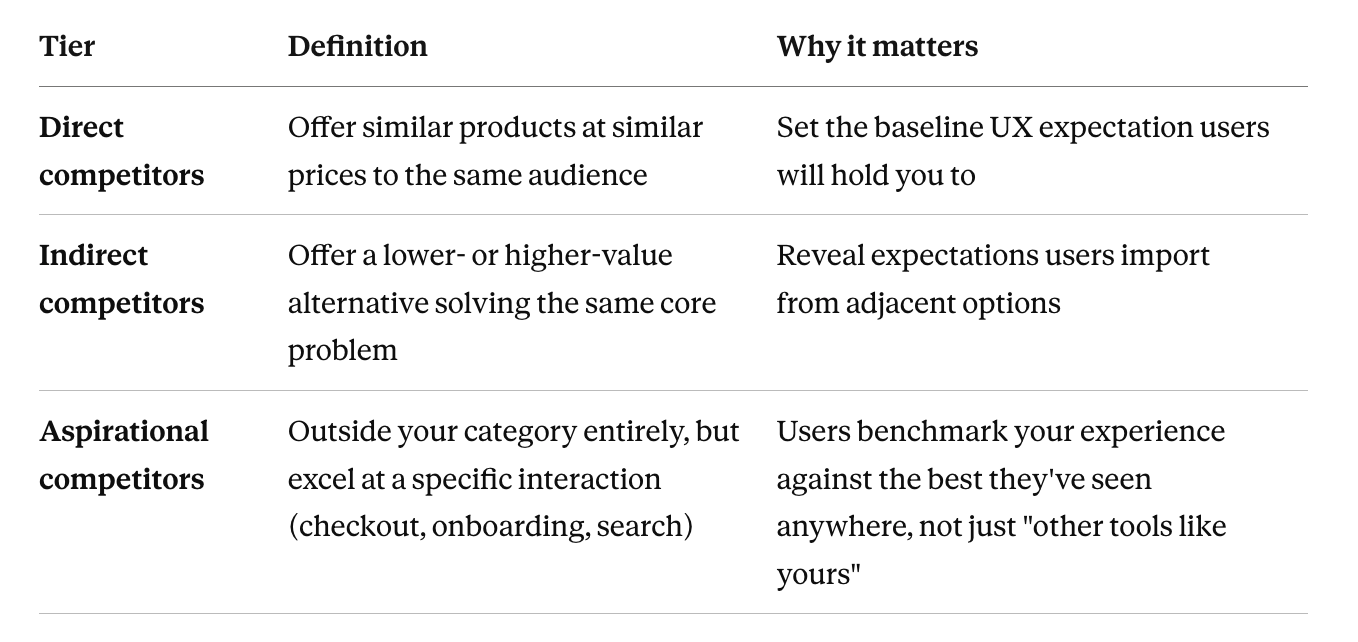
You likely already know a few direct competitors, but it's worth actively searching for more. Newer companies and startups solving the same problem often haven't shown up on your radar yet, and search engines and social channels are the fastest way to find them.
Tools That Make UX Competitive Benchmarking Easier
You don't need a large research budget to benchmark competitors effectively, but the right tools speed the process up considerably:
- Traffic and visibility tools (like SimilarWeb or Semrush) give you a rough read on a competitor's traffic volume, top pages, and where their visibility is growing or shrinking, useful context before you even open their product.
- Heatmap and session-recording tools can sometimes be run against your own product to compare how users behave versus how you'd expect them to behave based on a competitor's design choices.
- Review aggregators (app stores, G2, Capterra, Trustpilot) are a fast, free way to see what competitors' actual users complain about, often more candid than anything you'd get from a formal interview.
- Screen recording or screenshot tools make it easy to document a competitor's flow step by step for the feature-comparison stage, so the analysis isn't relying on memory.
- A shared spreadsheet or whiteboard tool (Notion, Airtable, Miro) to actually house the comparison matrix. It's simple, but this is the artifact that turns scattered notes into something your team will actually reference later.
None of this replaces steps 1 through 6 below. It just makes each step faster and the findings easier to act on.
Standard Competitive Analysis Template (6 Steps)
To complete a thorough review of your competition, follow this standard competitive analysis template, the same six steps we use internally:
- Outline your goals and define your product
- Employ UX competitive benchmarking
- Compile a list of direct and indirect competitors
- Create a list of features and data points to compare
- Identify the differences between products
- Summarize your findings and devise your strategy
Pairing this template with visual competitive analysis techniques (charts, matrices, mind maps) makes the findings far easier to digest and act on. A clean visual gives everyone on the team a fast overview of where you're winning and losing against the competition.
1. Outline Your Goals and Define Your Product
The first step is deciding what you actually want out of this analysis. Your product is a reflection of both your customers' goals and your business goals, so before you look at a single competitor, get specific about what you're trying to learn:
- Is there room in the market for another product like yours?
- How does your product's quality compare to the competition's?
- Who are the potential customers you're not currently reaching?
- Where are your product's real strengths and weaknesses?
A detailed competitive analysis template like this helps size the market and gauge demand, details that directly inform launch strategy and budget. If the market looks limited, for instance, that's a strong signal to avoid a massive marketing spend out of the gate.
Visual competitive analysis is especially useful here for comparing your product's qualities against specific competitor features, a form of comparative analysis you can use to find potential customers and concrete ways to improve your own product. Uncovering strengths and weaknesses also arms sales and marketing to focus on your real advantages instead of guessing at what resonates.
2. Employ UX Competitive Benchmarking
Without UX competitive benchmarking, your research lacks clearly defined data. You end up with a market overview but no real basis for comparison across multiple competitors.
Benchmarking tracks your product's performance relative to the competition over time. You can't always get sales data, but you can compare social media followers, website visits, and total user counts. Alongside external benchmarks, keep tracking your own internal KPIs, cost per customer acquisition, for instance, so you have a consistent baseline to measure both against.
3. Compile a List of Direct and Indirect Competitors
Using the tiers above, build out your list. Categorize by priority: direct competitors first, indirect competitors after. Map them visually (a simple mind map works well) so the full competitive landscape is easy to scan at a glance, rather than buried in a spreadsheet nobody opens again.
4. Create a List of Features and Data Points to Compare
Choose data points that are easy to track consistently. This is where a lot of competitive analyses quietly fall apart, by picking metrics that sound important but are impossible to measure reliably over time.
Beyond strengths and weaknesses, look specifically for opportunities and potential threats to your product's success. List the core UX elements you want to compare across competitors: interface, search functionality, navigation and menus, and any other elements central to the experience.
5. Identify the Differences Between Products
Using the benchmarking metrics from step 2, start identifying where your product and your competitors' products actually diverge. Compare the features from step 4 directly, primary functions, usability, interface, and build a visual competitive analysis that makes the differences obvious at a glance.
You'll also uncover commonalities in this step, which matter just as much as the differences. Shared features across the whole category highlight where the entire market has room to improve, and surpassing competitors in exactly those areas is often where the strongest competitive advantage hides.
6. Summarize Your Findings and Devise Your Strategy
The final step is turning research into action. Use what you've found to sharpen your marketing approach or improve the product itself. A visual chart summarizing the findings helps stakeholders outside the research process grasp the key takeaways quickly, without reading the full analysis.
How Often Competitors Actually Change Their UX
One reason a single competitive analysis goes stale faster than teams expect: competitor UX isn't static, even between major redesigns. Pricing pages get reworded, onboarding flows get trimmed by a step, checkout gets a new default option: small changes that individually look minor but collectively shift what "normal" looks like in your category.
This is part of why benchmarking (step 2 above) matters more than a one-time snapshot. Revisiting your competitor list on a set cadence, even a quick 30-minute pass each quarter, catches these incremental shifts before they add up to a gap you only notice once users start mentioning it. Teams that treat competitive analysis as a single deliverable tend to be surprised, a year later, that the market moved without them; teams that treat it as a standing habit rarely are.
It's also worth distinguishing between competitors who are iterating deliberately and competitors who are reacting to the same market pressure you are. If three competitors all simplify their signup flow within a few months of each other, that's not a coincidence. It's a signal that something about the old pattern stopped working for users industry-wide, and it's worth understanding why before you decide whether to follow, ignore, or do something different entirely.
Final Thoughts on Competitive Analysis UX
Competitive analysis UX research helps you uncover real, actionable detail about the current state of your market: what your competitors offer, and where your product has a genuine advantage or a genuine gap to close.
The insight from this process leads directly to better products and more effective UX design, but only if you follow through: define your goals clearly, use UX competitive benchmarking to keep the analysis grounded in real data, and treat the comparison as a starting point for strategy, not a one-time deliverable.
What Would You Add to Our Competitive Analysis Guide?
Let us know in the comments below, or book a free consultation to talk through your product's competitive positioning with our team. Learn more about our UX audit service.
Talk to us on LinkedIn, Instagram, Facebook, or Twitter.