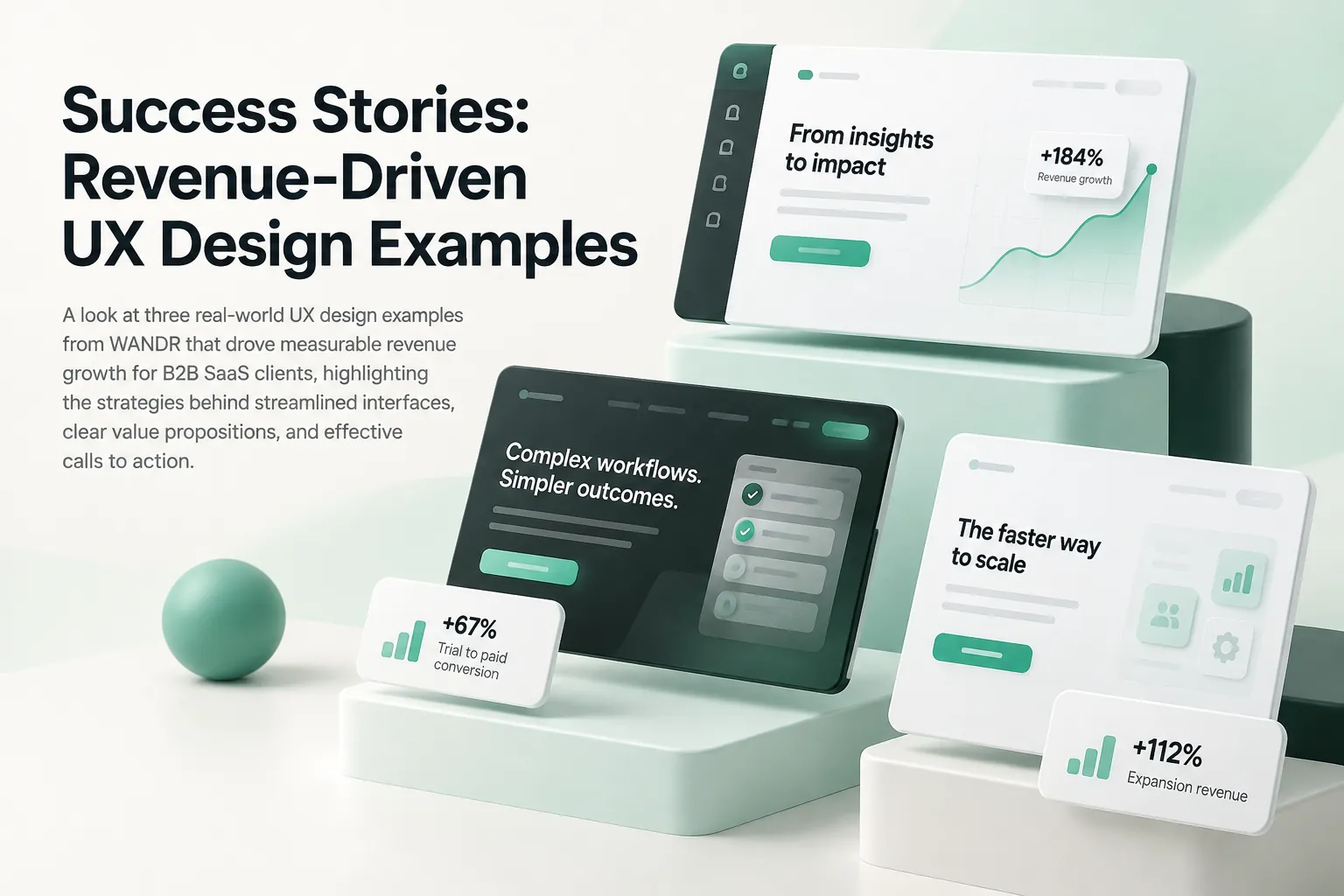
Quick answer: The best UX design examples share a few patterns you can copy: they give visitors value before asking for anything, state a clear value proposition at the top of the page, place calls to action right after that promise and talk about outcomes instead of features. Below are three B2B SaaS examples our team designed, what each one does well and a step-by-step way to apply the same ideas to your own product or landing page.
Check out these UX design examples that drive revenue. Learn more about product strategy from the experts brought to you by WANDR- ranked #1 UX Agency in Los Angeles by Clutch.
A successful UX design provides many advantages for both your customer and your business. If users enjoy using an application or navigating a website, they are more likely to continue using the product or browsing the site. This is more likely to lead to a sale.
Without a quality user experience, your sales suffer.
Unfortunately, many businesses fail to fully understand the importance of UX design.
In this article, we'll share three B2B SaaS tools that our team at WANDR designed, that resulted in more revenue for our clients. But first...
What Is UX Design?
User experience includes more than surface visuals and layouts. It includes every component of the application or interface, including the wireframes, and information architecture.
Before getting into the development stage, designers create an outline based on business objectives and the needs of users.
When UX designers understand the value of researching their target demographic, they can implement features that appeal to potential customers. This leads to greater sales and customer retention.
To increase your sales, invest in your UX design. Here are a few UX design examples that drive customer success.
1. ChimpQuote Delivers a Streamlined UX
ChimpQuote offers insurance quote comparisons from top insurers. This is one of our favorite UX design examples because it gives users a streamlined interface. Each users simply enters their zip code to immediately view average rates for their region.
In addition to the zip code, users can enter details for more accurate quotes. Users do not need to sign up or provide an email address to start viewing real estimates for insurance policies. They get immediate value. They get value before committing to the brand.
We chose to add it to our UX design examples because of it the team behind ChimpQuote understands the needs of its users. The average consumer does not want to complete a detailed contact form to compare quotes.
The purpose of an insurance quote comparison site is to provide an easier solution for comparing options. ChimpQuote delivers this solution without a hassle. The website gives users a simple interface that works on any device.
The landing page also avoids overcomplicating the sales pitch. Instead of thoroughly describing every step of the service, the company gives visitors a short summary. In just three steps, you can pick the right insurance policy and start saving.
After viewing a sampling of price quotes, users can decide whether they want to proceed and receive a real quote. By the time that they view the estimates, users are more likely to use the service to be matched with an insurance agent or agency.
ChimpQuote has one of the more effective UX design examples, enticing visitors with a free preview of their services before requesting additional information.
2. OOBEO Addresses the Needs of its Users
When looking at UX design examples, OOBEO stands out for understanding its target audience. The landing page carefully illustrates the benefit of using this application.
OOBEO offers valet parking software. At the top of the page, visitors can see screenshots of the application, making it easier to understand the features as they scroll through the page.
The landing page focuses on the value of the software instead of simply listing its features. The information provided explains why OOBEO is different compared to other valet parking solutions.
While the landing page contains a lot of useful information to help attract potential leads, it also delivers the unique selling point at the very top of the page followed by a call to action (CTA).
Placing the CTA immediately after the opening value proposition helps capture impulsive leads. This is a common technique found in most UX design examples.
Giving users too much information tends to decrease conversion rates. Instead of overloading visitors with details, simply provide enough information to move them on to the next step in the buyer’s journey.
3. PNYKA Explains the Value of its Application
PNYKA is one of the better UX design examples due to the way the home page explains the product. The initial headline delivers the unique value proposition while the rest of the website fills in the details.
The information is presented in a simple, easy-to-follow manner, allowing anyone to quickly decide whether or not they want to try the application.
Unlike the previous UX design examples, PNYKA has an added challenge. The company needs to explain how their application works.
PNYKA does a great job of explaining the intended use of the application, which is always a priority when marketing a niche product. Most people do not have previous experience with a similar application, requiring PNYKA to quickly explain the purpose of the product.
PNYKA is a communication platform for communities. Schools, churches, businesses, and individuals can use the application to message each other and engage in group chats.
To highlight some of the benefits of this application, PNYKA includes testimonials from participants. As with the other UX design examples, the website also provides multiple CTAs to capture leads at various points as visitors scroll through the page.
Why Do You Need to Follow Good UX Design Examples?
The UX design examples listed above use proven strategies to deliver a better user experience to visitors. Providing quality UX is an essential part of attracting and keeping customers.
Nielsen Norman Group's 10 usability heuristics for user interface design are a useful checklist for spotting these issues.
People tend to make up their mind about a product within seconds of reaching a landing page. If the page has poor navigation or loads slowly, visitors leave the site very quickly.
Based on the UX design examples, you should have a better understanding of what it takes to attract more leads and boost sales. Several of the key features found in these UX design examples include:
- Streamlined interfaces
- Clear value propositions
- Effective calls to action (CTAs)
- Focus on value over features
The three UX design examples discussed give visitors streamlined interfaces. All three sites have simple layouts and designs that look great on any device and load quickly.
These UX design examples also provide a clear, direct message at the very top of the page. You immediately understand what the company offers and who the intended audience is.
The clear value proposition is typically followed by a short, simple CTA. Additional CTAs follow throughout the page, typically after a text block that describes another benefit of the product.
One of the final elements found in these UX design examples is a focus on value over features. These websites give users the information that they want. They want to know how this product can solve their problems. Instead of explaining specific features, these three companies focus on the value of their solutions.
How to learn from UX design examples, step by step
Looking at good work is useful only if you can turn what you see into decisions for your own product. This process keeps the focus on patterns rather than surface style.
Step 1: Pick examples that share your context
Choose products with a similar audience, buying process and level of complexity. A consumer app and a B2B tool with a six-person buying committee solve different problems, so a pattern that works for one may hurt the other. Three to five relevant examples are enough.
Step 2: Walk through the main journey
Go through each example as a new visitor would. Note what you see first, what the page asks you to do and how many steps it takes to reach real value. Screenshot each screen so you can compare them side by side.
Step 3: Name the pattern, not the look
For each strong moment, write down why it works in plain words. "Shows an estimate before asking for an email" is a pattern you can reuse. "Uses a purple gradient" is not.
Step 4: Compare against your own product
Run the same walkthrough on your site or app. Where do you ask for commitment too early, bury the value proposition or present every feature with equal weight? List the gaps.
Step 5: Prioritize and test
Pick the one or two gaps closest to revenue, usually the first screen and the main call to action. Design a change, test it with a handful of users or as an A/B test and keep what improves the numbers you care about.
Patterns that show up in strong UX design examples
Value before commitment
ChimpQuote lets visitors see estimates before signing up. The same idea applies to free tools, interactive demos, product tours and sample reports. When people see value first, the request for their details feels like a fair exchange rather than a toll.
One clear promise at the top
OOBEO and PNYKA both state what the product does and who it is for in the first screen. Visitors decide within moments whether a page is relevant, so the headline has to answer that question without making them scroll.
Calls to action that match the reader's stage
A primary action for people who are ready, such as a demo or trial, and lighter actions for people who are still exploring, such as a tour or case study. Repeating the call to action after each benefit block captures interest when it peaks.
Explaining the unfamiliar simply
Niche products face an extra challenge: visitors may not have a mental model for what the product does. Short steps, simple visuals and a clear "how it works" section reduce the effort needed to understand it.
Proof placed near decisions
Testimonials, logos and short results work best next to the call to action they support, where a hesitant visitor needs reassurance most.
Practical example: applying these patterns to a B2B landing page
Imagine a SaaS company whose landing page opens with a long feature list and a single "Contact sales" button at the bottom. Using the steps above, the team rewrites the headline around the main outcome for its core buyer, adds a short three-step "how it works" section with product screenshots, places a demo button immediately after the headline and adds a secondary "Take the product tour" link for early-stage visitors. They move a short customer quote next to the demo button and cut the feature list to the four capabilities buyers ask about most. Each change comes directly from a pattern seen in the examples, and each can be measured on its own.
Common mistakes when copying UX design examples
- Copying visual style without understanding the problem it solved.
- Borrowing patterns from products with a very different audience.
- Changing many things at once, so you cannot tell what worked.
- Ignoring mobile, even though many first visits happen on a phone.
- Skipping research with your own users because an example "obviously" works.
UX design examples checklist
- Can a new visitor tell what the product does and who it is for within the first screen?
- Do people get some value before you ask for their details?
- Is there a clear primary call to action right after the main promise?
- Are lighter options available for visitors who are not ready yet?
- Does the page focus on outcomes rather than a list of features?
- Is supporting proof placed near the decision points?
- Does the experience work as well on a phone as on a desktop?
- Is there a way to measure whether each change helped?
Revisit your list of examples every few months. Products and patterns evolve, and the examples most relevant to your audience today may not be the ones that mattered a year ago.
When you share examples with your team, include your notes on why each pattern works. That context keeps discussions focused on user needs and business goals instead of personal taste.
Conclusion: Use the Best UX Design Examples for Inspiration
To start increasing sales, review every component of your UX design from the scope of the features to the overall strategy for identifying user needs. The UX design examples discussed should provide inspiration and help point you in the right direction.
In the end, every business should prioritize UX design when planning a product. This includes the UX design of the product itself and the landing pages used to market the product.
What is Your Favorite UX Design Example?
Let us know in the comments below.
Talk to us on LinkedIn, Instagram, Facebook, or Twitter.
For more on this topic, read 10 Best UX Websites of 2026 and UX Flow: How to Create a Seamless User Experience.
Posts You Might Like
8 Great SaaS Websites and Why They Work
Book a $499 UX audit call with Lina.